A Tour of Every Game Mode Inside CalcQuest
calc quest game modes, calc quest review, what games are in calc quest, number pyramid game, nonogram puzzle app, mini sudoku app, magic triangle puzzle, quick calculation game, number pattern puzzle, logic puzzle app, brain training app review, math puzzle app all games, best puzzle app for adults, puzzle game modes explained, Calc Quest tour
Calc Quest isn't one game. It's a collection of carefully designed challenges each one training a different part of your brain.
Most puzzle apps give you one format and repeat it forever. Calc Quest was built differently. Every game mode inside it targets a specific cognitive skill calculation speed, pattern recognition, logical deduction, visual reasoning, memory and together they add up to something closer to a complete brain workout than a single game ever could.
This is your guided tour. Whether you're brand new to Calc Quest or you've been playing one game mode for a while and want to know what else is in there here's everything, explained clearly, with no jargon.
"Each game mode in Calc Quest was built around one question: what skill does this train, and does it train it better than anything else available? Every mode has a clear answer."
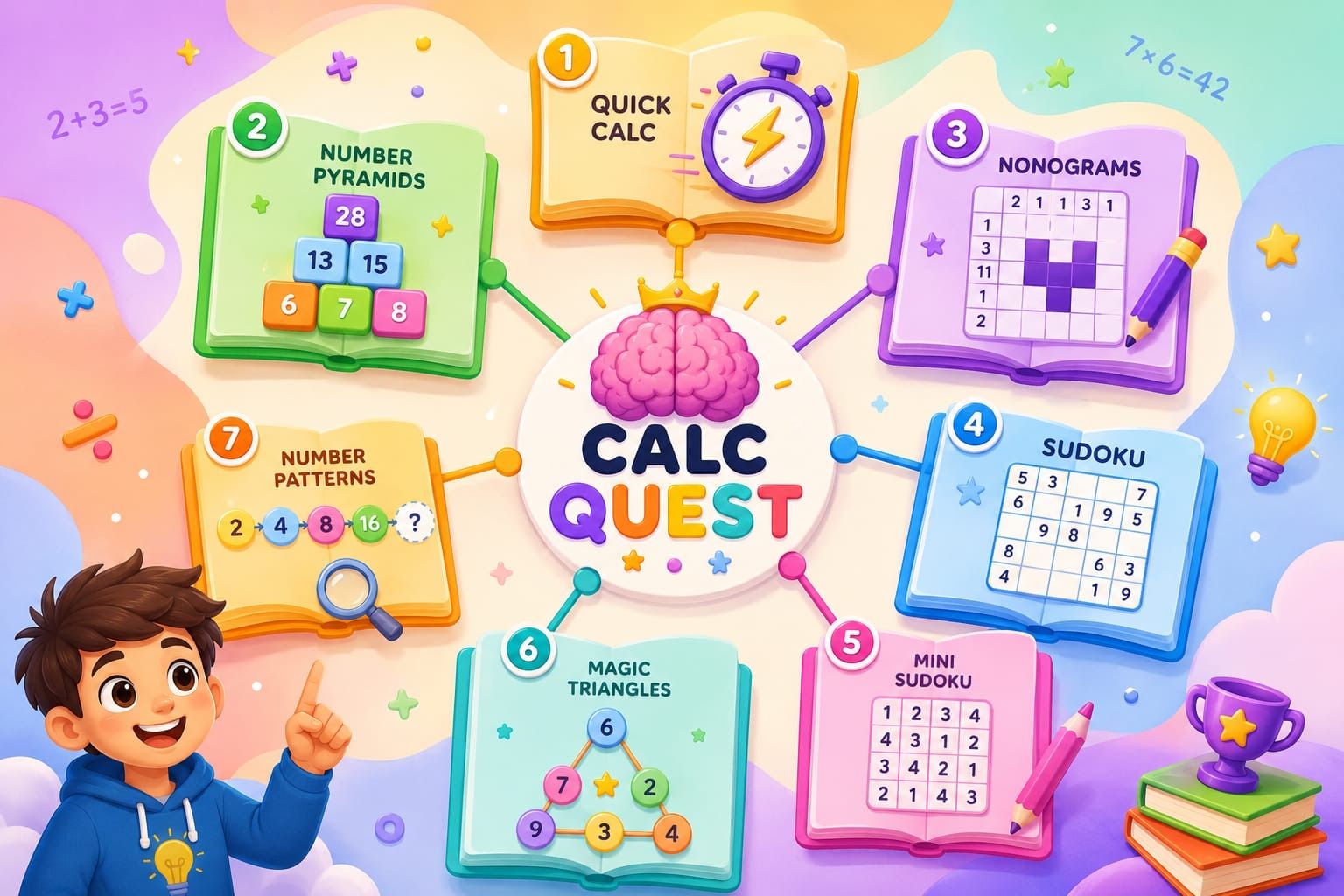
The Game Modes
1.Quick Calculation
What it is: A timed challenge where math questions appear on screen one at a time. You solve them as fast as you can. Your score is the number of questions you answer correctly before time runs out.
What it trains: Mental calculation speed, arithmetic fluency, and the ability to think clearly under pressure. Quick Calculation is the mode that most directly mirrors real-world situations where you need a fast, accurate number splitting a bill, checking a price, estimating a total.
What makes it satisfying: Your score is visible, personal, and improvable. Every session gives you a number to beat tomorrow. That feedback loop fast, clear, and entirely yours is one of the most motivating structures in the game.
💡 Best for: Anyone who enjoys speed, visible progress, and the feeling of getting measurably better from one session to the next.
First session tip: Don't aim for a perfect score on day one. Aim for a baseline. Your real score is what you hit on day five after your brain has started recognising the question types automatically.
2.Number Pyramids
What it is: A triangular grid where each block must equal the sum of the two blocks directly below it. Some numbers are given. The rest are yours to find.
What it trains: Logical reasoning, working memory, and the ability to work both bottom-up and top-down simultaneously. Number Pyramids are uniquely good at building the habit of checking your work as you go because one wrong number cascades upward and breaks the whole structure.
What makes it satisfying: Visible, layered progress. Every row you complete is a step closer to the top and when the final number slots into the peak of the pyramid, the whole structure clicks into place in a way that feels genuinely complete.
💡 Best for: Methodical thinkers who like clear structure, visible progress, and the satisfaction of a puzzle that builds logically from start to finish.
First session tip: Always start with the row that has the most numbers already filled in. That's your entry point and once you have one row complete, the pyramid opens up quickly from there.
3.Nonograms
What it is: A grid puzzle where number clues along each row and column tell you which squares to fill in. Solve the clues correctly and a hidden picture is revealed.
What it trains: Visual reasoning, spatial thinking, and logical deduction. Nonograms are the most visually oriented game in Calc Quest they ask you to hold the state of an entire grid in your mind while working through clues one row or column at a time.
What makes it satisfying: The reveal. As the hidden image gradually appears square by square, each correct move is immediately visible. Finishing a Nonogram gives you something to look at a complete picture that only exists because you reasoned your way to it.
💡 Best for: Visual thinkers, patient puzzlers, and anyone who finds purely numerical challenges a bit dry but loves the idea of uncovering something hidden through logic.
First session tip: Start with the rows and columns that have the largest numbers in their clues those constrain the most squares immediately and give you the quickest early progress.
4.Sudoku
What it is: The classic number placement puzzle. Fill a 9×9 grid so that every row, every column, and every 3×3 box contains the numbers 1 through 9 each exactly once.
What it trains: Strategic thinking, constraint management, and sustained concentration. Sudoku is the deepest logic workout in Calc Quest it asks you to track multiple overlapping constraints simultaneously across a large grid, which is genuinely demanding in the best possible way.
What makes it satisfying: The completeness. A finished Sudoku grid every cell filled, every rule satisfied is one of the most visually and mentally satisfying things a puzzle can produce. It's a small, perfect system, and you built it.
💡 Best for: Players who enjoy deep, sustained challenge people who want a puzzle that fully occupies their attention and rewards strategic thinking over speed.
First session tip: Start with the boxes, rows, or columns that already have the most numbers filled in. Look for cells where only one number is possible — those are your free moves, and every grid has several waiting to be found.
5.Mini Sudoku
What it is: Sudoku on a 4×4 or 6×6 grid. The same rule no repeats in any row, column, or box applied to a smaller, faster, more accessible format.
What it trains: Logical deduction and constraint thinking the same cognitive skills as full Sudoku, but in a format that produces a complete, satisfying solve in two to five minutes. Mini Sudoku is the best gateway into logical puzzle solving for players who find the full 9×9 grid intimidating.
What makes it satisfying: The speed of completion. Mini Sudoku gives you the full arc of a logic puzzle challenge, reasoning, resolution in a fraction of the time. For players with limited sessions, it's the most complete experience available per minute.
💡 Best for: Beginners building confidence, experienced players who want a fast satisfying solve, and anyone who finds the full 9×9 grid overwhelming but doesn't want to give up on Sudoku entirely.
First session tip: On a 4×4 grid, find any row or column with two numbers already placed the remaining two cells have only two possible values, and you can usually work out which is which immediately.
6.Magic Triangles
What it is: A number arrangement puzzle where you place a set of numbers into the corners and sides of a triangle so that every side adds up to the same total.
What it trains: Constraint satisfaction thinking, working memory, and the ability to reason about multiple conditions simultaneously. Magic Triangles are uniquely good at training the "hold several things in mind at once" skill because every corner number affects two sides at the same time.
What makes it satisfying: The hidden formula. Once you discover that the corner numbers must add up to a specific total calculable before you place a single number the puzzle transforms from trial and error into pure logic. That moment of understanding is one of the best "aha" experiences in Calc Quest.
💡 Best for: Players who enjoy finding the trick behind the trick people who aren't satisfied with a correct answer unless they also understand why it's correct.
First session tip: Use the corner sum formula before placing anything. Multiply your target side sum by 3, subtract the total of all your numbers the result is exactly what your three corner numbers must add up to. Find those corners first, and the rest falls into place.
7.Number Patterns
What it is: A sequence of numbers with one or more missing values. Your job is to identify the rule connecting the numbers and use it to find what's missing.
What it trains: Pattern recognition, analytical thinking, and the ability to find structure in incomplete information. Number Patterns is the game that most directly builds the mental library of mathematical relationships that makes every other game in Calc Quest faster and easier over time.
What makes it satisfying: The click of recognition. The moment you spot the rule doubling, adding a fixed number, alternating patterns, Fibonacci-style sequences the missing number becomes obvious instantly. That shift from "I don't see it" to "I see it completely" is one of the most rewarding moments in puzzle solving.
💡 Best for: Analytical thinkers who want to understand the why behind every answer and players who want to build skills that transfer across every other game mode in the app.
First session tip: Always check the simplest rule first. Is each number double the previous one? Is a fixed number being added each time? Is it alternating between two different operations? Start simple the rule is almost always cleaner than it first appears.
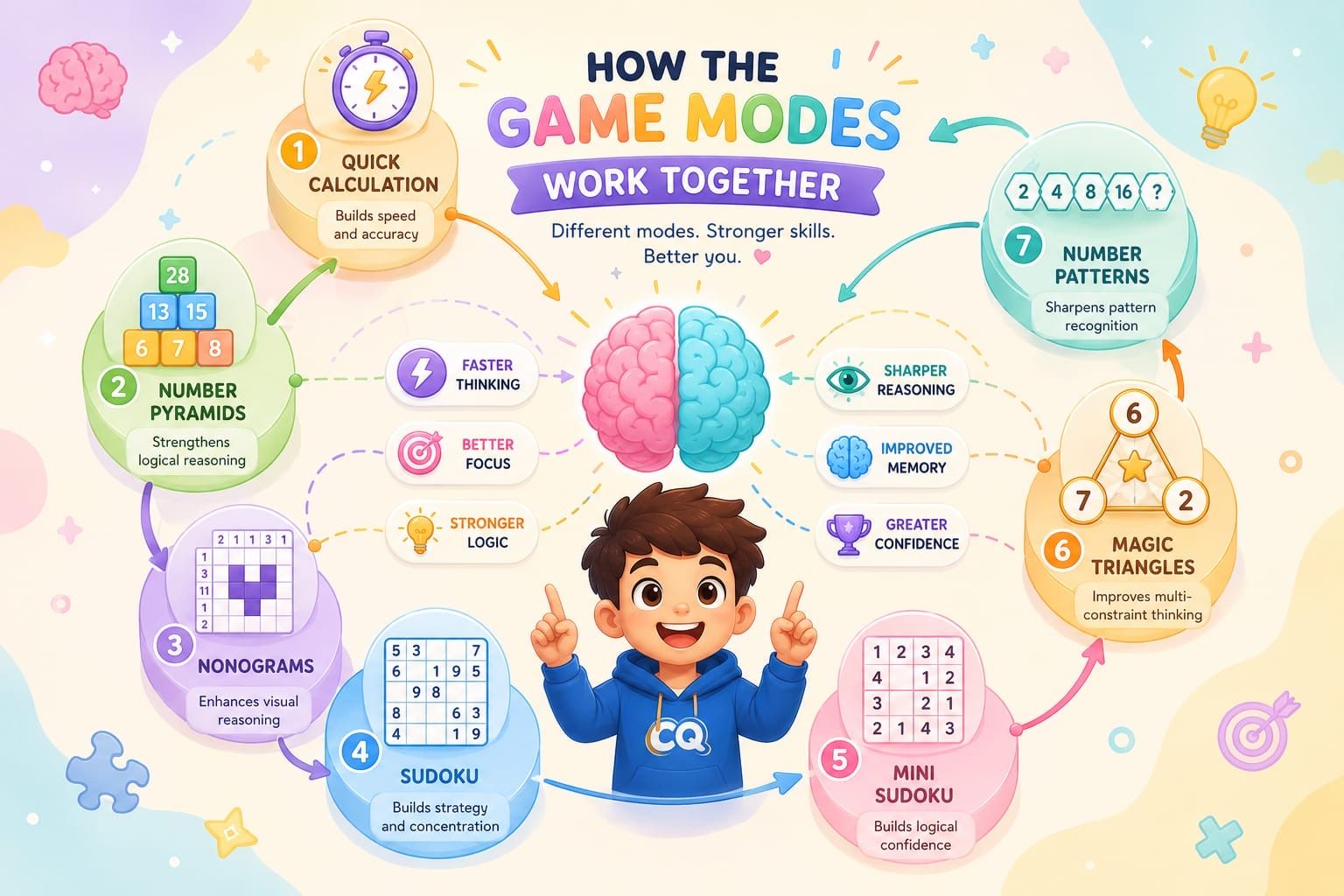
How the Game Modes Work Together
Each game mode in Calc Quest trains something specific. But they're designed to complement each other and players who rotate between multiple modes get a more complete mental workout than those who stick to just one.
- Quick Calculation builds the arithmetic speed that makes
- Number Pyramids faster to solve
- Number Patterns builds the recognition skills that make Sudoku and Mini Sudoku easier to crack
- Nonograms build the spatial reasoning that strengthens visual pattern recognition across all formats
- Magic Triangles build the constraint thinking that deepens your approach to every logic puzzle
- Mini Sudoku builds the logical foundation that makes full
- Sudoku feel like a natural next step
You don't need to play all seven every day. Even rotating between two or three builds a more balanced skill set than any single game mode can. Think of Calc Quest as a training programme and each game mode as a different exercise in it.
"No single puzzle trains everything. But the right combination trains more than you'd expect and Calc Quest was designed with that combination in mind."
Which Mode Should You Open First?
If you're brand new to Calc Quest, here's a simple starting guide based on what you're looking for:
- I want fast, visible improvement → Quick Calculation
- I want deep, satisfying logic → Sudoku or Number Pyramids
- I want something visually engaging → Nonograms
- I want to ease in gently → Mini Sudoku
- I want to understand how numbers connect → Number Patterns
- I want to find the hidden trick → Magic Triangles
Pick one. Play three sessions. Then try the one next to it on the list. By the end of your first week, you'll know which modes are yours and your brain will already be sharper for having tried them.
Every mode is waiting. All you have to do is start.