Binairo Explained: The Surprisingly Addictive Binary Logic Puzzle
what is binairo, binairo puzzle explained, how to play binairo, binairo rules, binairo tips, binary puzzle logic game, Takuzu puzzle, binairo for beginners, binairo brain benefits, logic puzzle with zeros and ones, binary logic puzzle, Calc Quest binairo, binairo strategy, brain training puzzles, zero one puzzle
Two symbols. Three rules. One of the most satisfying logic puzzles you've probably never heard of.
When most people see a Binairo grid for the first time, their reaction is some version of: "That's it?" A grid of cells filled with zeros and ones, a few clues already placed, and three short rules to follow. It looks like the simplest puzzle in the room.
It isn't. And the gap between how Binairo looks and how Binairo plays is exactly what makes it so memorable.
Within a few moves, the simplicity becomes depth. The three rules which seemed almost too obvious to be interesting start interacting in ways you didn't anticipate. And by the time you place the final number and the grid is complete, you've done something that felt impossible ten minutes ago.
"Binairo is proof that the most satisfying puzzles don't need complicated rules. Three constraints applied consistently across a grid is enough to produce a challenge that can absorb you completely."
What Is Binairo?
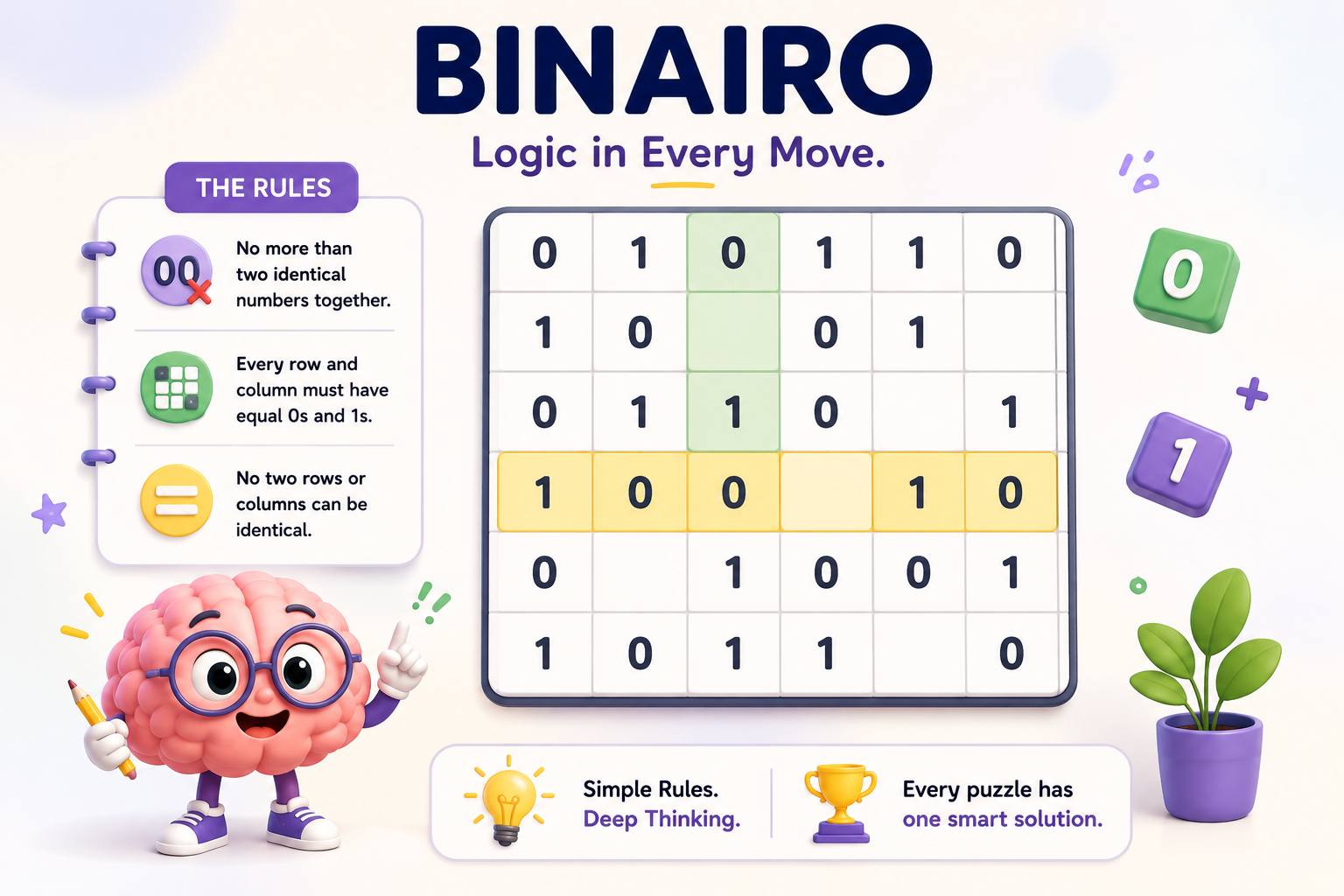
What it is: Binairo also known as Takuzu or Binary Puzzle is a logic puzzle played on a square grid where every cell must be filled with either a 0 or a 1. Some cells are given at the start. The rest are yours to determine through logic alone.
Where it comes from: Binairo originated in the puzzle magazine scene and has been published in various forms under different names Takuzu in France, Binary Puzzle in English markets, Binairo in others. Despite the different names, the rules are identical everywhere. The puzzle has built a dedicated global following precisely because the format is so clean and the logic so satisfying.
The two-symbol format just 0s and 1s makes Binairo feel uniquely modern. It's a logic puzzle built from the same binary foundation that underlies all digital computing. But you don't need to know anything about computers to play it. You just need to think carefully.
💡 Did you know? Binary the system of 0s and 1s that underlies all modern computing was formalised by mathematician Gottfried Wilhelm Leibniz in 1703. Binairo uses that same foundational system as its puzzle format. Every grid you solve is built on one of the most important ideas in the history of mathematics.
The Three Rules- Simple Enough to Learn in One Minute
Binairo has exactly three rules. Read them once and you're ready to start.
Rule 1 - No three in a row. Three identical numbers cannot appear consecutively in any row or column. Two zeros side by side is fine. Three zeros in a row horizontal or vertical is not. Same for ones.
Rule 2 - Equal balance in every row and column. Every row and every column must contain exactly the same number of zeros and ones. On a 6×6 grid, every row and column has three zeros and three ones. On an 8×8 grid, four of each. Always equal. Always.
Rule 3 - No two rows or columns can be identical. Even if two rows have the right balance of zeros and ones, they cannot contain those numbers in the same order. Every completed row is unique. Every completed column is unique.
Three rules. That's the entire game. And yet those three rules, working together across a grid, produce a puzzle that requires genuine sustained logic to solve and that has exactly one correct solution every time.
💡 Tip: The most powerful rule for beginners is Rule 1. The moment you place two identical numbers consecutively in any row or column, the cell immediately before and after them is forced it must be the opposite number. Use this forced placement every time it appears. It will unlock more of the grid than any other technique.
Why Binairo Is Harder Than It Looks
The Rules Interact in Non-Obvious Ways
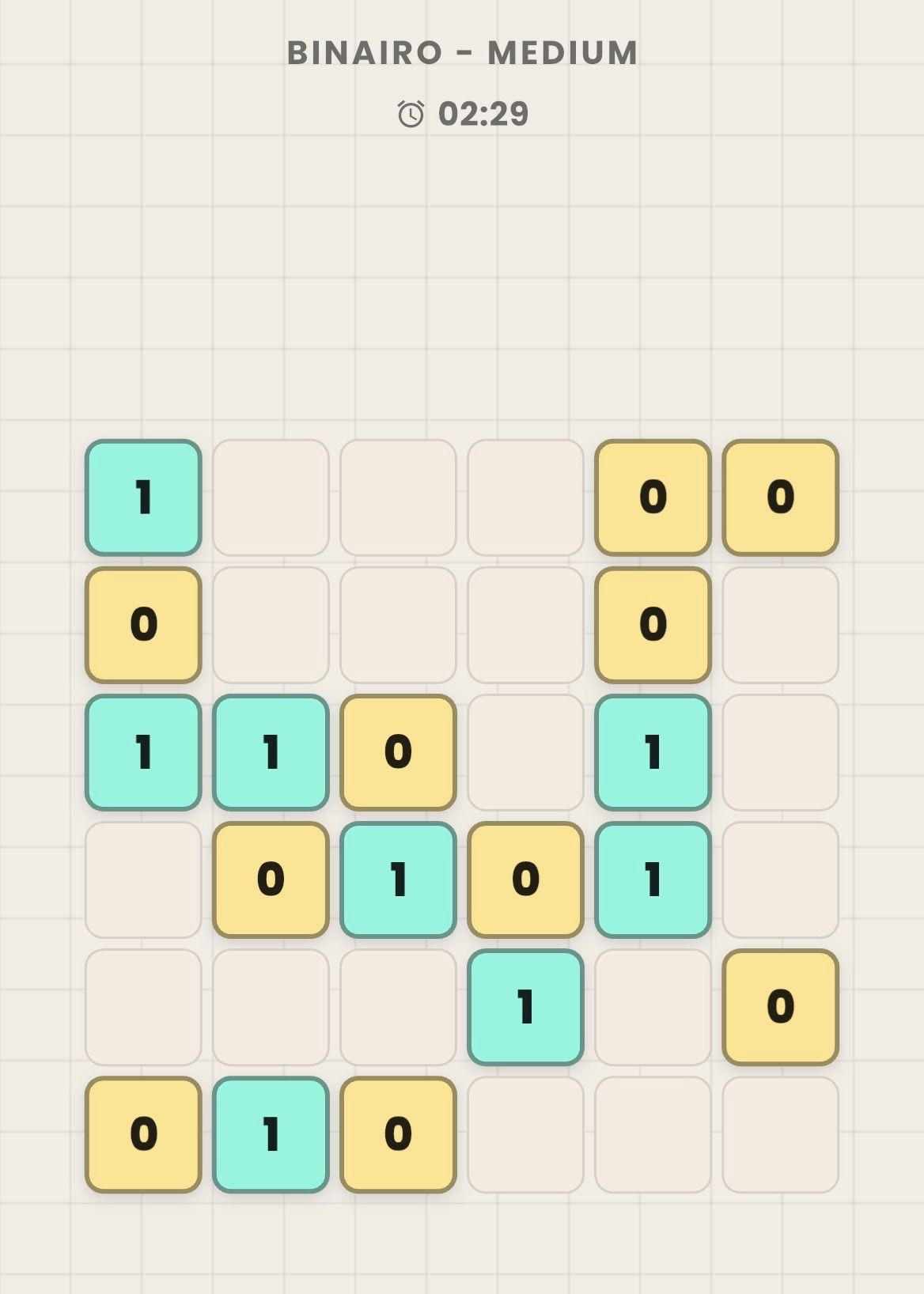
Individually, each rule is easy to understand. Together, they create constraints that compound in ways beginners rarely anticipate. A placement that satisfies Rule 1 locally might disrupt the balance required by Rule 2. A row that looks balanced might create a duplicate of another row, violating Rule 3. Tracking all three constraints simultaneously across every row and every column at the same time is where the real difficulty lives.
This is not a puzzle you can solve by focusing on one rule at a time. All three must be active in your thinking at every move. That simultaneous constraint management is what gives Binairo its genuine cognitive depth and what makes experienced solvers noticeably faster than beginners, even though they're following the same rules.
Two Symbols Create Tighter Constraints Than You'd Expect
With only two options for every cell, you might assume the puzzle would feel simple. The opposite is true. Because there are only two choices, every cell you fill immediately changes the constraints on a large number of other cells. Place a 0 somewhere, and you've affected the balance of its entire row and column, potentially forced the symbol in adjacent cells, and constrained every other row and column that must remain unique from this one.
That ripple one placement affecting dozens of other cells simultaneously is what makes Binairo feel alive as you solve it. Nothing happens in isolation. Everything is connected.
The Uniqueness Rule Is Subtler Than It Appears
Most beginners focus on Rules 1 and 2 and treat Rule 3 no identical rows or columns as something they'll worry about at the end. This is a mistake. Rule 3 often forces specific placements mid-solve, when two rows or columns become so similar that only one arrangement keeps them distinct.
Experienced solvers track row and column similarity throughout the puzzle not just at the end and use it as an active deduction tool. That awareness of uniqueness, maintained continuously across the entire grid, is one of the clearest markers of a skilled Binairo player.
"The uniqueness rule in Binairo does something most puzzle rules don't it makes the global structure of the grid matter locally. What's happening across the whole grid determines what's valid in one specific cell. That's elegant puzzle design."
What Binairo Builds in Your Brain
Logical Reasoning
Every move in Binairo has a logical justification. Nothing is guessed. Nothing is arbitrary. Every 0 and every 1 you place is placed because the rules applied carefully made it the only valid option. That discipline of always having a reason of never placing a number without being able to say why is logical reasoning in its purest, most direct form.
Players who practice Binairo regularly develop a stronger instinct for reasoning from constraints an ability to look at a set of rules and systematically derive what must follow from them. That instinct transfers directly to formal logic, analytical work, and any situation that requires clear deductive thinking.
Pattern Recognition
After solving dozens of Binairo grids, something changes. Constraint patterns that once required conscious analysis start jumping out automatically. Two identical numbers in a row immediately triggers "the neighbours are forced." A row with four of one symbol and two cells remaining triggers "both remaining cells must be the other symbol." These patterns, once internalised, make the solving process dramatically faster not because you're thinking less, but because you're recognising more.
That progressive pattern recognition is exactly how expertise develops in any domain, and Binairo makes it measurable. Your solving speed is a direct, visible record of how much your pattern library has grown.
Concentration and Working Memory
Tracking three constraints simultaneously across an entire grid updating your mental picture of every row and column with each new placement is a genuine working memory task. Binairo demands sustained, focused concentration in a way that most casual games don't.
That demand is also what makes it so effective as a brain training tool. The concentration required by a Binairo puzzle is exactly the kind of active, focused attention that strengthens over time with regular practice.
Critical Thinking and Patience
Binairo cannot be rushed. Impulsive placements ones made without fully checking all three rules create contradictions that can be difficult to trace back to their source. The puzzle rewards players who take an extra moment before each move: checking the row, checking the column, checking uniqueness, then placing.
That deliberate, checked approach is a form of critical thinking the habit of verifying reasoning before acting that is one of the most broadly valuable cognitive skills available. And Binairo builds it quietly, in every single session, simply by being the kind of puzzle that punishes shortcuts.
💡 Research on cognitive training consistently identifies working memory, logical reasoning, and sustained concentration as the three skills most predictive of general cognitive performance across academic and professional domains. Binairo trains all three simultaneously in sessions short enough to fit into any day.
How to Solve Binairo - A Practical Starting Guide
Step 1 - Find the forced placements first. Before doing anything else, scan every row and column for two consecutive identical numbers. The cell before them and the cell after them are both forced to be the opposite number. Fill these in immediately they're free moves that cost you nothing and generate new information.
Step 2 - Track the balance in every row and column. Keep a running count of zeros and ones in each row and column as you place. The moment a row reaches its quota for one symbol, all remaining cells in that row are the other symbol. The same applies to columns. This rule resolves large sections of the grid quickly once the counts tip.
Step 3 - Compare similar rows and columns. When two rows look almost identical differing in only one or two positions use the uniqueness rule to force the distinction. If completing one arrangement would make two rows identical, that arrangement is invalid. The alternative must be correct.
Step 4 - Never guess. If no forced placement is visible, look more carefully it's almost always there. Check every pair of consecutive identical symbols. Check every row and column approaching its quota. Check for near-identical rows and columns. The logic always provides the next move. You just have to find it.
Step 5 - Work rows and columns simultaneously. Every cell belongs to both a row and a column. A cell that appears unconstrained when you check its row might be immediately forced when you check its column. Switching perspective constantly horizontal and vertical, local and global is what reveals the moves that stay hidden when you work in only one direction.
💡 The best Binairo solvers don't think faster than beginners. They check more directions at once and that wider checking reveals forced moves that beginners walk straight past. The skill is attention, not speed.
Who Is Binairo For?
For anyone new to logic puzzles: Binairo's two-symbol format and clear rules make it one of the most accessible entry points into logical puzzle solving. The constraints are easy to state, the feedback is immediate, and the sense of progress is visible from the very first forced placement.
For Sudoku players looking for something different: Binairo uses the same logical instincts forced placements, balance tracking, uniqueness constraints but applies them in a completely different format. The skills transfer immediately. The experience feels entirely fresh.
For anyone who wants to unwind and think at the same time: Binairo has the same rare quality as Shikaku it genuinely relaxes you while keeping your brain meaningfully engaged. There's no time pressure in the logic itself. Just a grid, three rules, and the quiet satisfaction of working through it correctly.
For people who want measurable cognitive improvement: Binairo builds logical reasoning, pattern recognition, working memory, and critical thinking all in one puzzle format, in sessions that fit comfortably into a short daily break. The improvement is real, visible, and cumulative.
⭐ Fun fact: Binairo puzzles are guaranteed to have exactly one solution reachable through pure logic no guessing ever required. This is a strict design standard that every valid Binairo puzzle must meet. If you find yourself guessing, the puzzle isn't asking you to guess it's asking you to look more carefully. The logic is always there.
Simple Rules. Deep Strategy. Endless Satisfaction.
That description fits Binairo better than almost any other puzzle available. The rules are genuinely simple you can hold all three in your head from the very first move. The strategy is genuinely deep experienced players see forced moves that beginners miss entirely, and the difference between them is practice, not talent. And the satisfaction of a completed Binairo grid every cell filled, every rule satisfied, perfectly balanced, perfectly unique is the kind of clean, complete feeling that keeps puzzle players coming back day after day.
If you've never tried it, you're in for a surprise. A good one.
Start with the forced moves. The rest will follow.