Can You Solve These 5 Math Challenges Under 30 Seconds?
mental math challenges, math puzzles, brain teasers, quick math tricks, mental calculation, math challenge for kids, math challenge for students, improve mental math, number puzzles, fast math skills, logic puzzles, math games, brain training, CalcQuest math blog
You don't need to be a math genius. You just need to think a little differently.
Here's a question: when was the last time you did math in your head not on a phone, not on paper just you and the numbers?
For most people, the answer is "not recently." And that's a shame, because mental math isn't just a school skill. It's a thinking skill. The same mental muscles that help you split a bill, figure out a discount, or check if something adds up those are trained, not inherited.
"Mental math isn't about being fast. It's about seeing patterns that other people miss."
The five challenges below are designed to test exactly that. Some are quick. Some will make you pause. All of them have a shortcut and once you see it, you'll never forget it.
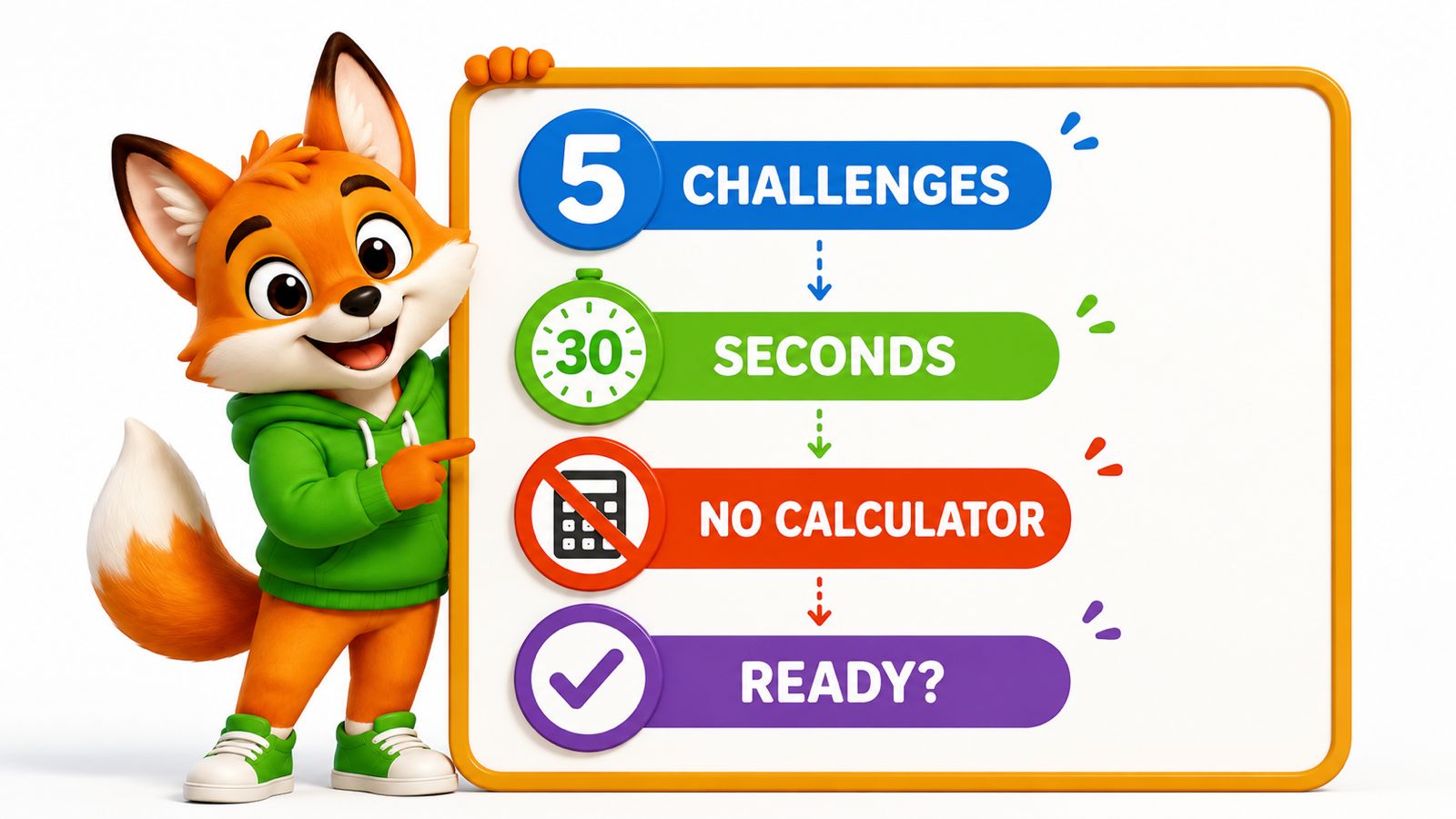
Set a timer for 30 seconds. Work through as many as you can. Then check your answers.
Five Problems. Thirty Seconds. Go.
Challenge 1 — The Speed Multiply
25 × 16 =?
The trick here is to avoid multiplying directly. Break 16 into 4 × 4. Since 25 × 4 = 100, you're really just doing 100 × 4. The problem rewrites itself once you spot it.
This is called decomposition one of the most powerful mental math moves you can learn at any age.
Answer: 400
Shortcut: 25 × 4 = 100 → 100 × 4 = 400
Challenge 2 — Pattern Power
3, 6, 12, 24, 48, ___
Every number doubles to give the next one. It's a simple rule but under a ticking clock, your brain has to find the pattern first. That's where most people lose time: not in the calculation, but in the recognition.
Sequences like this show up everywhere: savings growing, pixels multiplying, populations expanding. Pattern spotting isn't just math it's how the world works.
Answer: 96
Shortcut: ×2 each step → 48 × 2 = 96
💡 Did you know? Children who practice number patterns regularly develop stronger logical reasoning skills not just in math, but in reading comprehension and problem solving too.
Challenge 3 — Percentage Sprint
What is 15% of 200?
Don't try to work out 15% in one go split it. 10% of 200 is always just moving the decimal: 20. Half of that is 10. Add them: 30. Done in three steps, no calculator needed.
This method works for almost any percentage. Need 35%? That's 30% + 5%. Need 17.5%? It's 10% + 5% + 2.5%. Once you see percentages as building blocks, nothing feels hard.
Answer: 30
Shortcut: 10% = 20 + 5% = 10 → 30
Challenge 4 — The Logic Test
A number is multiplied by 3, then 6 is added. The result is 30. What's the number?
The fastest way to solve this is to reverse the steps no algebra required. The last thing that happened was +6, so undo it: 30 − 6 = 24. Before that, ×3, so undo it: 24 ÷ 3 = 8.
Working backwards like this shows up far beyond math debugging code, tracing a problem at work, even figuring out why a recipe went wrong. It's logical thinking in action.
Answer: 8
Shortcut: 30 − 6 = 24 → 24 ÷ 3 = 8
Challenge 5 — The Final Boss (No Calculator Allowed)
99 × 99 = ?
If you tried to multiply 99 × 99 directly, that's where most people run out of time. The shortcut: treat 99 as (100 − 1) and use the identity (a − b)² = a² − 2ab + b².
100² = 10,000. Subtract 2 × 100 × 1 = 200. Add 1² = 1. Total: 9,801. This same trick works for 98 × 98, 97 × 97 any number close to a round figure.
Answer: 9,801
Shortcut: (100 − 1)² = 10,000 − 200 + 1 = 9,801
How Did You Do?
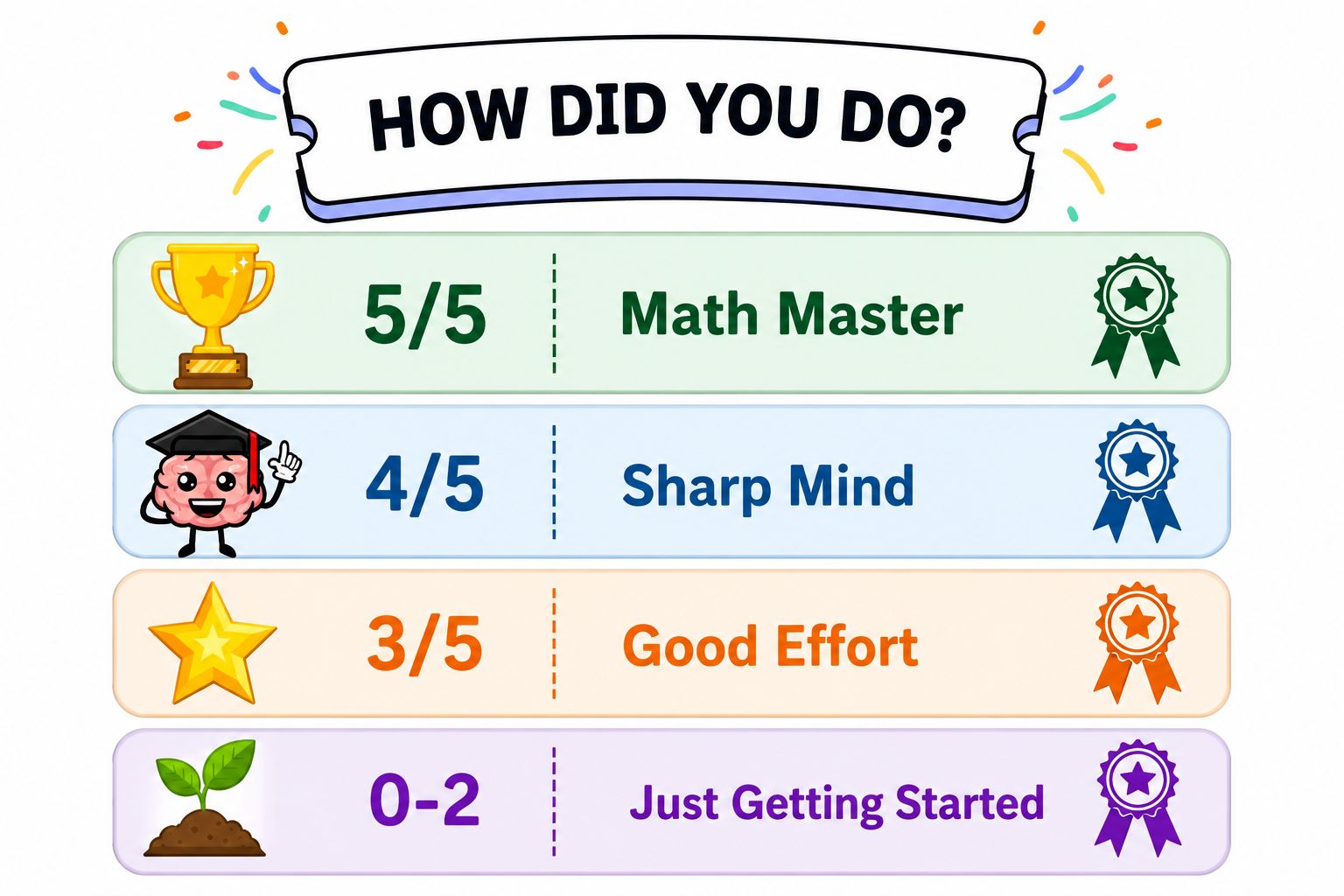
5/5 — Math Master
You're not just calculating you're seeing. That's the real skill.
4/5 — Sharp Mind
Strong instincts. One more session and nothing will slow you down.
3/5 — Good Effort
You're building the right habits. Keep going it clicks fast.
0–2 — Just Getting Started
That's exactly where it gets interesting. Every expert started here.
That's exactly where it gets interesting. Every expert started here.
Mental math isn't magic it's pattern memory. When you solve the same type of problem repeatedly, your brain stops treating it as a calculation and starts treating it as a recognition task. That's why experienced math thinkers seem to "just know" answers: they've seen the shape of the problem before.
Neuroscience calls this chunking . Your brain groups related information into single units, so "25 × something" eventually triggers "think in 100s" automatically the same way a word like "hello" doesn't require you to read each letter.
- 21 days of daily practice can build a new mental math habit
- 3x faster recall when problems are practiced in timed sessions
- Any age mental math skills improve at 6 or 60, it's never too late
The good news: you don't need hours of drilling. Short, regular practice even five minutes a day is more effective than long occasional sessions. Your brain consolidates the patterns while you sleep.
"The goal isn't to remember answers. It's to recognize problems and that comes from playing with numbers, not memorizing them."
Three Habits That Actually Work

You don't need a curriculum. You need three things:
- Do it daily, but briefly. Five minutes of timed problems beats an hour of passive reading. Consistency is what builds the reflex.
- Learn the shortcut, not the answer. Knowing that 99 × 99 = 9,801 is useless. Knowing the (100 − n)² trick gives you every answer near 100, forever.
- Make it harder as you improve. The moment a problem feels easy, it's stopped building your skill. You need problems at the edge of your ability not past it, not below it.
⭐ Fun fact: Many competitive mental math champions started as average students. What separated them wasn't natural talent it was consistent, structured practice with problems slightly harder than they were comfortable with.
Your Next Challenge Is Waiting
Calc Quest is built around exactly these principles timed puzzles that scale with your ability, daily challenges that keep you consistent, and shortcuts baked into every level so you're always learning to think, not just to calculate.