Can You Solve These Number Pyramid Challenges?
number pyramid puzzle, number pyramid challenge, how to solve number pyramids, math pyramid puzzle, pyramid addition puzzle, number pyramid for kids, brain puzzles with numbers, logic math puzzles, math puzzles for beginners, number pyramid answers, Calc Quest, math puzzle app, addition puzzles, pyramid math game, mental math puzzles
They look simple. They're not. And that's exactly what makes them so satisfying.
A Number Pyramid starts with a single rule: each block is the sum of the two blocks directly below it. That's it. One rule. A small grid. A handful of missing numbers.
And yet the moment you sit down with one, you'll find yourself thinking harder than you expected. Adjusting. Backtracking. Trying a different approach. Then finally, when the last number clicks into place, feeling a quiet satisfaction that's completely out of proportion to the size of the puzzle.
That's the magic of Number Pyramids. Simple rules. Real thinking. And a reward that feels genuinely earned.
"Number Pyramids are deceptively simple one rule, endless challenge. That combination is exactly what makes a great puzzle."
How Number Pyramids Work
The rule: each block equals the sum of the two blocks directly beneath it. Fill in the missing numbers so that every block follows this rule, from the bottom row all the way up to the single block at the top.
Start from what you know. Look for rows or blocks where only one number is missing those are your entry points. Solve those first, and the rest of the pyramid begins to open up naturally.
💡 Tip: Number Pyramids can be solved from the bottom up or the top down sometimes both directions at once. If you're stuck going one way, try working backwards from the top. The answer is often hiding in plain sight.
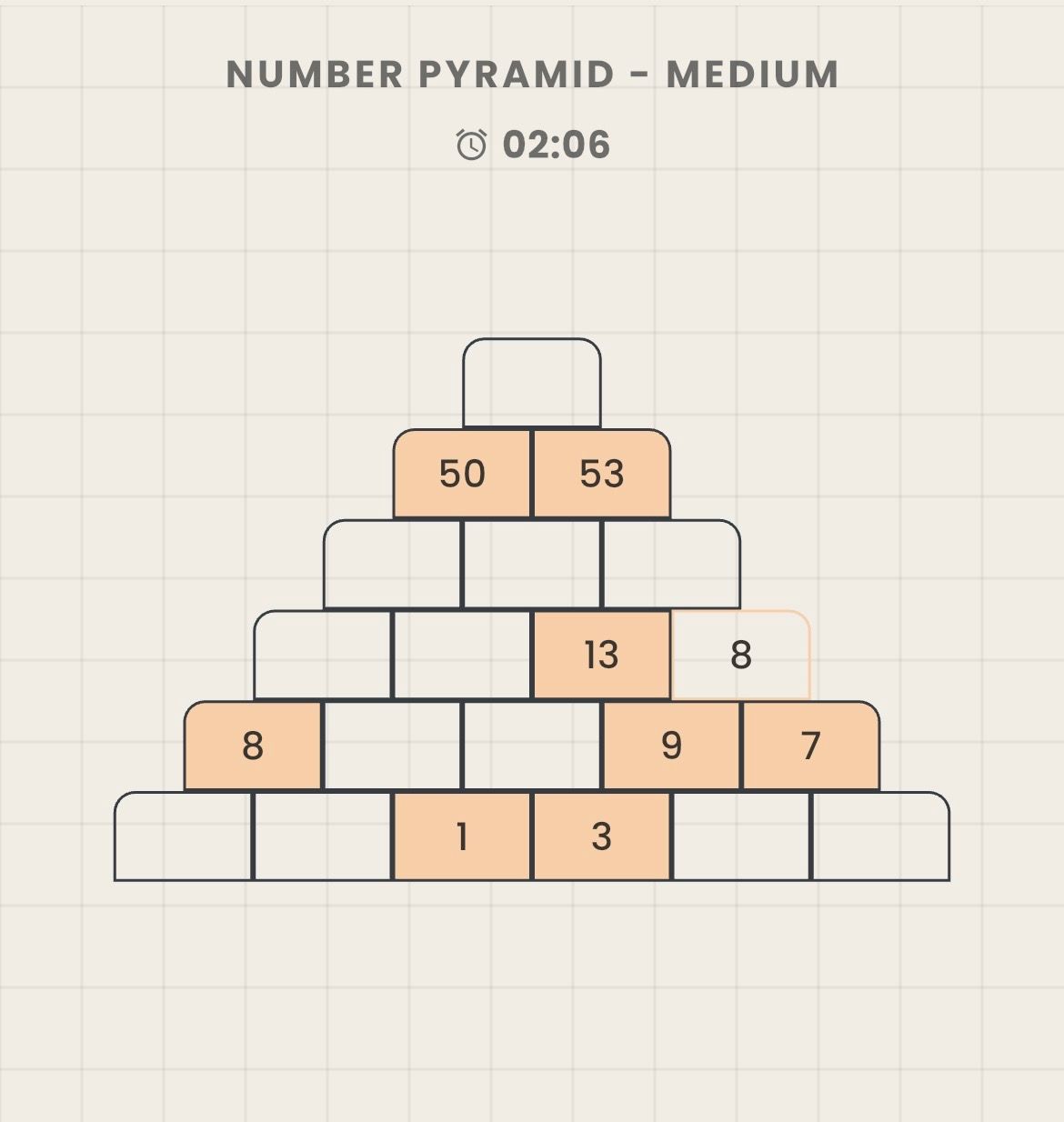
The advanced pyramid has multiple valid approaches the goal is to find any solution that satisfies every rule simultaneously. That kind of open-ended thinking is exactly what makes it an advanced challenge.
Why Number Pyramids Are So Good for Your Brain
They Train You to Think in Both Directions
Most math problems have one direction: start here, follow the steps, reach the answer. Number Pyramids break that habit. Sometimes you work bottom-up. Sometimes you work top-down. Sometimes you switch mid-puzzle when one direction gets stuck.
That flexibility the ability to approach a problem from multiple angles is one of the most valuable thinking skills you can develop. It transfers directly to real-world problem solving, where the "right" starting point is rarely obvious.
They Make Addition Feel Strategic
In a Number Pyramid, addition isn't a mechanical task it's a tool for reasoning. Every sum you calculate tells you something about the numbers around it. A block that's "too high" means something below it needs to be smaller. A block that doesn't match means backtracking one step, not starting over.
That shift from addition as calculation to addition as reasoning is a genuine upgrade in how your brain handles numbers.
They Build Logical Patience
Number Pyramids can't be rushed. Guessing rarely works one wrong number cascades upward and breaks the whole structure. The only path to a solution is careful, step-by-step logic.
That kind of patient, methodical thinking is something most people don't practice enough. Number Pyramids make it feel less like discipline and more like problem solving which is exactly when it starts to stick.
💡 Did you know? The pyramid structure mirrors how mathematicians build proofs each step depends on the ones below it being correct. Practicing Number Pyramids builds the same "check your foundations" mindset that underlies all rigorous thinking.
Who Are Number Pyramids For?
The honest answer: almost everyone. Younger players build addition fluency and logical confidence in a format that feels like play rather than practice. Older players get a satisfying mental workout that sharpens reasoning, number sense, and the ability to hold multiple constraints in mind simultaneously.
And for anyone in between students, adults, puzzle lovers, people who just want something better to do during a spare five minutes Number Pyramids hit a rare sweet spot: quick enough to fit into a short break, deep enough to make that break feel genuinely worthwhile.
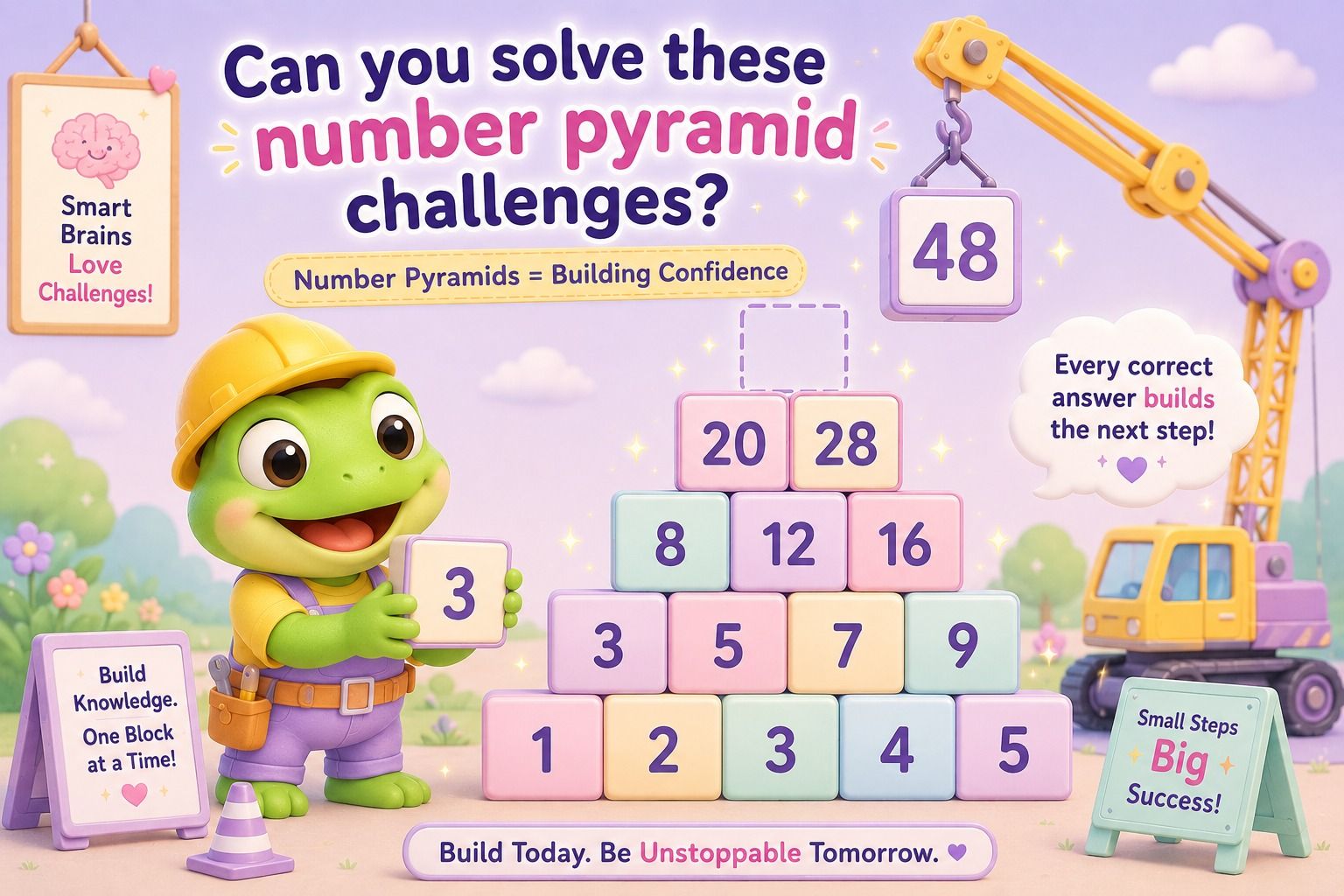
⭐ Fun fact: Number Pyramids are used by teachers worldwide as a classroom warm-up tool not because they're easy, but because they're fast to set up, immediately engaging, and build exactly the arithmetic reasoning skills that make everything else in math easier.
How to Get Better at Number Pyramids
1.Always start with the most constrained block. Find the row or position where the fewest numbers are missing. That's your entry point solve it first and let it unlock the rest.
2. Use both directions. If working bottom-up gets you stuck, try top-down. The two approaches give you different information and together they almost always reveal the missing piece.
3. Check as you go. After filling in each number, verify the blocks above it. Catching a mistake one step after it happens is far easier than untangling a pyramid that's three rows wrong.
4. Embrace the backtrack. Getting stuck and reversing a step isn't failure — it's the puzzle working exactly as intended. Every backtrack teaches you something about the structure that a straight-through solve wouldn't.
Ready to Try One?
The three challenges above are just a starting point. Number Pyramids come in every size and difficulty level from quick two-minute beginner puzzles to multi-row challenges that take real sustained focus to crack.
The more you solve, the faster you'll get. Not because you're memorizing anything but because your brain starts recognizing the structure of the pyramid before you've even read the clues. That's when puzzle solving stops feeling like work and starts feeling like thinking at full speed.
Try one. See how far you get.