Easy, Medium or Hard? How to Pick the Right Puzzle Difficulty!?
how to pick puzzle difficulty, easy medium hard puzzle, right difficulty for learning, optimal challenge level, zone of proximal development puzzles, 85% learning rule, puzzle difficulty tips, how to improve at puzzles faster, Calc Quest difficulty, brain training difficulty, learning zone puzzles, puzzle difficulty guide, how hard should puzzles be, cognitive challenge level, deliberate practice puzzles
The puzzle you pick matters as much as the time you spend on it. Here's how to always pick the right one.
Most people pick puzzle difficulty the same way they pick anything else they're not sure about: they go with their gut, they default to the middle option, or they start easy because it feels safer. None of these is wrong exactly but none of them is optimal either.
Difficulty selection is actually one of the most important decisions in any practice session. Too easy and your brain coasts you feel productive but you're not growing. Too hard and your brain overwhelms you feel frustrated and quit earlier than you should. The right difficulty sits in a narrow range between those two extremes, and spending time there is what produces the fastest, most durable improvement.
This post explains exactly how to find that range and how to know when to move up, when to stay, and when stepping back is actually the smartest move you can make.
"The right difficulty isn't the hardest you can attempt. It's the hardest you can learn from. Those are rarely the same thing."
The Science Behind Difficulty Selection
The Zone of Proximal Development
Psychologist Lev Vygotsky introduced the concept of the "Zone of Proximal Development" the range of difficulty that sits just beyond what you can do independently but within reach with effort. This zone is where learning happens fastest. Below it, you're practising what you already know. Above it, you're overwhelmed and can't extract useful learning from the experience.
For puzzle solving, this translates directly: the right difficulty level is the one where you can solve most puzzles but not without genuine effort, and not without making some mistakes along the way. That combination of mostly-succeeding with regular challenge is the sweet spot that produces both skill development and sustained motivation.
The 85% Rule
Research on optimal learning difficulty has converged on a surprisingly specific number: 85%. Studies on human learning across multiple domains consistently find that the fastest skill development occurs when learners get the right answer approximately 85% of the time and the wrong answer approximately 15% of the time.
At 100% accuracy, the task is too easy no new learning is occurring. At 50% accuracy, the task is too hard errors are too frequent to extract clear learning signals from. At 85%, the challenge is calibrated perfectly: enough success to stay motivated and reinforce correct patterns, enough failure to identify gaps and drive improvement.
💡 The 85% rule comes from research at Brown University on machine learning systems but it has since been validated in human learning contexts across mathematics, language acquisition, and motor skill development. It's one of the most robust findings in learning science, and it applies directly to puzzle difficulty selection.
Why Your Brain Needs Mistakes to Grow
Mistakes are not just acceptable in the right difficulty zone they're essential. When you get something wrong, your brain receives a prediction error signal: the outcome didn't match what it expected. That signal triggers a learning update your brain adjusts its internal model to better predict the right answer next time.
No mistakes means no prediction errors. No prediction errors means no learning updates. No learning updates means no growth regardless of how many puzzles you complete or how much time you spend. A session where you never struggle is a session where your brain was never asked to grow.
Getting something wrong in a puzzle isn't failure. It's information the most valuable kind the brain receives. The right difficulty level ensures you get enough of it.
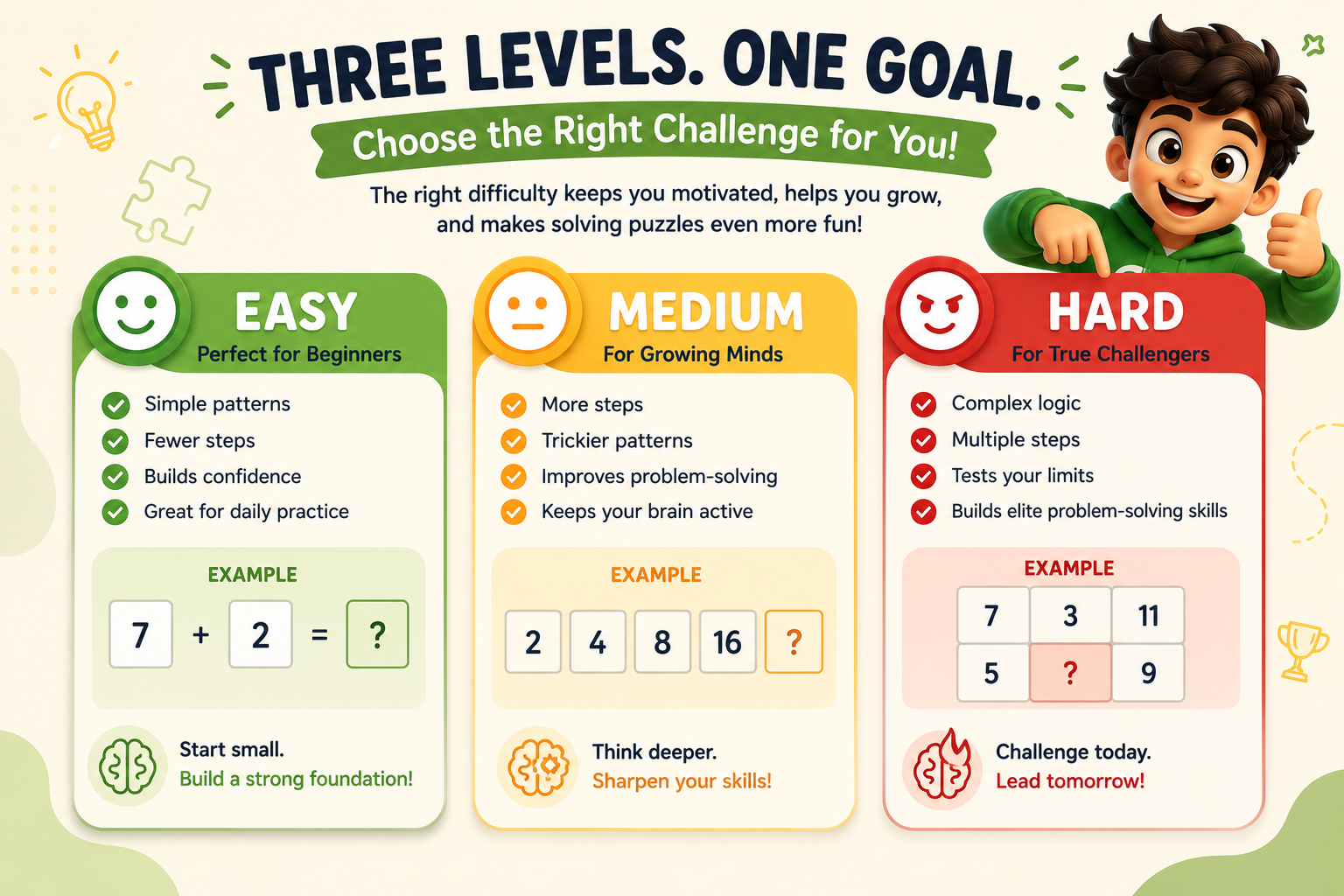
What Each Difficulty Level Actually Means
Easy - Building Foundations and Restoring Confidence
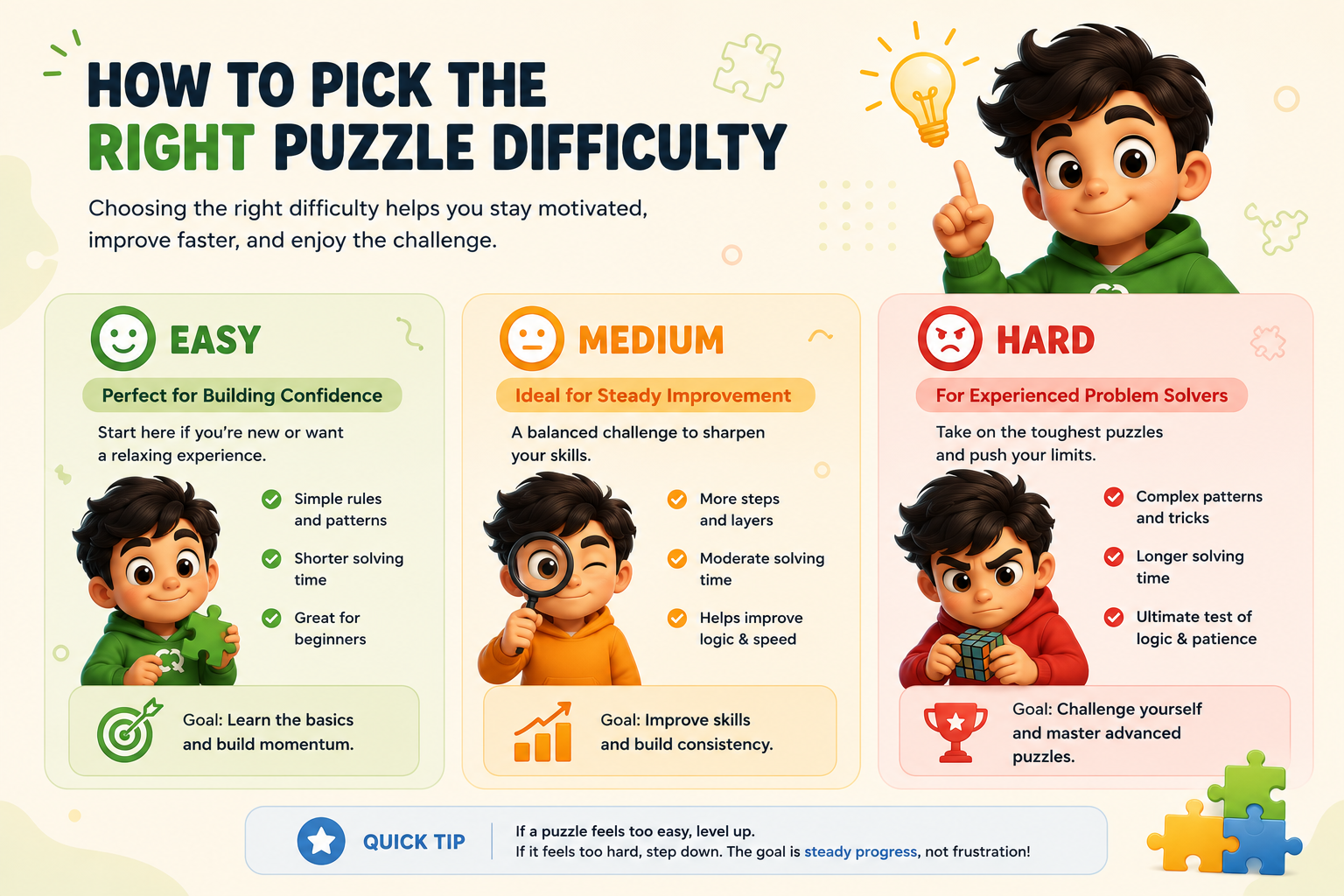
Easy puzzles are not wasted time but they serve a specific purpose, and that purpose is not improvement. Easy difficulty is valuable when you're new to a puzzle type and need to internalise the rules without cognitive overload. It's valuable when you're returning after a break and need to restore fluency before pushing harder. It's valuable when you're using puzzles as a genuine warm-up or wind-down rather than as a training session.
What easy difficulty is not valuable for is skill development. If you've been solving easy puzzles for more than two weeks and they still feel easy you've been coasting. The brain adapts quickly, and once it has, easy puzzles maintain existing skills without building new ones.
💡 Easy difficulty has one powerful use case that's often overlooked: rebuilding confidence after a frustrating session or a difficult period. Returning to easy puzzles isn't regression it's resetting the baseline and reminding your brain what success feels like before pushing harder again.
Medium - The Primary Training Zone
Medium difficulty is where most of your practice time should be. It's the zone most likely to sit at or near the 85% success rate challenging enough to produce mistakes and learning, achievable enough to produce completion and motivation. It's where pattern libraries grow, where working memory is exercised, where logical reasoning is pushed and extended.
Medium difficulty also has the most consistent motivational profile. Easy puzzles can feel boring once they're mastered. Hard puzzles can feel discouraging when they resist repeatedly. Medium puzzles solved with genuine effort and occasional struggle produce the most reliable combination of satisfaction and drive to continue.
If you're unsure which difficulty to choose for any session, medium is almost always right. It's the reliable default that delivers training value without the risk of either coasting or overwhelming.
"Medium difficulty is where improvement lives. Not where it occasionally visits where it lives. Players who default to medium consistently outperform those who alternate between easy comfort and hard ambition."
Hard - Stretching the Limits of Current Ability
Hard difficulty serves a specific and valuable purpose but it's one that requires the right context to be effective. When your medium-difficulty puzzles have become genuinely easy when you're completing them quickly, making few mistakes, and feeling understimulated hard is exactly the right move. It pushes you back into the learning zone and restarts the growth cycle.
Hard difficulty also builds something that medium doesn't quite reach: resilience. The experience of sitting with a genuinely difficult problem of being stuck, searching for a move that isn't immediately obvious, eventually finding it builds a tolerance for difficulty that makes medium puzzles feel manageable and easier approaches to problems feel automatic.
What hard difficulty requires, though, is the right mindset. If you approach a hard puzzle expecting to solve it quickly and smoothly, you'll be disappointed and demotivated. Approached with the expectation that it will take time, require multiple attempts, and produce real struggle hard difficulty is one of the most effective learning environments available.
💡 Hard puzzles are most effective when you've already built a solid base at medium. Jumping to hard too early before the fundamental patterns are internalised produces frustration without learning, because there's no pattern library to stretch. Build the foundation first. Then stretch it.
Signs You're at the Wrong Difficulty
Signs You're Too Easy
- You complete puzzles without ever pausing to think
- You make almost no mistakes across multiple sessions
- Sessions feel more like going through the motions than solving something
- You feel slightly bored but keep choosing the same level out of habit
- Your solving speed has plateaued and hasn't changed in weeks
Any two or more of these signals consistently across sessions means it's time to move up. Your brain has adapted to this difficulty level which means it's no longer being challenged and no longer growing. The comfortable feeling isn't progress. It's stagnation wearing a familiar face.
Signs You're Too Hard
- You give up on puzzles regularly before completing them
- You make so many errors that you can't identify a clear learning signal
- Sessions feel consistently demoralising rather than occasionally frustrating
- You're guessing rather than reasoning and the guesses are usually wrong
- You dread starting a session because you expect to fail
These signals mean the difficulty is producing frustration without learning which is the least productive possible use of practice time. Stepping back to medium isn't failure. It's calibration. The goal is to be in the zone where you're mostly succeeding with genuine effort not the zone where you're mostly failing regardless of effort.
Signs You're at the Right Difficulty
- Most puzzles feel challenging but achievable
- You make mistakes but they're informative ones you can learn from
- You occasionally get stuck, but find a way through with persistence
- Sessions feel engaging rather than easy or exhausting
- You notice your solving speed or accuracy improving over days and weeks
This is the zone. If this describes your experience at a given difficulty level stay there. Resist the temptation to move up before you've extracted the full learning value from where you are. Progress will come to you here. You don't need to chase it by jumping ahead.
"The right difficulty feels slightly uncomfortable. Not agonising. Not boring. Slightly uncomfortable like a stretch that's working. That feeling is learning happening in real time."
How Difficulty Works Differently Across Puzzle Types
Calculation Puzzles (Quick Calculation, Rootdown)
In timed calculation games, difficulty manifests primarily as speed requirement and number complexity. Easy difficulty gives you comfortable time and familiar number ranges. Hard difficulty compresses the time window and introduces larger, less familiar values. The right difficulty is the one where you're answering correctly at a pace that requires genuine focus not so fast that you're guessing, not so slow that the time pressure disappears.
Logic Puzzles (Sudoku, Binairo, Tango, Queens, Shikaku)
In logic puzzles, difficulty manifests as the number of given clues and the length of the deduction chains required. Easy grids have many given values forcing lots of obvious moves early. Hard grids have fewer starting values requiring longer chains of constraint reasoning before anything is definitively forced. The right difficulty is the one where you can find forced moves with genuine effort not where every move is immediately obvious, and not where no moves ever become clear.
Memory Games (Simon Sequence, Memory Matrix)
In memory games, difficulty manifests as sequence length and grid size. Easy difficulty uses shorter sequences and smaller grids within the comfortable range of most players' working memory. Hard difficulty pushes into the territory where active strategies chunking, rhythmic encoding, systematic scanning become necessary rather than optional. The right difficulty is the one where raw memory alone isn't quite enough where strategy starts to be required.
Pattern Puzzles (Number Patterns, Number Pyramids)
In pattern puzzles, difficulty manifests as the complexity and obscurity of the underlying rule. Easy patterns use familiar operations doubling, adding a fixed number. Hard patterns use combinations of operations, alternating rules, or multi-step relationships that aren't immediately visible. The right difficulty is the one where you need to test a few hypotheses before finding the rule not where the rule is immediately obvious, and not where it's so obscure that testing hypotheses produces no useful information.
⭐ Fun fact: The concept of optimal challenge the idea that learning is fastest at a specific difficulty calibration point appears independently in educational psychology, cognitive science, neuroscience, and game design. The fact that entirely separate fields have converged on the same principle is strong evidence that it reflects something genuinely fundamental about how human learning works.
A Simple Framework for Every Session
Before every Calc Quest session, ask yourself one question:
How did the last session at this level feel?
- Mostly easy with rare challenge → move up one level
- Mostly challenging with occasional success → stay here
- Mostly frustrating with rare success → move down one level
- About right challenging but achievable → stay here and keep going
That's the whole framework. One question. Four outcomes. Apply it consistently and you'll spend the vast majority of your practice time in the zone where growth actually happens without overthinking the decision or defaulting to whichever option feels safer.
The Permission to Move Down
This deserves its own section because it's the insight most people resist most strongly. Moving down in difficulty choosing an easier puzzle than the one you were just attempting feels like going backwards. It feels like admitting defeat. For many people, it feels too uncomfortable to do even when they know it's the right call.
It isn't going backwards. It's calibration. The goal of difficulty selection is to be in the zone where learning is happening not to be at the highest level you can technically attempt. A session at medium difficulty where you're learning is worth more than a session at hard difficulty where you're just struggling without extracting anything useful.
The best puzzle players move down without hesitation when the situation calls for it. They treat difficulty as a tool, not a test of character. And because they spend more time in the actual learning zone, they improve faster than people who refuse to step back regardless of what the session is telling them.
"Moving to an easier puzzle isn't retreat. It's intelligence the recognition that learning happens at a specific calibration point and that finding that point matters more than the number on the difficulty label."
Start Where the Learning Is
The right difficulty isn't a fixed destination. It moves as you improve and following it is what keeps your practice sessions productive rather than comfortable. Easy when you need to build foundations or restore confidence. Medium as your primary training ground. Hard when you've outgrown medium and need to stretch.
The framework is simple. The discipline is to apply it honestly to let your actual experience in each session, not your ego or your habits, determine where you play next.
Find the level where you're mostly succeeding and occasionally struggling. Stay there. That's where you grow.