How Math Pairs Improves Both Speed and Accuracy
math pairs game, how to improve math speed and accuracy, math fluency game, speed and accuracy math, math matching game, arithmetic fluency practice, working memory math game, math pairs calc quest, recognition memory mathematics, math practice game for kids, improve mental arithmetic, math pairs strategies, timed math game, math fluency for students, calculation vs recognition math
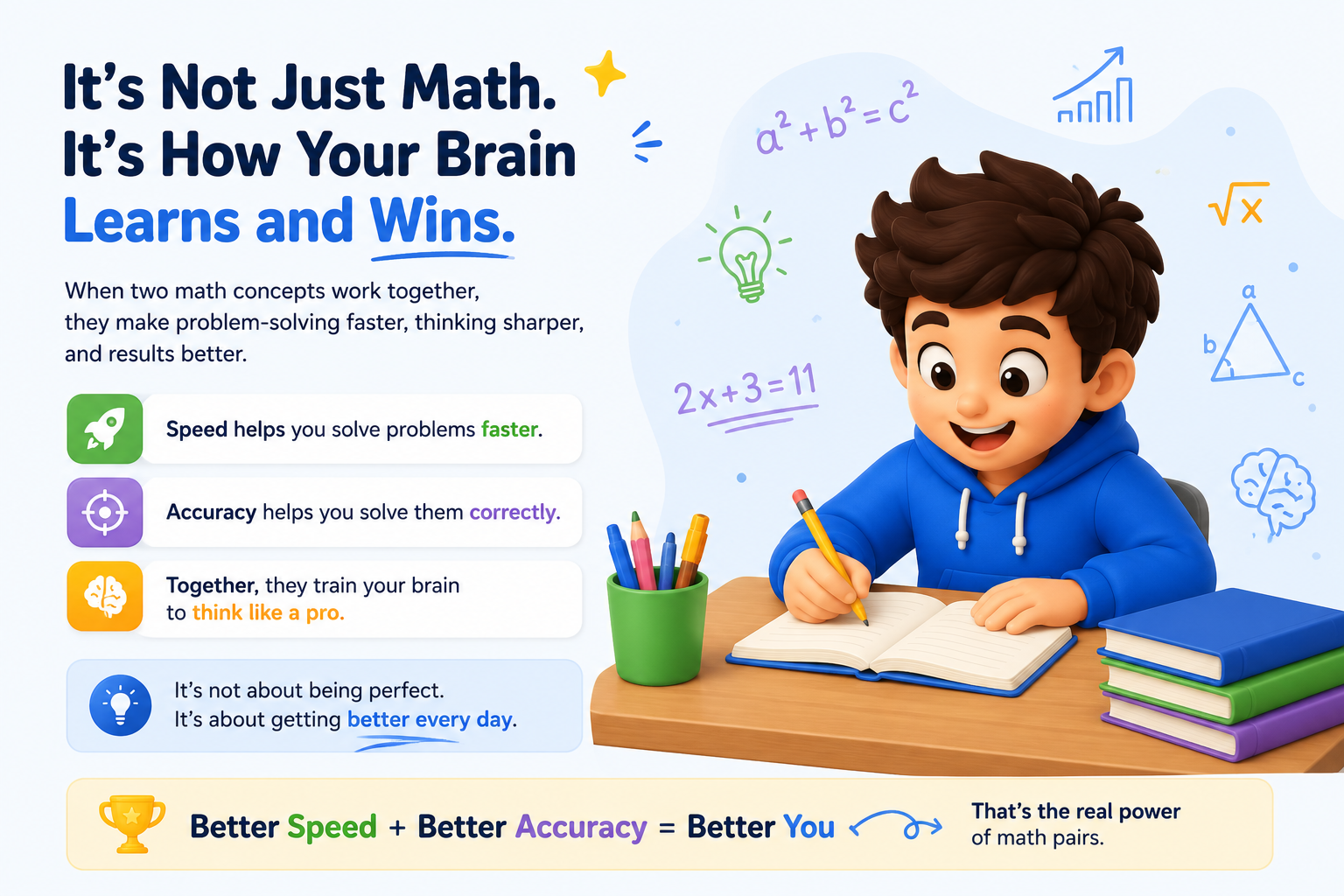
Most practice methods improve speed or accuracy. Math Pairs is built to improve both and the reason why tells you something important about how mathematical skill actually works.
Speed and accuracy are usually treated as a trade-off. Go faster and you make more mistakes. Slow down for accuracy and you lose pace. Most timed math games implicitly ask you to choose which one matters more and most learners default to one at the expense of the other.
Math Pairs is designed around a different premise: that speed and accuracy aren't opposites. They're both symptoms of the same underlying quality fluency. And when fluency is built correctly, both improve together. Not one at the cost of the other. Both, simultaneously, through the same practice.
"Speed without accuracy is noise. Accuracy without speed is too slow to be useful. Fluency is when both arrive together and Math Pairs builds fluency directly."
What Is Math Pairs?
What it is: Math Pairs is a matching game inside Calc Quest where mathematical expressions and their values are displayed across a grid of cards. Your goal is to find and match pairs an expression with its correct answer as quickly and accurately as possible. Matched pairs clear. Unmatched pairs flip back. The round ends when every pair has been found.
What makes it different: Unlike pure calculation drills where you're given a problem and asked to produce an answer, Math Pairs requires both calculation and recognition you have to compute the value of an expression and identify which visible card matches it simultaneously. That dual demand computing and recognising at the same time trains a richer and more flexible form of mathematical fluency than single-mode practice alone.
The memory element adds another layer: cards that have been seen but not yet matched must be held in working memory as the round progresses. The best players aren't just fast calculators they're also efficient memory managers, tracking which values they've already seen and where they appeared.
💡 The combination of calculation, recognition, and working memory in a single game format makes Math Pairs one of the most cognitively complete math practice games available training three distinct skill components simultaneously where most games train only one.
Why Speed and Accuracy Usually Conflict and Why Math Pairs Resolves It
The Root of the Trade-Off
The speed-accuracy trade-off exists because most people are calculating rather than recognising. When you calculate 7 × 8 by working through a multiplication process, speed and accuracy compete directly going faster means leaving less time for the calculation to complete correctly. The faster you try to go, the more likely an error becomes.
But when you recognise 7 × 8 as 56 not because you calculated it but because you've seen that pairing enough times that it's been stored as a single unit speed and accuracy stop competing. Recognition is both fast and accurate, because it bypasses the calculation process entirely. You're not computing the answer. You're retrieving it.
The shift from calculation to recognition is what fluency means in practice. And it's precisely what Math Pairs builds through repeated exposure to expression-value pairings in a context that rewards both speed of recognition and accuracy of retrieval.
"The speed-accuracy trade-off is a symptom of calculating. Recognition doesn't have a trade-off it's fast and accurate by nature. Math Pairs trains the shift from one to the other."
How Math Pairs Resolves the Trade-Off
Math Pairs works because it trains the specific transition point between calculation and recognition the range where an expression is almost familiar enough to be recognised but not quite automatic yet. In this zone, practice produces the largest improvement per session: each successful match makes the pairing slightly more automatic, and over dozens of matches across multiple sessions, the transition from calculating to recognising is completed.
The matching format accelerates this transition in a way that pure calculation drills don't. When you see an expression and its value displayed simultaneously even briefly, on a card you're not currently matching your brain encodes the pairing passively. When you then calculate the expression and search for its matching value, you're actively reinforcing the same pairing. Both passive encoding and active retrieval happen within the same session, producing a significantly faster consolidation than either alone.
💡 This combination of passive encoding and active retrieval within the same session is sometimes called "interleaved practice" in learning science. Research consistently shows that interleaved practice produces stronger long-term retention than blocked practice where encoding and retrieval are separated into different sessions or phases.
What Math Pairs Trains Specifically
Arithmetic Fluency Across Multiple Operations
Math Pairs exposes you to expressions involving addition, subtraction, multiplication, and division within the same session often within the same round. That variety is a feature, not a coincidence. Rotating between operations prevents the over-specialisation that comes from drilling a single operation type where you become fast at multiplication but slower at division because the two have been practised in isolation.
Mixed-operation practice builds what cognitive scientists call "operation flexibility" the ability to move fluidly between different arithmetic types without the hesitation that comes from mental mode-switching. Experienced mental math practitioners exhibit strong operation flexibility. Math Pairs builds it naturally through the variety of expressions in each round.
Recognition Memory for Mathematical Expressions
Every time you successfully match an expression with its value in Math Pairs, you strengthen the memory trace connecting that specific expression to that specific value. Over multiple sessions, these traces become strong enough that the expression-value pairing is recognised rather than computed which is exactly the automaticity that produces both speed and accuracy simultaneously.
This recognition memory is distinct from procedural memory the memory of how to perform a calculation. Procedural memory tells you the steps to find 8 × 9. Recognition memory tells you the answer directly. Math Pairs builds recognition memory deliberately and efficiently, session by session, across the full range of expressions it presents.
Working Memory Under Cognitive Load
The card-matching format adds a working memory demand that pure calculation practice doesn't include: remembering which values you've already seen, where they appeared, and which ones you still need to find. This demand tracking a set of seen-but-unmatched values while simultaneously calculating new expressions places your working memory under genuine cognitive load.
That load is productive. Working memory strengthens through use, and the specific use pattern in Math Pairs holding multiple values in mind while performing active calculation mirrors exactly the demands of real-world mental arithmetic in complex situations: tracking a running total while adding new items, holding partial results while completing multi-step calculations, or monitoring multiple numbers simultaneously in financial or analytical contexts.
💡 Did you know? Working memory researchers use tasks that combine active processing with concurrent memory demands exactly the structure of Math Pairs as their standard measure of working memory capacity. The format isn't just good game design. It's one of the most validated cognitive assessment and training formats in the research literature.
Attention and Visual Scanning
Finding the matching card in Math Pairs requires efficient visual scanning the ability to survey a grid of values quickly, identify the target, and locate its position without losing track of the other cards you've seen. This skill structured, goal-directed visual attention is trained with every round and improves measurably with practice.
Players who develop efficient scanning strategies working through the grid systematically rather than jumping randomly between cards complete rounds significantly faster than those who scan randomly, even when their calculation speed is identical. Scanning strategy is a genuine performance variable in Math Pairs, and it's one that improves rapidly with conscious attention.
The Improvement You'll Notice and When
Within the First Few Sessions
The first thing most players notice in Math Pairs is the jolt of frustration when a card they've already seen flips back before they could use it. This frustration is productive it's the signal that your working memory is being genuinely challenged. By the end of the first session, most players have developed an instinct to pay closer attention to card values when they're first revealed, even when they're not currently needed.
That instinct encoding card values proactively rather than reactively is the first skill shift the game produces. It arrives quickly because the feedback (flipping a card back that you needed) is immediate and clear.
After One to Two Weeks
After a week or two of regular play, most players notice that certain expression-value pairings no longer require conscious calculation. 6 × 7 doesn't produce a thought process it produces 42, directly and automatically. 144 ÷ 12 produces 12 without steps. These aren't the most complex calculations they're the ones that have been encountered often enough in Math Pairs that recognition memory has formed.
The effect is measurably visible in round completion times rounds that took two minutes in week one take ninety seconds in week two. That improvement isn't from trying harder. It's from specific expression-value pairings having crossed the threshold from calculation to recognition.
With Consistent Long-Term Practice
With consistent practice over weeks and months, the recognition effect spreads across an increasingly wide range of expressions. The working memory demand of tracking seen cards reduces as more cards are matched quickly which frees up mental bandwidth for scanning and strategy. Round times continue to fall. Accuracy remains high because recognition, unlike calculation, doesn't degrade under speed.
The most experienced Math Pairs players describe the late-stage experience as feeling qualitatively different from early play less like effortful calculation and more like fluent reading, where the meaning arrives automatically and the process is invisible. That shift is exactly what mathematical fluency feels like and it's what Math Pairs is built to produce.
"The end state of Math Pairs practice isn't getting faster at calculating. It's stopping calculating and starting recognising. That's a fundamentally different experience of mathematics."
Strategies That Improve Your Math Pairs Performance
- Encode every card when it's first revealed, not just the ones you need. The best Math Pairs players treat every card flip as an opportunity to load information into working memory regardless of whether that card is currently useful. The investment pays off when you need that value two moves later and already know where it is.
- Calculate the expression before flipping the second card. Flip the expression card, compute its value mentally, then flip cards to find the match rather than flipping randomly and hoping. This approach is faster and more accurate than random scanning because it converts the search from recognition of an unknown to retrieval of a known target.
- Scan systematically, not randomly. Work through the visible value cards in a consistent order left to right, top to bottom when searching for a match. Systematic scanning ensures you don't miss the target card, and it makes your scans faster because your eyes follow a predictable path rather than jumping unpredictably across the grid.
- Prioritise matching the values you've already seen. If you know where a specific value is from a previous flip, go there next rather than revealing new cards. Known matches are guaranteed correct and cost no additional working memory. Chasing known matches first reduces the number of live values you need to track at any moment.
- Use the unmatched cards to practise calculation, not just memory. When you flip an expression you haven't seen before and can't immediately find its match, treat the search as a calculation practice opportunity compute the value deliberately, hold it clearly in mind, and notice how quickly or slowly the answer arrives. The expressions that slow you down are the ones to focus on in subsequent sessions.
💡 The strategies above reflect two distinct skill components that Math Pairs trains: mathematical fluency (how fast and accurately you produce values from expressions) and working memory management (how efficiently you track and retrieve seen card values). Both components improve with practice and the best players develop both intentionally rather than letting one lag behind the other.
Who Benefits Most From Math Pairs
Students building arithmetic foundations: Math Pairs exposes the specific expression-value pairings that aren't yet automatic and provides the repeated, varied exposure that makes them automatic. For students whose multiplication tables or division facts have gaps, Math Pairs identifies and fills those gaps more efficiently than drilling tables alone.
Students preparing for timed assessments: Timed tests penalise both slow calculation and inaccurate calculation. Math Pairs directly addresses both by building the recognition fluency that removes the speed-accuracy trade-off entirely. Students who play Math Pairs regularly going into a timed assessment enter it with a meaningfully different relationship to arithmetic faster, more reliable, and less prone to time pressure errors.
Adults rebuilding number confidence: Math Pairs provides immediate, visible evidence of fluency developing in the form of faster round times and fewer hesitations. For adults who've lost confidence with numbers since school, that visible evidence is exactly the kind of concrete feedback that rebuilds the belief that mathematical fluency is achievable and improving.
Anyone who wants sharper mental arithmetic: The recognition memory that Math Pairs builds doesn't stay inside the game. It shows up in every real-world situation where arithmetic is needed checking bills, calculating discounts, estimating quantities, verifying numbers in reports. The fluency built in Math Pairs generalises to any context where those same expressions appear.
⭐ Fun fact: Memory matching games the format underlying Math Pairs have been used as cognitive assessment tools since the 1970s, measuring both working memory capacity and processing speed simultaneously. The format was chosen for assessment precisely because it taxes both systems at once. Math Pairs inherits that dual-assessment quality and turns it into a training tool.
Speed and Accuracy Together
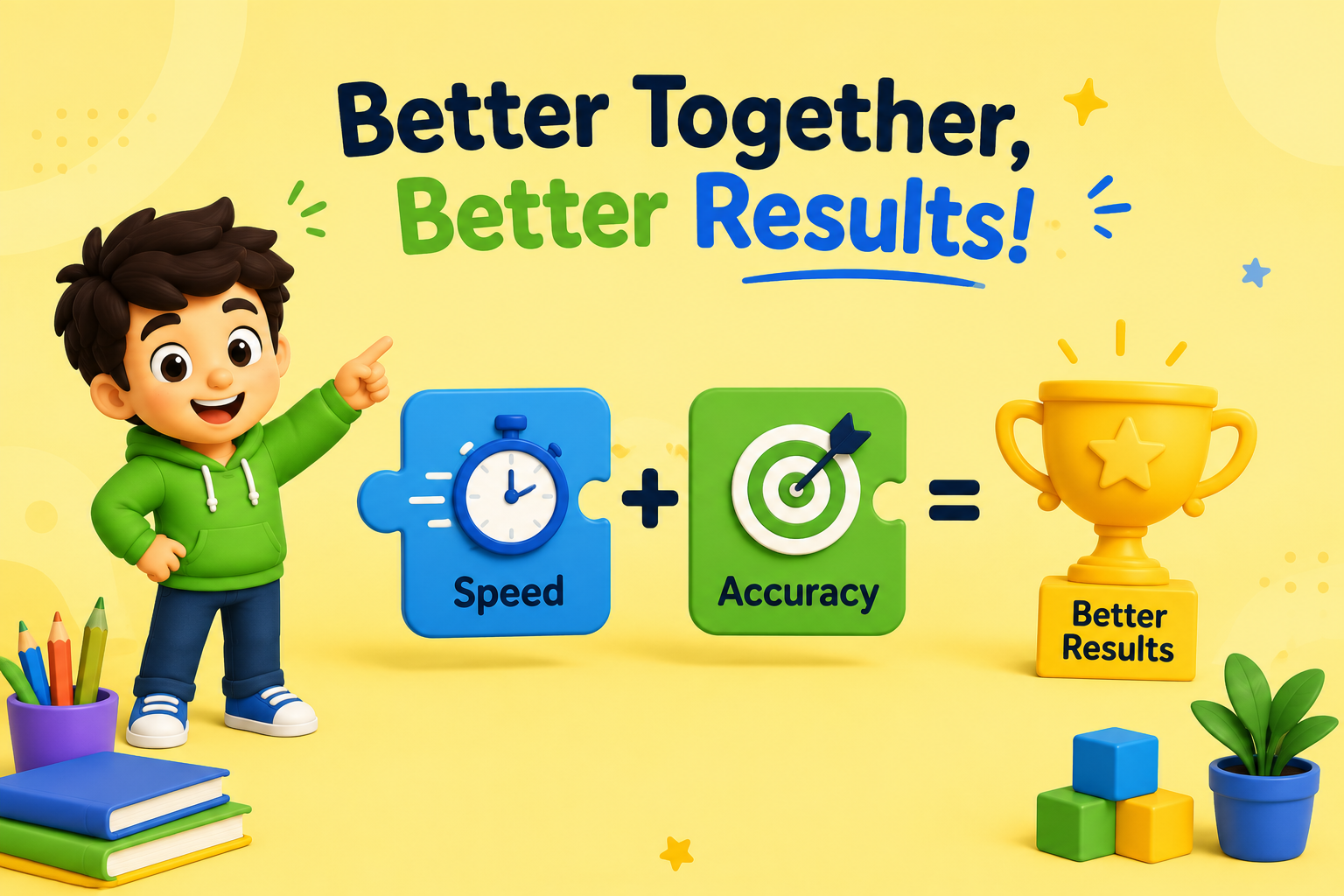
The insight at the heart of Math Pairs is simple but important: speed and accuracy aren't in tension. They're both products of the same thing fluency and fluency is what happens when recognition replaces calculation. Build recognition, and both speed and accuracy follow automatically. No trade-off. No compromise. Just fluency, arriving in both dimensions at once.
That's what Math Pairs builds. That's why it works. And that's why the improvement it produces shows up not just in faster round times and fewer errors inside the game but in a measurably different relationship with numbers outside it.
Find the pairs. Build the fluency. Watch what changes.