How Simon Sequence Trains Your Brain Without Feeling Like Homework!?
simon sequence brain training, what is simon sequence, simon game brain benefits, simon sequence working memory, simon sequence tips, how to get better at simon, memory sequence game, brain training without homework, simon electronic game history, sequential memory training, attentional control exercises, Calc Quest simon sequence, memory games for kids, cognitive training app, simon sequence for adults
There are very few things that genuinely train your brain and genuinely feel like fun at the same time. Simon Sequence is one of them.
Most brain training feels like what it is work dressed up in a thin disguise. You know you're supposed to be improving. You can feel the effort. And that self-consciousness about the process often gets in the way of the process itself.
Simon Sequence is different. It pulls you in through pure instinct the same drive that made the original Simon toy impossible to put down in the 1970s and by the time you realise your brain is being genuinely trained, it's already happened.
This is what's actually going on inside your brain when you play Simon Sequence and why it works so well precisely because it doesn't feel like it should.
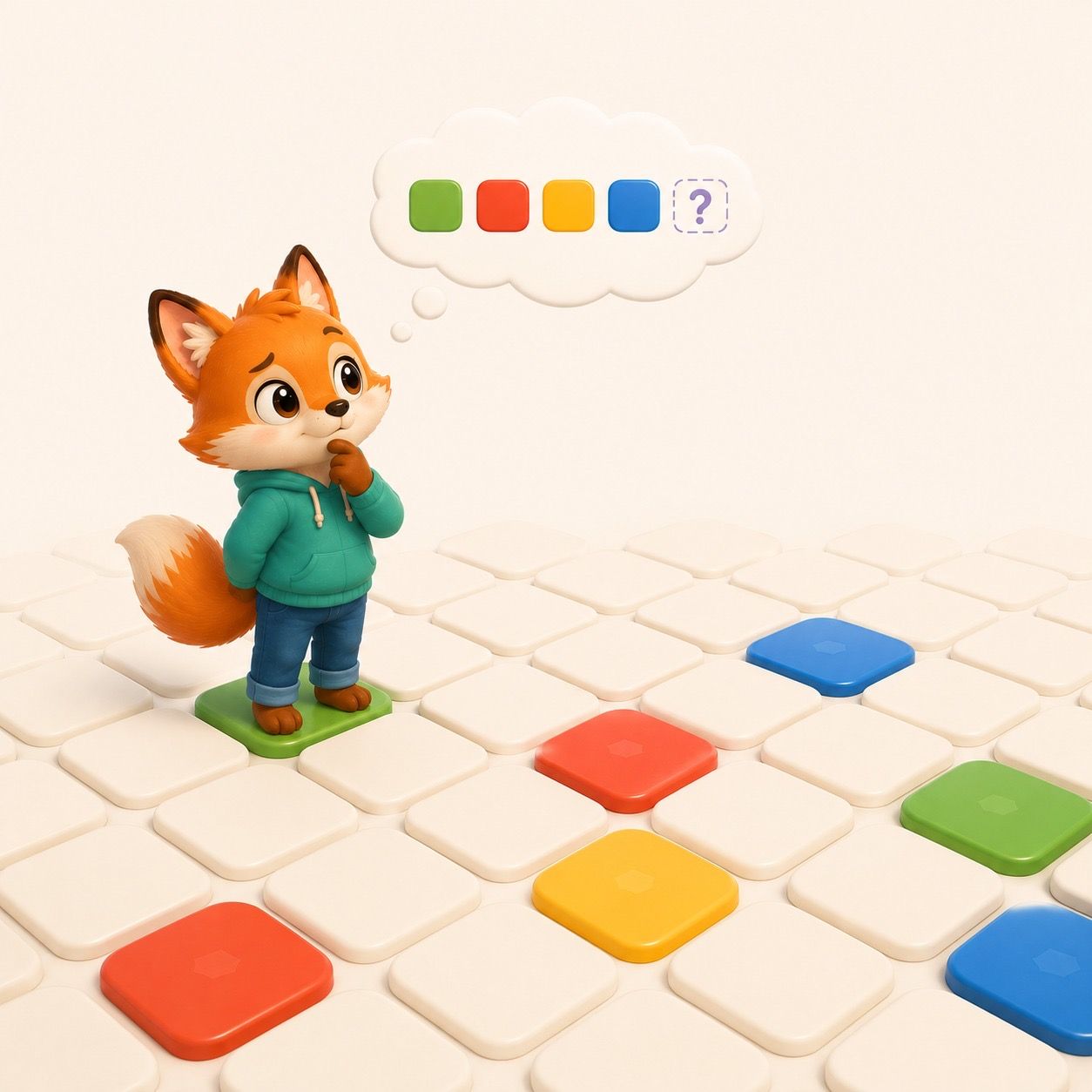
"The best brain training is the kind you forget is training. Simon Sequence has been doing this since before brain training was a category."
What Is Simon Sequence?
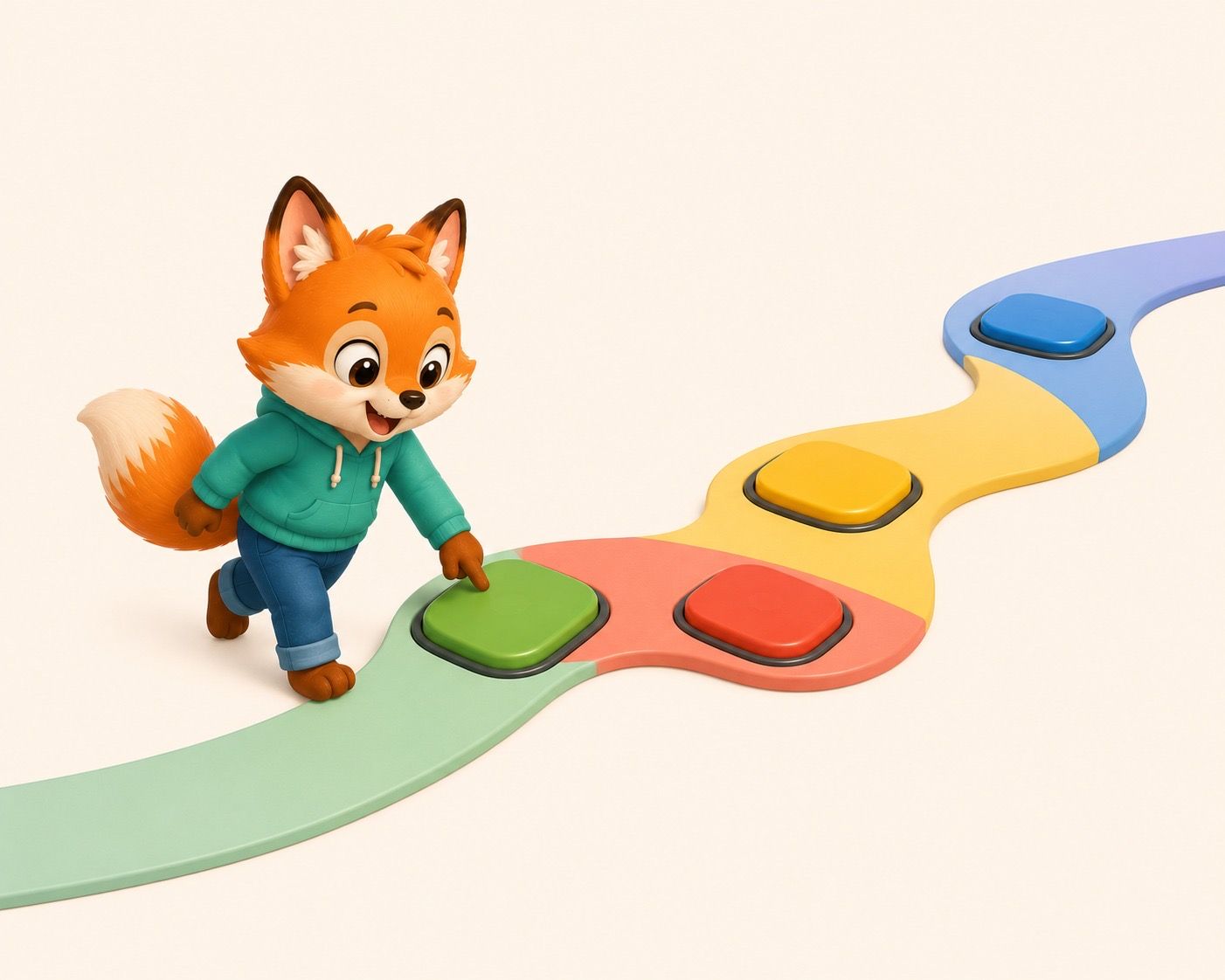
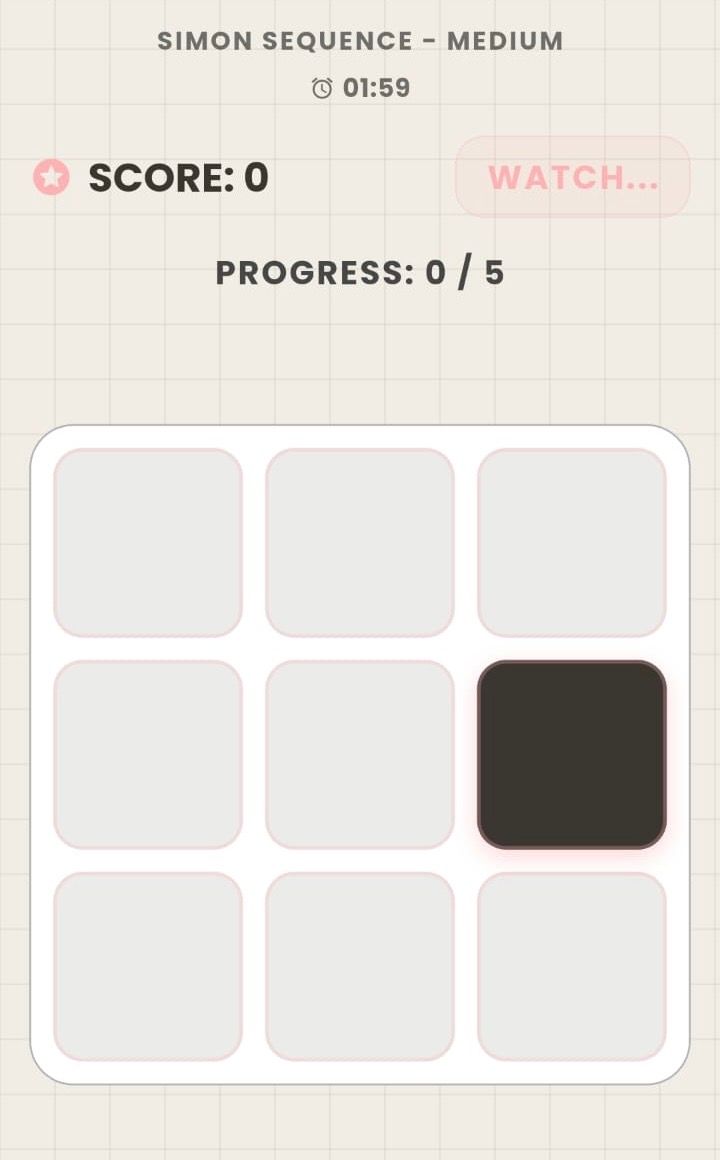
What it is: A sequence of colours, sounds, or patterns is shown to you one step at a time. After each step is added, you must repeat the entire sequence back from the beginning in the correct order. Each round adds one more element. The sequence grows. The challenge grows with it.
Where it comes from: Simon Sequence is based on the classic Simon electronic game, invented by Ralph Baer and Howard Morrison and released by Milton Bradley in 1978. It became one of the best-selling toys of its era not because it was marketed as educational, but because it was genuinely, almost compulsively fun. Players would sit with it for hours, pushing their sequence length further and further, driven by the same impulse that makes any personal best worth chasing.
The digital version inside Calc Quest carries that same essential quality. The rules haven't changed. The challenge hasn't changed. And neither has the particular satisfaction of extending your sequence by one more element than last time.
💡 The original Simon toy was inducted into the National Toy Hall of Fame not for its educational value, but for its cultural staying power. Forty-five years later, the format remains one of the most effective working memory challenges ever designed.
Why It Doesn't Feel Like Homework
The Goal Is Immediately Clear
One of the things that makes traditional brain training feel like work is ambiguity. You're told you'll improve memory or processing speed eventually, with consistent effort, over time. The benefit is abstract and distant.
Simon Sequence eliminates that ambiguity completely. The goal is right in front of you: remember one more element than last time. That's it. The feedback is instant, the target is personal, and the improvement is visible within a single session. There's no "trust the process" required you can see the process working in real time.
It Triggers the Same Drive as Any Good Game
Simon Sequence works on the brain's reward system in the same way any compelling game does. Each successfully recalled sequence releases a small dopamine reward. Each new element added to the sequence raises the stakes just enough to keep you engaged. And each near-miss remembering nine out of ten elements correctly before getting the tenth wrong produces exactly the kind of frustration that brings you straight back for another attempt.
Game designers call this the "almost" effect the feeling of being just one step from success is more motivating than success itself. Simon Sequence has this built into its very structure. You're always one element away from a new personal best. That proximity is what makes it so hard to stop.
"Simon Sequence is one of the few games where failure makes you want to play more, not less. That's not an accident it's the whole design."
There's No Studying, No Memorising, No Preparation
Homework requires preparation. It asks you to engage with material before the task, hold it in mind, and then apply it correctly. Simon Sequence requires none of this. You show up, the sequence starts, and your brain engages immediately and automatically.
There's no background reading. No rules to memorise. No strategy to prepare. Just a sequence appearing on screen and the immediate, instinctive challenge of matching it. That immediacy is a huge part of why it doesn't feel like work because the cognitive engagement happens before you've had time to think about whether you want to do it.
What Simon Sequence Is Actually Training
Sequential Working Memory
Sequential working memory is the ability to hold a series of items in mind and recall them in the correct order. It's distinct from general memory you're not just remembering that something happened, you're remembering what happened first, second, third, and in exactly what sequence.
This skill is used constantly in everyday life: following multi-step instructions, recalling the order of events in a conversation, keeping track of a process that has specific steps that must happen in sequence. Simon Sequence trains it directly not as a side effect, but as its entire purpose.
💡 Did you know? Sequential working memory is one of the strongest predictors of reading comprehension and mathematical reasoning in children. The ability to hold and process ordered information underlies both skills more deeply than most educational approaches recognise.
Sustained Attention
As the Simon Sequence grows longer, maintaining attention across the entire sequence becomes progressively harder. Your focus can't drift a single lapse anywhere in the sequence will cause you to lose the element at that position, which then breaks your recall of everything that follows.
That demand for sustained, unbroken attention across an increasingly long sequence is genuinely rigorous. And it's trainable. Players who practice Simon Sequence regularly report improvements in their ability to concentrate on extended tasks without losing the thread in work, study, and everyday conversation.
Auditory and Visual Processing Speed
Simon Sequence presents information quickly each element in the sequence appears briefly before the next one follows. Processing and encoding that information fast enough to retain it accurately is a processing speed challenge as much as a memory one.
Regular practice strengthens the speed at which your brain takes in, registers, and files visual and auditory information. Over time this improvement shows up not just in the game but in real-world situations that require quick, accurate perception following fast speech, reading efficiently, catching details in a busy environment.
The Ability to Recover From Distraction
One of the most underrated skills Simon Sequence builds is the ability to refocus quickly after a moment of distraction or doubt. Mid-sequence, it's very common to experience a flash of uncertainty "was that red or orange?" and the players who perform best are not the ones who never experience that doubt, but the ones who can set it aside and keep going without losing the rest of the sequence.
That recovery skill staying on task after a disruption is one of the most practically valuable cognitive skills in daily life, and it's almost never explicitly trained. Simon Sequence builds it as a natural consequence of the format.
💡 The ability to refocus quickly after distraction is closely linked to what researchers call "attentional control" one of the executive functions that underpins academic performance, professional effectiveness, and general cognitive resilience. Simon Sequence trains it through pure repetition without ever naming it.
How the Difficulty Builds
It Starts Effortlessly
In the early rounds two, three, four elements Simon Sequence feels almost passive. The sequence is short enough that you barely need to try. Your brain registers it automatically, recalls it automatically, and moves on. Most players feel slightly impatient at this stage. It feels too easy to be worth anything.
It isn't. Those early rounds are calibration. Your brain is learning the format, the pacing, and the mechanics of the task before the real challenge begins.
The Middle Range Is Where the Training Happens
Around seven to nine elements right at the upper edge of most people's natural working memory capacity the game shifts. Recall stops being automatic and starts requiring active effort. You find yourself encoding more deliberately, using strategies you didn't consciously choose, making small errors that reveal exactly where your attention slipped.
This range challenging enough to require effort, achievable enough to keep you trying is the zone where genuine cognitive improvement happens. Most of your sessions will be spent here, and that's exactly right.
The Advanced Levels Require Strategy
Beyond ten or twelve elements, raw memory is rarely enough. Players who consistently reach these levels have usually developed strategies grouping elements into chunks, using rhythm or pattern to anchor the sequence, mentally narrating the sequence as it plays. These strategies aren't cheating they're exactly the kind of higher-order memory techniques that transfer to other cognitively demanding tasks.
⭐ Fun fact: The world record for the longest Simon sequence recalled correctly stands at over 31 consecutive elements achieved through deliberate chunking and rhythm strategies rather than exceptional raw memory. The record demonstrates that Simon Sequence is ultimately a game of technique, not just talent.
Strategies That Actually Help
- Chunk the sequence into groups of three. Instead of trying to remember ten individual elements, remember three groups of three plus one. The brain handles grouped information far more efficiently than a long undifferentiated list and three-element chunks sit comfortably within working memory capacity.
- Use rhythm to anchor the sequence. Many experienced Simon players narrate the sequence rhythmically as it plays giving each element a beat or a syllable that creates a musical pattern rather than a list of items. Rhythmic encoding uses a different memory pathway from purely visual encoding, effectively doubling the storage.
- Focus harder on the newest element. The beginning of a sequence gets reviewed every round and becomes increasingly familiar. The newest element always added at the end gets only one exposure before you have to recall it. Train your attention to sharpen specifically when the new element appears.
- Don't tap too fast during recall. Speed during the recall phase increases error rate significantly. The game rewards accuracy, not pace take the extra half-second to confirm each element before tapping. Slower and correct beats faster and wrong every time.
- Treat each wrong answer as data. When you make an error, notice exactly where in the sequence it happened. Was it the newest element? Was it mid-sequence after a strong start? That information tells you precisely where your encoding broke down and where to direct your attention next time.
Who Benefits Most From Simon Sequence
Children: Simon Sequence builds sequential working memory and sustained attention two skills that directly underpin reading comprehension and mathematical reasoning. For children who find traditional memory exercises boring or stressful, it delivers the same cognitive benefit in a format that feels entirely like play.
Students: Sequential memory and attentional control are critical for exam performance following complex questions, holding multi-part problems in mind, maintaining focus under time pressure. Simon Sequence trains all three simultaneously, in sessions short enough to fit between study blocks.
Adults: In a world of constant distraction and fragmented attention, the ability to follow a sequence accurately and refocus after disruption is increasingly rare and increasingly valuable. Simon Sequence rebuilds that capacity systematically fifteen minutes at a time.
Anyone with a competitive streak: Simon Sequence has a personal best. That number your longest recalled sequence is a direct, unambiguous measure of your working memory performance. It goes up with practice. Watching it go up is one of the most satisfying forms of self-improvement available in a game format.
"Simon Sequence measures one thing precisely and improves it visibly. In a world full of vague self-improvement promises, that clarity is genuinely rare."
The Game That Trains Without Telling You
The reason Simon Sequence has endured for nearly five decades from a plastic toy with coloured buttons to a digital game inside a modern brain training app is that it solves the hardest problem in cognitive training: getting people to actually do it.
It doesn't ask you to believe in the process. It doesn't require discipline or motivation or a commitment to self-improvement. It just shows you a sequence, asks you to repeat it, and adds one more element. Your competitive instinct does the rest.
The training happens whether you're thinking about it or not. And that might be the most impressive thing about it.
"The best version of brain training is one you'd do even if it had no benefits. Simon Sequence is that and it has all the benefits too."
Your sequence is waiting. How far can you take it?