Math Games vs Traditional Practice: Which Is More Effective for Learning?
Are math games better than traditional practice? Explore the benefits, limitations and research behind both approaches to discover the most effective way to build math skills, confidence andlong-term learning.
The worksheet vs. the screen — and why the answer isn't as obvious as you think.
Picture two kids doing math for 20 minutes.
One has a worksheet rows of multiplication problems, a pencil, and a quiet desk. The other has a tablet, racing against a timer to defeat a "math monster" by solving problems correctly.
Which one is actually learning more?
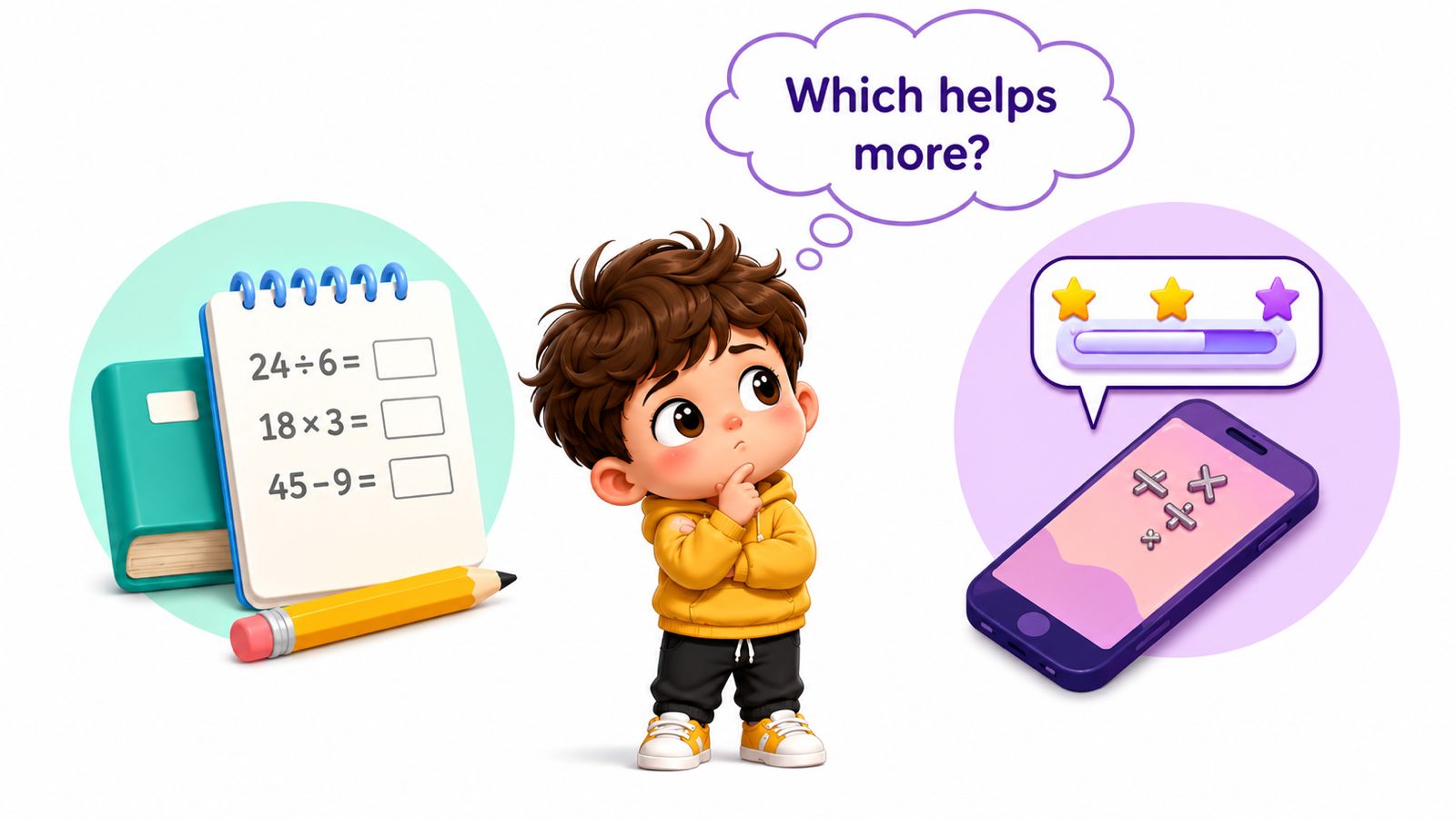
The honest answer: it depends on what "learning" means to you. Both approaches build real skills but they build different things, in different ways, and knowing the difference changes how you should think about practice.
"The best practice method isn't the one that feels productive. It's the one a kid actually wants to come back to tomorrow."
Round 1 — Traditional Practice
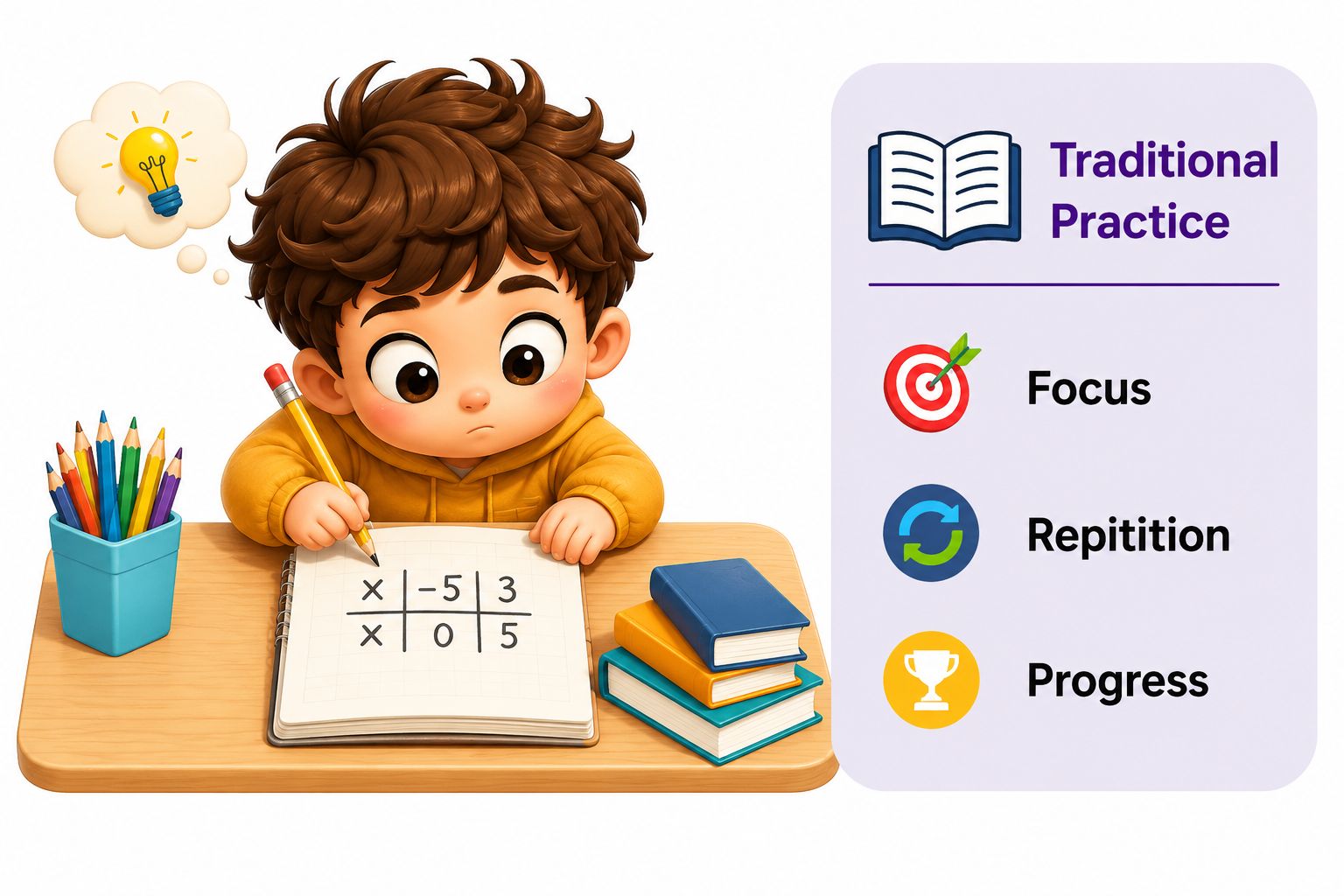
What it's good at
Traditional practice worksheets, textbooks, repetition drills has one major strength: depth. When a student works through 30 long-division problems in a row, they're not just practicing division. They're building stamina, attention to detail, and the ability to sit with a hard problem without giving up.
This is the kind of practice that builds what's sometimes called "math fluency" the ability to do calculations smoothly, without conscious effort, freeing up mental space for harder problem-solving later.
Where it struggles
The downside is just as well documented: motivation. Worksheets don't adapt. A student who's already mastered a concept still has to grind through 30 problems, and a student who's struggling gets the same 30 problems with no extra support.
There's also no immediate feedback loop. A student might do an entire page wrong before a teacher checks it by which point, the mistake has been practiced 20 times.
Did you know? Studies on "desirable difficulty" show that repetition does build long-term retention but only when the learner stays engaged. Disengaged repetition barely improves memory at all.
Round 2 — Math Games
What they're good at
Math games flip the traditional model. Instead of "do 30 problems," the goal becomes "beat this level," "unlock the next world," or "beat your previous score." The math is still there but it's wrapped in something the brain finds rewarding on its own.
This matters more than it sounds. Game-based learning typically includes:
- Instant feedback — you know immediately if you're right or wron
- Adaptive difficulty — problems adjust to your skill level in real time
- Built-in motivation — points, streaks, and levels create a reason to continue
- Low-stakes failure — getting something wrong just means "try again," not "you failed"
That last point is bigger than it seems. In traditional practice, a wrong answer often feels like a mark against you. In a game, a wrong answer is just part of the loop you try again immediately, with no shame attached. That changes how students relate to mistakes entirely.
Where they struggle
The criticism most often leveled at math games is that they can prioritize speed and points over depth. A student might get very good at quick mental arithmetic in a game format, but struggle to apply that same skill to a multi-step word problem that requires sustained focus.
There's also a risk of "gaming the game" figuring out shortcuts that earn points without actually engaging with the math. A well-designed game minimizes this, but it's a real design challenge.
🎮 Did you know? Research on educational games consistently shows higher engagement and time-on-task compared to traditional homework — students often choose to spend more time on math games voluntarily, which traditional worksheets rarely achieve.
So... Which One Actually Wins?

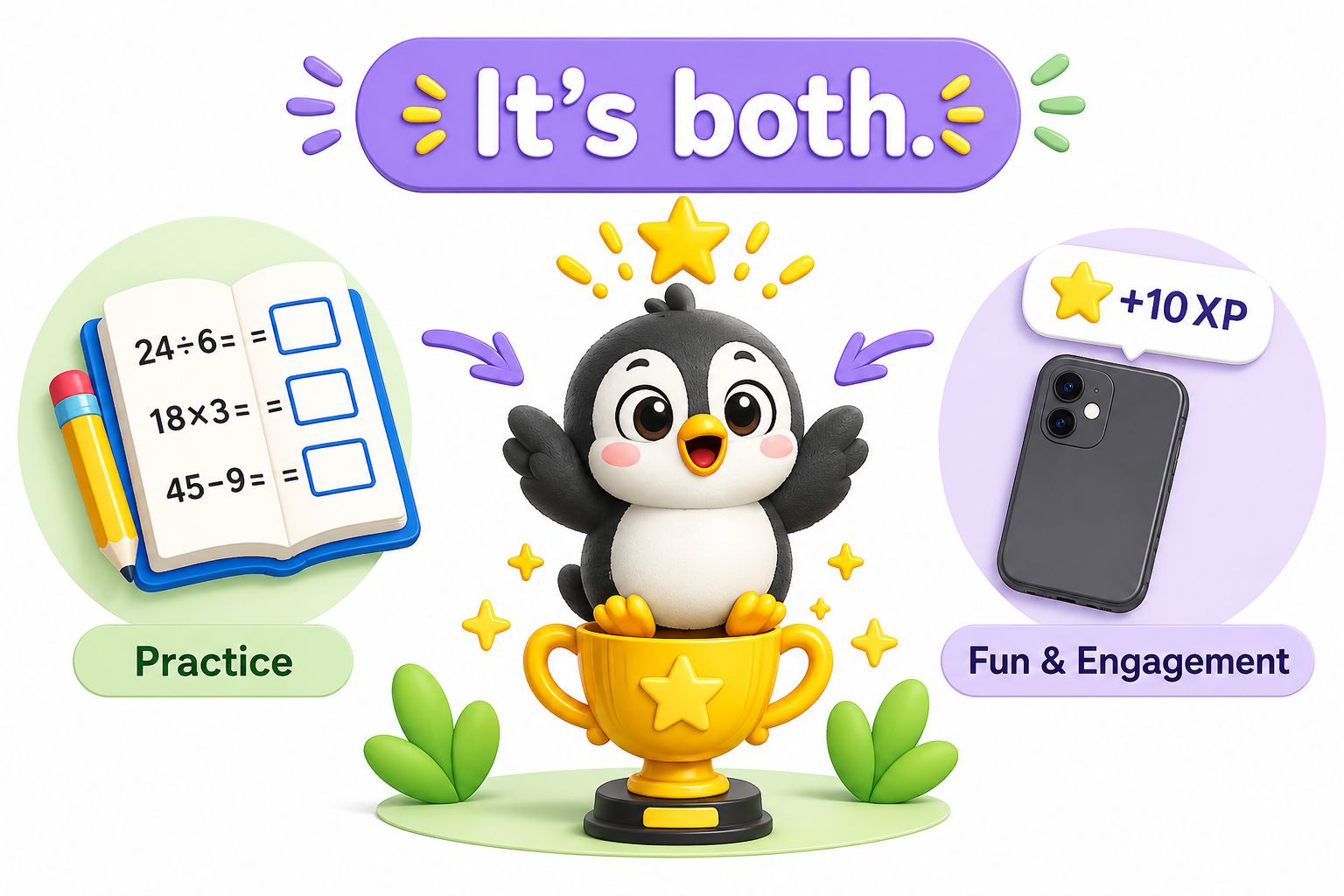
Here's the thing: this isn't really a competition. The research consistently points toward combination, not replacement.
Traditional practice builds the deep, fluent foundation the "muscle memory" of math. Games build the motivation, engagement, and willingness to keep practicing in the first place. One without the other tends to fall short:
- Only traditional practice → strong fundamentals, but often low motivation and math anxiety
- Only games → high engagement, but can lack depth and transfer to harder problems
- Both, combined → fluency built through games, reinforced and extended through deeper practice
Think of it like physical fitness. A structured workout plan (traditional practice) builds strength and consistency. A fun sport (games) keeps you coming back and makes movement feel less like a chore. The people who stay fittest long-term usually do both — and the same is true for math.
"Games don't replace practice. They make you want to practice — and that's the part most learning methods get wrong."
What This Means for How You Practice
If you're a student, parent, or teacher trying to decide where to spend practice time, here's a simple way to think about it:
- Use games to build the habit. If math practice feels like a chore, a game-based format removes that friction. Five minutes a day, voluntarily, beats thirty minutes a week under protest.
- Use traditional practice to go deeper. Once a concept feels comfortable in a game, working through a few "real" problems multi-step, written out helps cement that it transfers beyond the screen.
- Let speed and depth take turns. Quick, timed games are great for building recall and confidence. Slower, untimed problems are great for building reasoning. Both matter just not at the same moment.
⭐ Fun fact: Many top-performing math students report that games were what first made math "click" for them emotionally — even if their formal skills were ultimately built through a mix of methods.
The Real Answer
"Which is more effective?" is the wrong question. The right question is: which one will you actually do consistently?
A perfect practice method that nobody wants to use loses to an imperfect one that gets done every day. Games close that gap they make the "boring but necessary" part of learning feel less boring, without removing the necessary part.
That's the whole idea behind Calc Quest: timed, game-based challenges that build real mental math skill the kind that's fast, intuitive, and actually sticks, because you'll want to come back and play again tomorrow.