Math Grid Strategies Every Beginner Should Know
math grid strategies for beginners, how to solve grid puzzles, sudoku strategies for beginners, logic puzzle tips, puzzle solving strategies, how to get better at puzzles, grid puzzle techniques, beginner puzzle guide, constraint solving strategies, elimination strategy puzzles, forced placement sudoku, how to stop guessing in puzzles, Calc Quest puzzle tips, backtracking puzzles, logic grid puzzle guide
Most beginners approach math grid puzzles the same way and most beginners get stuck the same way. Here's what to do differently.
Math grid puzzles Sudoku, Binairo, KenKen, Shikaku, Number Pyramids, Magic Triangles all look different on the surface. Different shapes, different symbols, different rules. But underneath the surface differences, experienced solvers use a remarkably consistent set of strategic principles that work across all of them.
These principles aren't secret. They're not advanced techniques reserved for expert players. They're foundational strategies that beginners can learn immediately and that will make every grid puzzle they attempt from this point forward more approachable, more enjoyable, and more solvable.
This post covers the most important ones. Learn them once. Apply them everywhere.
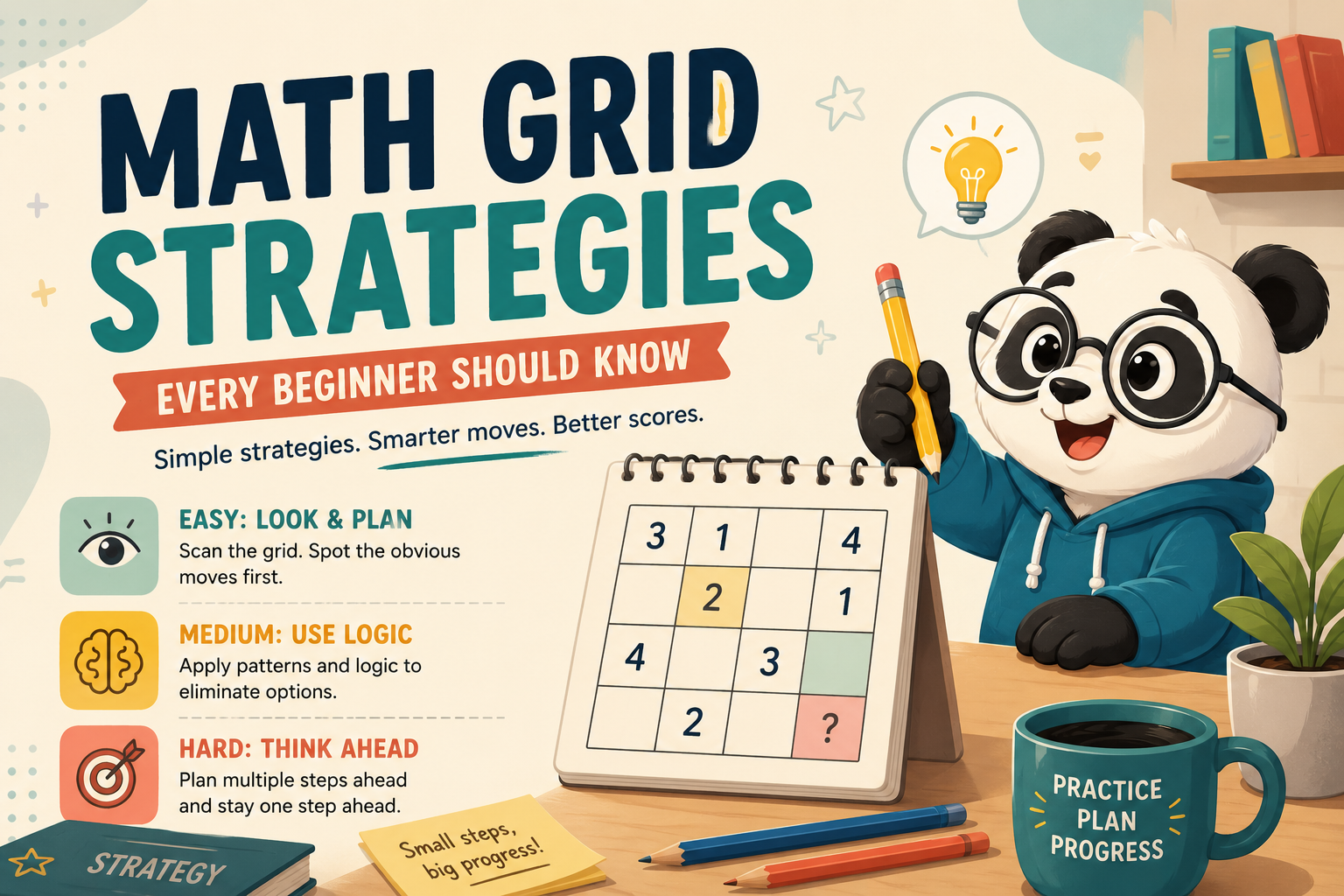
"The difference between a beginner who gets stuck and an experienced player who doesn't isn't puzzle-specific knowledge. It's a small set of transferable strategies that nobody thought to explain at the start."
Strategy 1 - Start With the Most Constrained Position
This is the single most important strategy in grid puzzle solving and the one most beginners skip. Instead of starting wherever feels natural or convenient, always start with the position that has the fewest valid options.
In Sudoku, that means finding the cell where only one or two numbers could possibly fit. In Shikaku, it means finding the number with the fewest possible rectangle shapes. In Binairo, it means finding the row or column closest to its quota of zeros and ones. In KenKen, it means finding the cage with the fewest valid number combinations.
The reason this strategy is so powerful is simple: fewer options means more certainty. And certainty knowing what must go somewhere is the resource that unlocks everything else. Every confirmed placement generates new constraints on the positions around it, which reveals the next most constrained position, which generates more placements, and so on.
The whole puzzle opens from the most constrained position. Starting there isn't just more efficient it's how the logic is supposed to flow.
💡 The "most constrained first" principle is also called the "Minimum Remaining Values" heuristic in computer science it's the same logic used by constraint-solving algorithms in artificial intelligence. When computers solve Sudoku, they start here too. It's the optimal strategy regardless of whether the solver is human or machine.
Strategy 2 - Eliminate Before You Place
Beginners tend to ask: "What can I put here?" Experienced solvers ask: "What can I eliminate here?" That shift in question is more important than it sounds.
Elimination is faster, more reliable, and more productive than searching for valid options from scratch. When you eliminate options from a position, you're narrowing the field systematically and systematic narrowing almost always reveals the answer faster than positive searching does.
In Sudoku: look at what numbers already exist in a cell's row, column, and box. Eliminate those. What remains is the valid set. In Binairo: look at how many zeros and ones a row already has and what the three-in-a-row rule rules out. What remains is valid. In Magic Triangles: calculate which numbers can't go in the corners given the corner sum formula. What remains are your candidates.
Every puzzle format has a set of elimination tools built into its rules. Learning to apply them aggressively and immediately before attempting any placement is what separates solvers who make steady progress from those who place numbers hopefully and then backtrack repeatedly.
"Ask not what can go here ask what cannot. The answer to the second question almost always tells you the answer to the first."
Strategy 3 - Work in Both Directions
Almost every math grid puzzle can be approached from multiple directions and most beginners only use one. They work left to right. They work top to bottom. They solve rows and ignore columns. They progress through a puzzle linearly when the puzzle is actually a network.
Experienced solvers constantly switch perspectives. A cell that's unconstrained when viewed from its row might be immediately forced when viewed from its column. A region that looks open horizontally might be almost complete vertically. The information hidden in one direction is often exactly what you need to make progress in the other.
In Number Pyramids: work bottom-up when you have the base, and top-down when you have the peak. In Nonograms: alternate between solving rows and solving columns each direction generates new information for the other. In Sudoku: don't just scan rows scan columns and boxes separately. Each perspective reveals different constraints.
The habit of switching directions of treating the puzzle as a multi-dimensional object rather than a left-to-right sequence is one of the most impactful changes a beginner can make. It doesn't require any additional knowledge. It just requires looking at the same puzzle from more than one angle.
💡 In logic, the principle of working in multiple directions is called "bidirectional reasoning" using both forward inference (what follows from what I know?) and backward inference (what must be true for this to be correct?) simultaneously. The most efficient puzzle solvers do both constantly, often without consciously distinguishing between them.
Strategy 4 - Use Forced Placements Immediately
A forced placement is a position where only one option is valid where the rules of the puzzle, applied to the current state of the grid, leave exactly one possible answer. Forced placements are the free moves of puzzle solving. They require no creative thinking, no uncertainty, no risk. They're guaranteed correct by the rules themselves.
The mistake most beginners make is not using them immediately. They spot a forced placement, note it mentally, and continue scanning planning to come back to it. By the time they return, the chain of consequences that forced placement would have unlocked has gone unfollowed, and the puzzle feels harder than it should.
The rule is simple: when you find a forced placement, fill it in immediately. Then scan for any new forced placements its addition has created. Fill those in immediately too. This chain of forced placements each one unlocking the next is the engine that drives most grid puzzle solutions forward. Following it without interruption is what keeps the momentum going.
"Forced placements are the puzzle's gift to you. Every time you find one, you're not solving you're collecting. Collect immediately. Then look for what the collection unlocked."
Strategy 5 - Track the Global State, Not Just the Local Cell
Beginners focus on the cell they're currently trying to fill. Experienced solvers keep one eye on the global state of the entire grid the running balance of each row and column, the constraints that span the whole puzzle, the patterns emerging across multiple regions simultaneously.
This global awareness is what allows experienced solvers to spot opportunities that local focus misses entirely. In Binairo: knowing that a row already has its full quota of zeros means every remaining cell in that row is forced even if no individual cell has been examined yet. In Sudoku: knowing that a number can only appear in one row of a particular box forces its position within that row a deduction that requires seeing the box globally, not cell by cell.
Building global awareness is simple in practice: keep a running count of relevant values in every row and column as you place. Update it with every placement. Refer to it before examining any individual cell. This habit transforms your solving from local guesswork into grid-wide logical deduction and it's what makes the "aha" moments in puzzle solving arrive consistently rather than occasionally.
💡 Chess players develop a similar habit called "board vision" the ability to perceive the state of the entire board rather than focusing narrowly on one piece or one threat. In grid puzzles, global awareness is the equivalent skill. It develops the same way: through deliberate practice of keeping the whole picture in mind while examining any one part of it.
Strategy 6 - When Stuck, Look for the Hidden Constraint
Every grid puzzle no matter how stuck it feels contains a next move. It's always there. The puzzle guarantees it. When you can't find it, the problem isn't that the move doesn't exist it's that you haven't applied a constraint you're already aware of.
When genuinely stuck, work through this checklist systematically:
- Have I applied the three-in-a-row rule to every pair of consecutive identical symbols? (Binairo, Tango)
- Have I checked every row and column for balance quotas being met? (Binairo, Tango, Sudoku)
- Have I looked at every cage from both the cage rule and the no-repeat rule simultaneously? (KenKen, Sudoku)
- Have I checked which cells would be forced if I applied a constraint I normally use only locally globally?
- Have I tried looking at the puzzle from a column perspective when I've been solving rows, or vice versa?
- Have I checked whether any two rows or columns are close enough to identical that the uniqueness rule is forcing something? (Binairo, Sudoku)
In nearly every case of genuine stuckness, one of these checks reveals the hidden move. The puzzle isn't harder than it was you just hadn't applied a rule you already knew to the position you were examining. Systematic checking is the antidote to feeling stuck.
"Stuck doesn't mean the puzzle is unsolvable. It means the next move is hiding behind a constraint you haven't applied yet. The checklist finds it every time."
Strategy 7 - Backtrack Cleanly and Early
Every experienced puzzle solver backtracks. Not occasionally regularly. Backtracking isn't a sign of failure or poor solving. It's a fundamental part of the logical process the moment when a chain of reasoning reveals itself to be incorrect, and the solver returns to the decision that started it.
The key skill isn't avoiding the need to backtrack it's doing it cleanly and early. Clean backtracking means knowing exactly which placement triggered the contradiction and removing it precisely, without disturbing the rest of the grid. Early backtracking means recognising the signs of an approaching dead end before it fully closes off when a region is down to one option that looks wrong, or when two constraints are about to conflict and reversing before the consequences compound.
Late backtracking returning to an error only after it has cascaded through five subsequent placements is painful, confusing, and discouraging. Early backtracking catching the error after one or two steps is clean, informative, and fast. The difference between them is the habit of monitoring the grid for early warning signs rather than only checking for contradictions when they become unavoidable.
💡 The logical method behind backtracking in puzzles is identical to the "proof by contradiction" technique used in formal mathematics. You assume something is true, follow the logical consequences, and when a contradiction emerges, you conclude the assumption was false. Puzzles teach this foundational logical technique in the most intuitive, practical form available.
Strategy 8 - Build the Habit of Checking
The single habit that most consistently separates improving puzzle solvers from stagnating ones is the checking habit the practice of verifying each placement against all relevant rules before moving on, rather than placing quickly and hoping for the best.
Checking feels slow. It feels like it's interrupting momentum. But the time spent checking a placement is almost always less than the time spent backtracking from a wrong one especially when that wrong placement has generated several subsequent placements before the error surfaces.
In practice, the checking habit looks like this: after every placement, ask three questions. Does this placement satisfy the local rule? Does it maintain the global balance? Does it avoid creating a contradiction in any adjacent region? If all three answers are yes move on. If any answer is uncertain investigate before proceeding.
This three-question check takes about three seconds. The backtracking it prevents regularly takes three minutes. The arithmetic is straightforward: checking is always faster than not checking.
"Speed in puzzle solving doesn't come from placing faster. It comes from placing correctly which requires checking before placing. The three-second check is the fastest move in the game."
How These Strategies Work Together
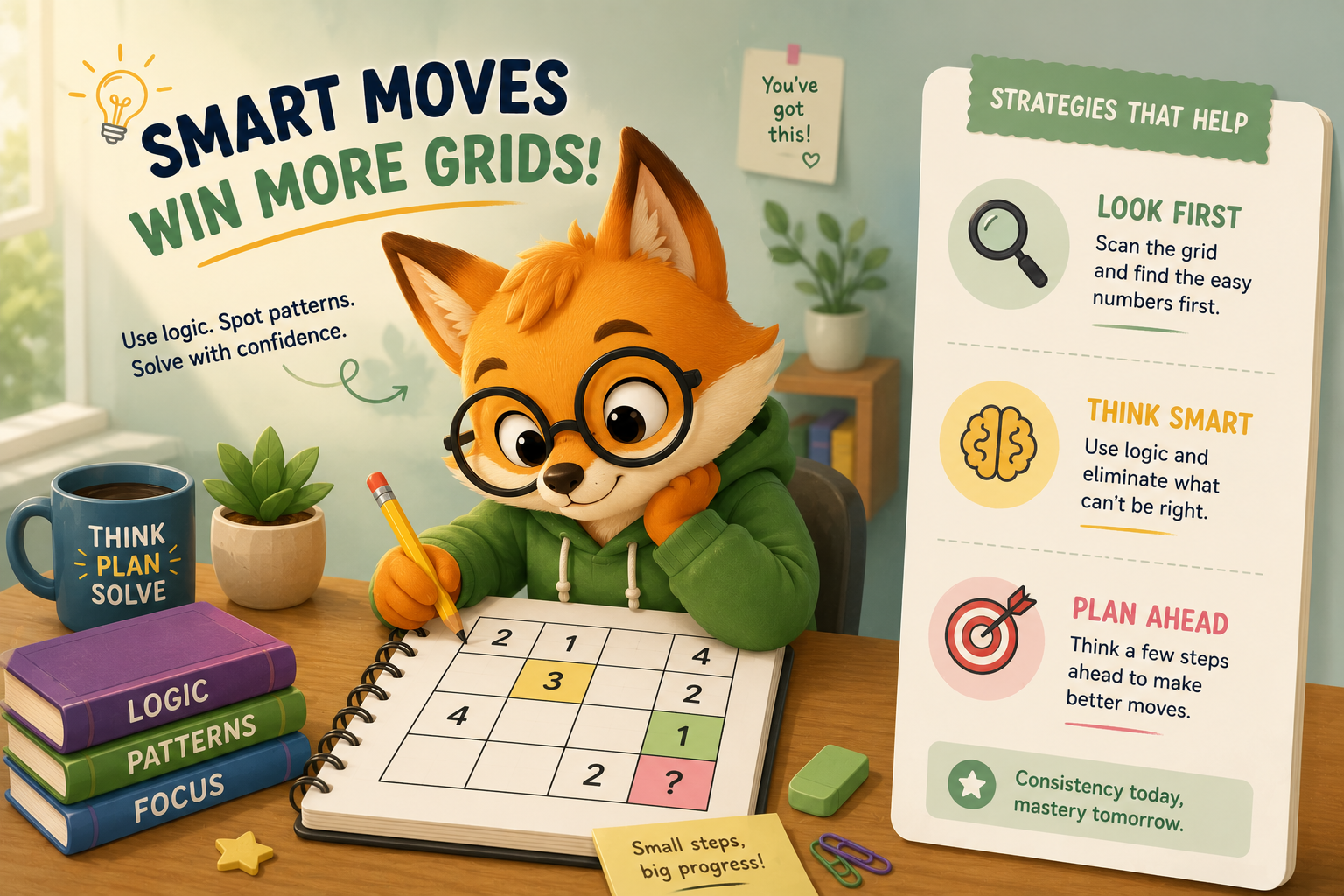
These eight strategies aren't independent techniques to deploy one at a time. They work together as a system a natural sequence that experienced solvers follow without consciously thinking through each step.
- Scan the whole grid to identify the most constrained position (Strategy 1)
- Apply elimination to that position to find valid options (Strategy 2)
- Check both row and column perspectives before placing (Strategy 3)
- Fill in any forced placements immediately and chain them (Strategy 4)
- Update the global count and balance after each placement (Strategy 5)
- When stuck, run the hidden constraint checklist (Strategy 6)
- Backtrack cleanly and early when a contradiction appears (Strategy 7)
- Check every placement against local and global rules before moving on (Strategy 8)
This sequence scan, eliminate, shift perspective, force, track, check, backtrack when needed is the underlying logic of every effective grid puzzle solve. It looks different in Sudoku than in Binairo than in Shikaku but the same eight principles are operating in every case.
⭐ Fun fact: The strategies described above were independently discovered by puzzle enthusiasts across different countries and different puzzle formats and then found to be the same when puzzle communities began comparing notes. That convergence is evidence that they're not arbitrary techniques but genuine logical principles that the structure of grid puzzles makes inevitable.
Putting the Strategies Into Practice
The fastest way to internalise these strategies is to apply them deliberately and consciously in your next few sessions even if it slows you down initially. Naming the strategy as you use it ("I'm starting with the most constrained cell"; "I'm eliminating before I place") helps embed it as a habit faster than applying it silently.
After five or ten sessions of conscious application, most of these strategies will start to feel automatic. You'll find yourself scanning for the most constrained position without deciding to, eliminating options before you consciously frame the question, and checking placements as a reflex rather than a deliberate step.
That automaticity is the goal. When the strategies become invisible when they're just how you solve rather than techniques you're applying you've completed the transition from beginner to intermediate solver. And the puzzles will feel fundamentally different as a result.
"Strategy is most valuable when it disappears when it stops being something you consciously apply and becomes simply the way you think. That transition is what the practice is for."
Pick up the next grid puzzle. Apply the first strategy you remember. The rest will follow.