Mental Arithmetic: The Skill That Makes Everyday Math Effortless
why mental arithmetic matters, mental math benefits, how to improve mental arithmetic, mental math tricks, mental arithmetic practice, benefits of doing math in your head, mental math for adults, number fluency, mental arithmetic exercises, math anxiety and mental math, working memory and mental math, mental math habits, Calc Quest mental math, daily mental math practice, mental arithmetic skills
Calculators are everywhere. So why does mental arithmetic still matter?
Your phone can calculate any sum in under a second. Your shopping app shows the total before you reach the till. Your bank statement does the math so you don't have to. By almost every practical measure, the calculator has won.
And yet something important gets lost when we stop doing arithmetic in our heads entirely. Not the ability to get answers machines are better at that than we'll ever be. Something more fundamental: the ability to think with numbers, not just read them.
Mental arithmetic was never really about calculation. It was always about thinking. And in a world where the calculations are handled for us, the thinking part matters more than ever.
"A calculator gives you the answer. Mental arithmetic gives you the understanding. Those are not the same thing and only one of them makes you smarter."
What Mental Arithmetic Actually Is
Mental arithmetic is solving mathematical problems entirely in your head no paper, no phone, no writing it down. Not because you're showing off, but because your brain has developed enough fluency with numbers to process them directly.
The examples are everywhere in daily life:
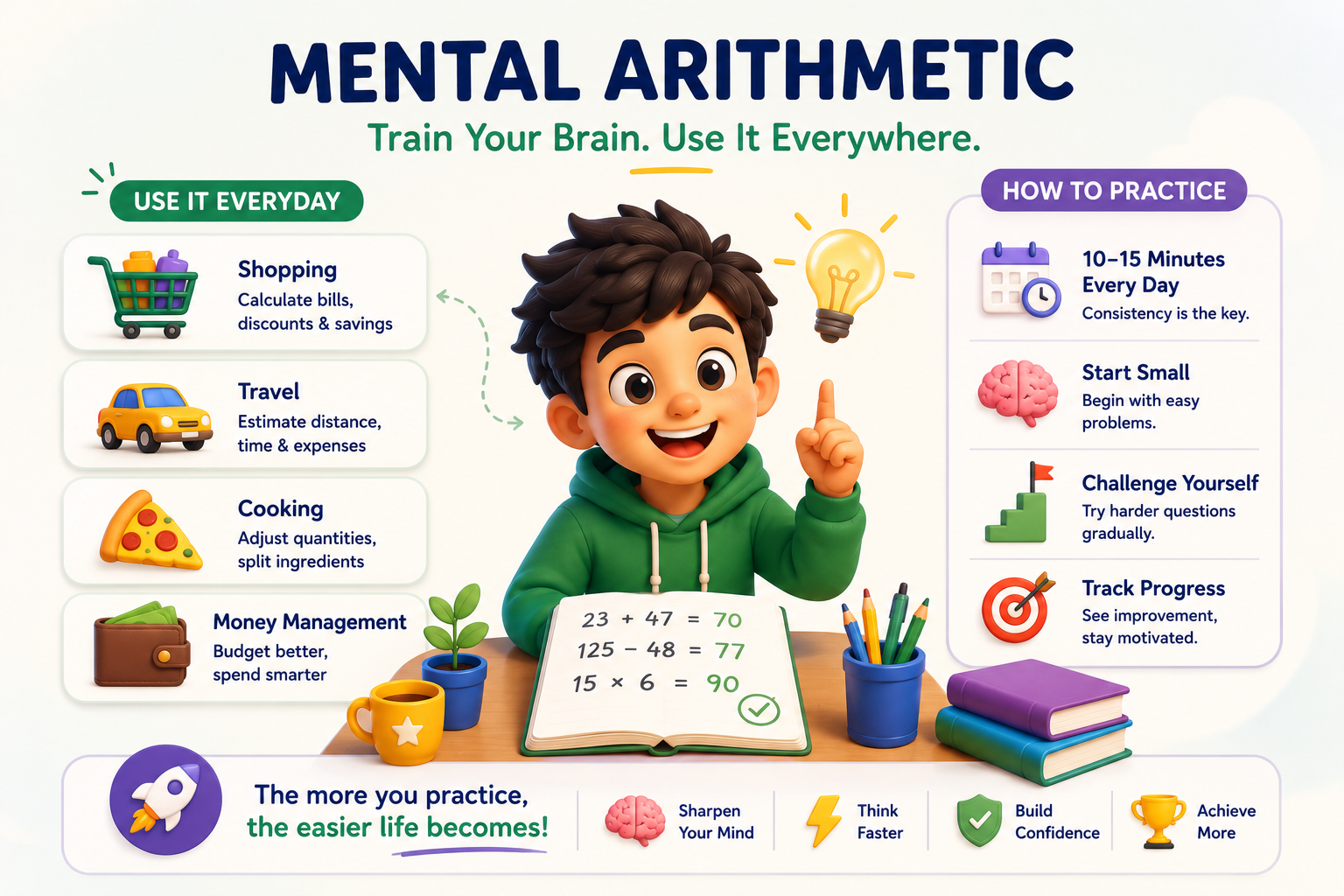
- Splitting a restaurant bill between four people
- Checking whether a "30% off" price actually matches what the tag says
- Estimating whether your shopping basket is approaching your budges
- Working out how long a journey will take at a given speed
- Calculating a tip without reaching for your phone
None of these require remarkable mathematical talent. They require number fluency a comfort with arithmetic that comes from practice, not genius. And that fluency is built through mental math, not through relying on a calculator every time a number appears.
💡 Number fluency isn't the same as being "good at math." It's the ability to work with numbers comfortably and confidently in everyday situations and it's something anyone can build at any age.
What You're Actually Training When You Do Mental Math
Working Memory
When you solve 98 + 47 in your head, you're not just adding. You're holding the first number in mind while processing the second, tracking a partial result, and then combining everything into a final answer all without losing any piece along the way. That's working memory in action.
Working memory is the mental scratchpad your brain uses for almost everything: following conversations, learning new skills, reading complex sentences, making multi-step decisions. Every mental arithmetic session strengthens it and that strengthening carries across every other cognitive task that relies on it.
Processing Speed
The more you practice mental arithmetic, the faster your brain routes through familiar number relationships. What started as a conscious calculation "25 × 4, let me think..." becomes an automatic recognition: "100." That shift from calculation to recognition is processing speed improving in real time.
Faster processing doesn't just help with math. It shows up as quicker thinking in conversations, faster pattern recognition in problems, and sharper reaction to new information in any context.
Pattern Recognition
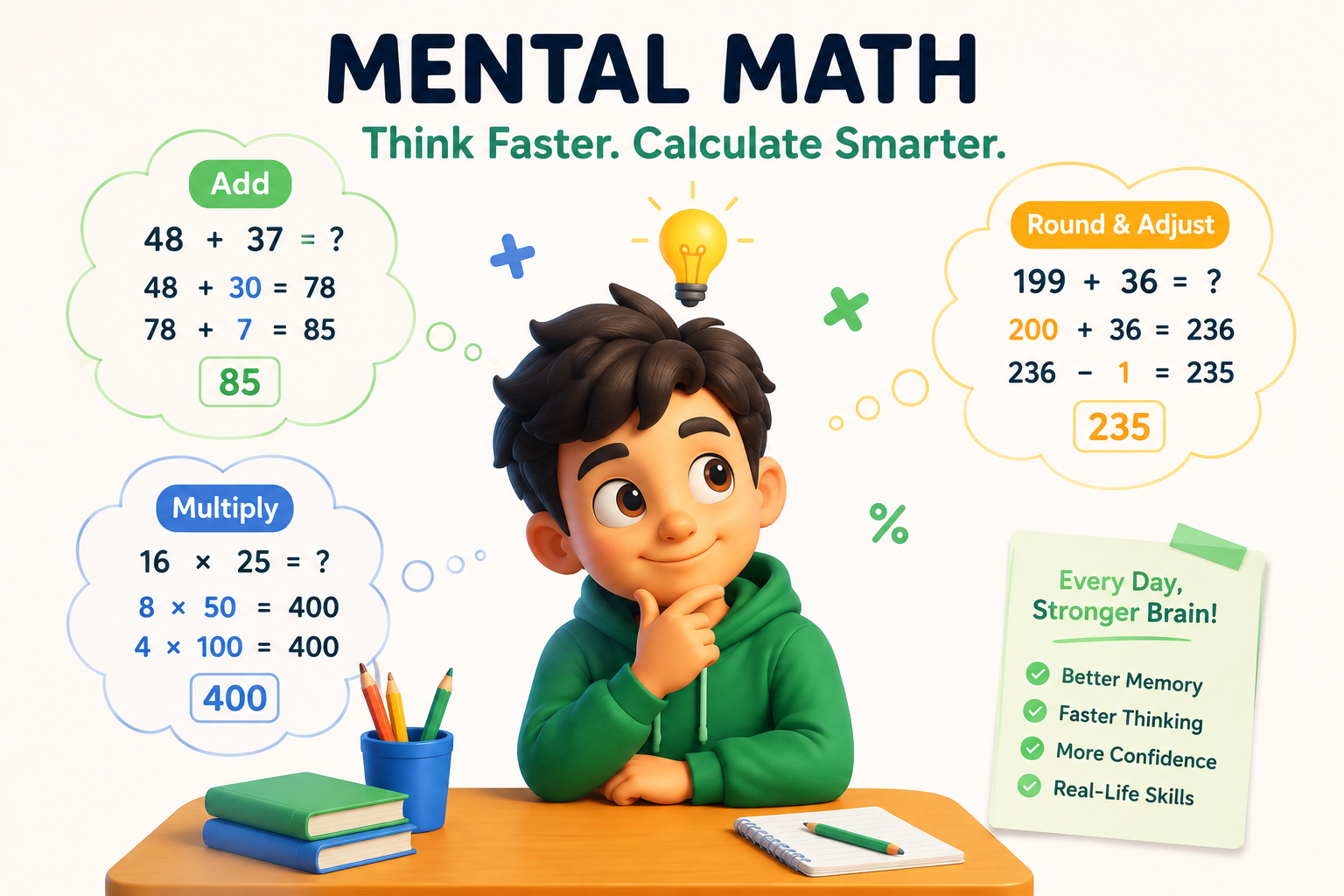
Mental arithmetic teaches you to see the structure of numbers rather than just their surface values. You stop seeing 48 + 37 as two numbers to add and start seeing it as 50 + 35 a friendlier form of the same problem that's easier to process. You stop seeing 199 × 3 as a column calculation and start seeing it as 200 × 3 − 3.
That ability to reframe problems to find the easier version of what's in front of you is pattern recognition. And it transfers far beyond arithmetic into logical reasoning, problem solving, and strategic thinking across every domain.
Confidence With Numbers
This one is underrated. A large number of adults carry quiet anxiety around numbers not because they're incapable, but because they never built the fluency that makes numbers feel manageable. Every time they reach for a calculator for a calculation they feel they should be able to do, that anxiety quietly deepens.
Regular mental arithmetic practice reverses this. Not dramatically or overnight but consistently. Each calculation you handle independently is a small piece of evidence that numbers aren't something to avoid. That evidence accumulates. The confidence it builds is real and lasting.
"Math anxiety almost never comes from genuine inability. It comes from lack of practice and the only thing that reliably resolves it is the thing it tells you to avoid. Mental math is the antidote to math anxiety."
Six Mental Math Tricks Worth Learning Today
These aren't shortcuts that skip the thinking they're smarter ways to think. Each one works because it uses a mathematical property that was always there. Once you see it, you'll use it automatically.
Trick 1 - Break Numbers Apart
Instead of adding two numbers directly, split the second number into round parts and add them one at a time.
48 + 37 → 48 + 30 = 78 → 78 + 7 = 85 ✓
Your brain handles round numbers effortlessly. Breaking non-round numbers into round components plus a remainder turns one hard step into two easy ones.
Trick 2 - Round Then Adjust
When a number is close to a round figure, use the round figure and correct the difference afterward.
199 + 36 → 200 + 36 = 236 → 236 − 1 = 235 ✓
This works for subtraction too. 301 − 48 becomes 300 − 48 + 1 = 253. The adjustment is always small. The calculation becomes dramatically easier.
Trick 3 - Double and Halve
When multiplying, you can double one number and halve the other without changing the result and keep going until the calculation becomes trivial.
16 × 25 → 8 × 50 → 4 × 100 → 400 ✓
This works because doubling and halving are inverse operations the product stays constant. It's especially powerful when one of the numbers can be quickly reduced to something round.
Trick 4 - The Percentage Flip
Percentages are commutative 4% of 75 gives the same result as 75% of 4. When one direction is hard, flip it and try the other.
4% of 75 → hard to see immediately 75% of 4 → three-quarters of 4 = 3 ✓
This trick is surprisingly powerful and almost nobody knows it. Any time a percentage calculation feels awkward, ask whether the flipped version is easier. It often is.
Trick 5 - Split the Percentage
For any percentage, find 10% first just move the decimal point then build from there.
15% of 200 → 10% = 20 → 5% = 10 (half of 10%) → 20 + 10 = 30 ✓
Need 35%? That's 30% + 5%. Need 17.5%? That's 10% + 5% + 2.5%. Percentages become modular once you see them as building blocks rather than fixed formulas.
Trick 6 - Use the Nearest Round Number for Multiplication
When multiplying by a number close to a round figure, use the round figure and subtract the correction.
47 × 99 → 47 × 100 = 4,700 → 4,700 − 47 = 4,653 ✓
The same logic works for 98, 999, 1,000 minus one any number one step away from something easy. One subtraction replaces an entire column multiplication.
How to Actually Build the Habit
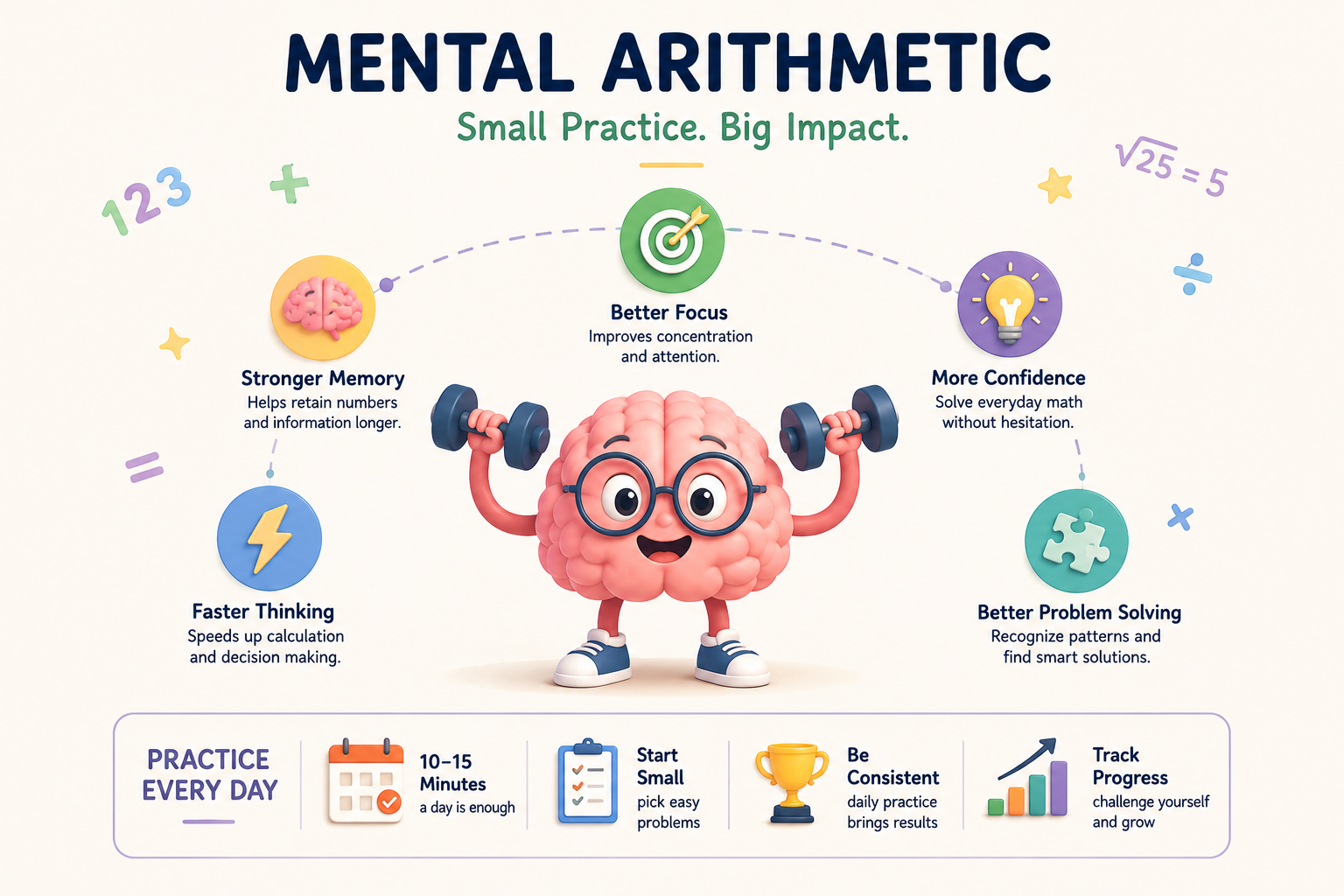
Knowing the tricks isn't enough. Mental arithmetic is a physical skill as much as an intellectual one it improves through repetition, not through understanding alone. You have to practice.
The good news is that the practice doesn't need to be painful or time-consuming. Here's what actually works:
- Do it in real life, not just in practice sessions. Every time you reach for your phone to calculate something simple, try to get the answer in your head first. Restaurant bills. Shopping totals. Percentage discounts. These real-world moments are practice and they come with natural motivation.
- Spend 10 minutes a day on focused practice. Real-world mental math is irregular and unpredictable. Structured daily practice timed challenges, number puzzles, calculation games fills in the gaps and builds the fluency that makes real-world mental math feel automatic.
- Make it slightly harder than comfortable. Easy calculations maintain fluency but don't build it. The calculations that are just beyond your current automatic range the ones that take a few seconds of genuine effort are the ones that actually improve your speed and confidence over time.
- Use games instead of drills. Timed puzzles, mental math challenges, and calculation games engage your brain's reward system in a way that worksheets don't. The practice happens faster, feels better, and sticks longer when it's wrapped in something that's genuinely enjoyable to do.
💡 Did you know? Research on skill acquisition consistently shows that skills practised in short, regular sessions are retained significantly better than the same total time spent in longer, infrequent sessions. Ten minutes daily beats seventy minutes weekly for mental math as much as for anything else.
The Real Reason Mental Arithmetic Still Matters
It's not about being able to do without a calculator. Calculators are better than human brains at pure computation faster, more accurate, never distracted. Nobody is arguing otherwise.
What mental arithmetic gives you that calculators never can is understanding. When you work through a calculation in your head, you're not just getting a result you're developing a feel for how numbers behave. How quantities relate. When an answer feels right and when something is off. That feel built through practice, not through reading is what makes you genuinely numerate.
Genuinely numerate people don't just accept numbers they're shown. They sense when something is plausible, when an estimate is reasonable, when a result deserves a second look. That instinct protects you from errors, bad deals, misleading statistics, and the quiet everyday moments where a number that looks right is actually wrong.
"Calculators tell you what numbers are. Mental arithmetic tells you what they mean. The calculator handles the first part better than you ever will. The second part is entirely yours."
Start Today - Not With a Worksheet
The best way to build mental arithmetic is through practice that doesn't feel like practice. Timed challenges. Daily puzzles. Calculation games that engage your competitive instincts and make you want to come back tomorrow.
That's exactly what Calc Quest is built for daily mental math challenges that build real number fluency through the kind of practice you'll actually want to do.
Your brain is ready. Give it something to work with.