Queens Puzzle Explained: Easy to Learn, Hard to Master
queens puzzle explained, what is the queens puzzle, eight queens problem, queens puzzle logic game, how to solve queens puzzle, queens puzzle tips, n queens problem, constraint satisfaction puzzle, queens puzzle brain training, logic puzzles for adults, Calc Quest queens puzzle, chess queens puzzle, queens puzzle colour regions, spatial reasoning puzzle, hard logic puzzles
One rule. One piece. Infinite frustration in the best possible way.
The Queens Puzzle is one of those rare challenges where you can explain the entire ruleset in thirty seconds and still watch a highly intelligent person struggle with it for twenty minutes. Not because it's poorly designed because it's brilliantly designed. The simplicity of the rule and the complexity of its consequences create exactly the kind of tension that makes a puzzle genuinely great.
If you've never tried it, this post will explain everything you need to know to start. If you have tried it and found yourself unexpectedly stuck this post will explain why that happened, and what to do about it.
"The Queens Puzzle is proof that the most profound challenges don't need complicated rules. One constraint, applied consistently, is enough to produce a puzzle that has occupied mathematicians for over 150 years."
What Is the Queens Puzzle?
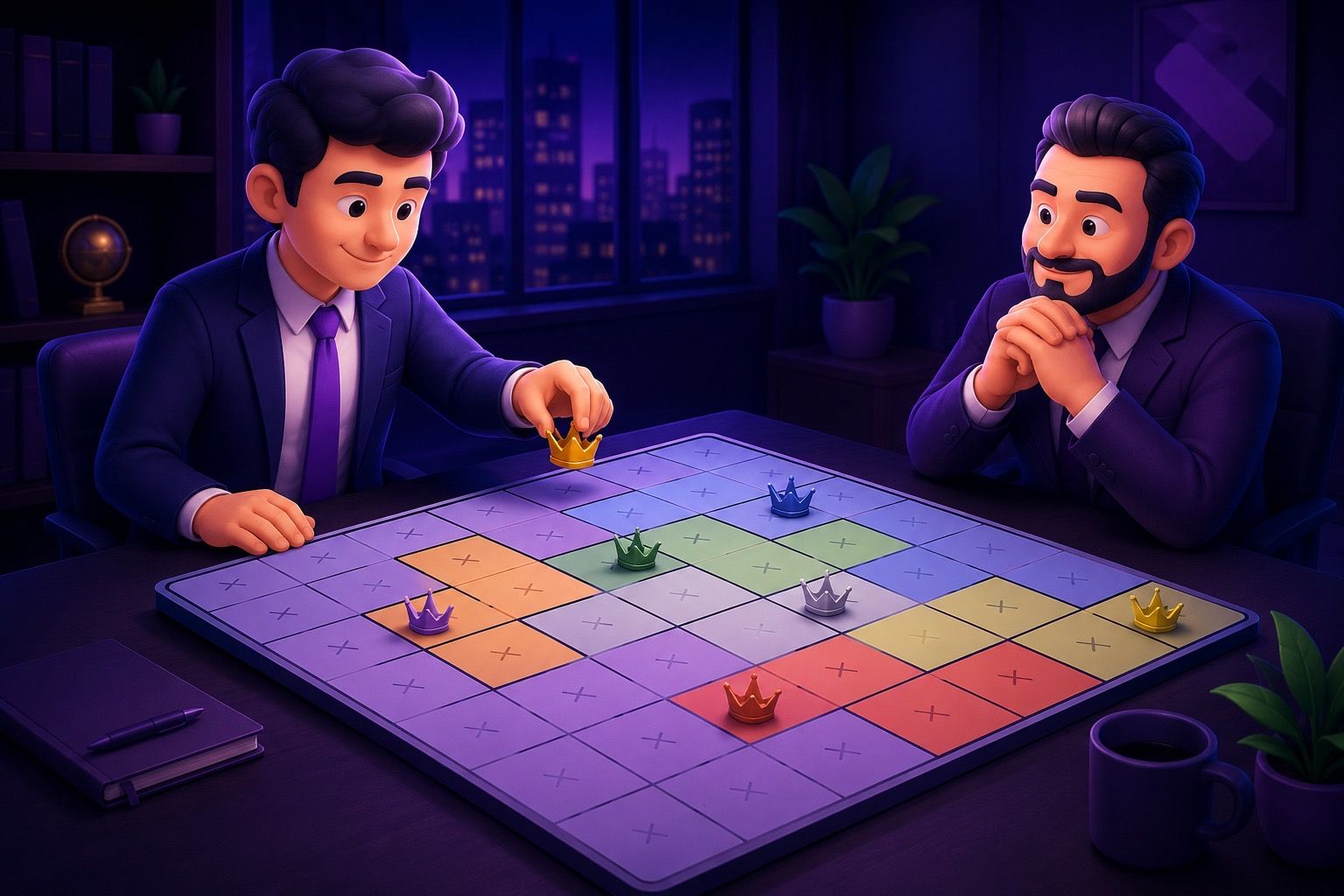
The classic version: Place eight queens on an 8×8 chessboard so that no two queens threaten each other. In chess, a queen can attack any square in the same row, column, or diagonal. So the challenge is to find an arrangement where no two queens share a row, a column, or a diagonal line.
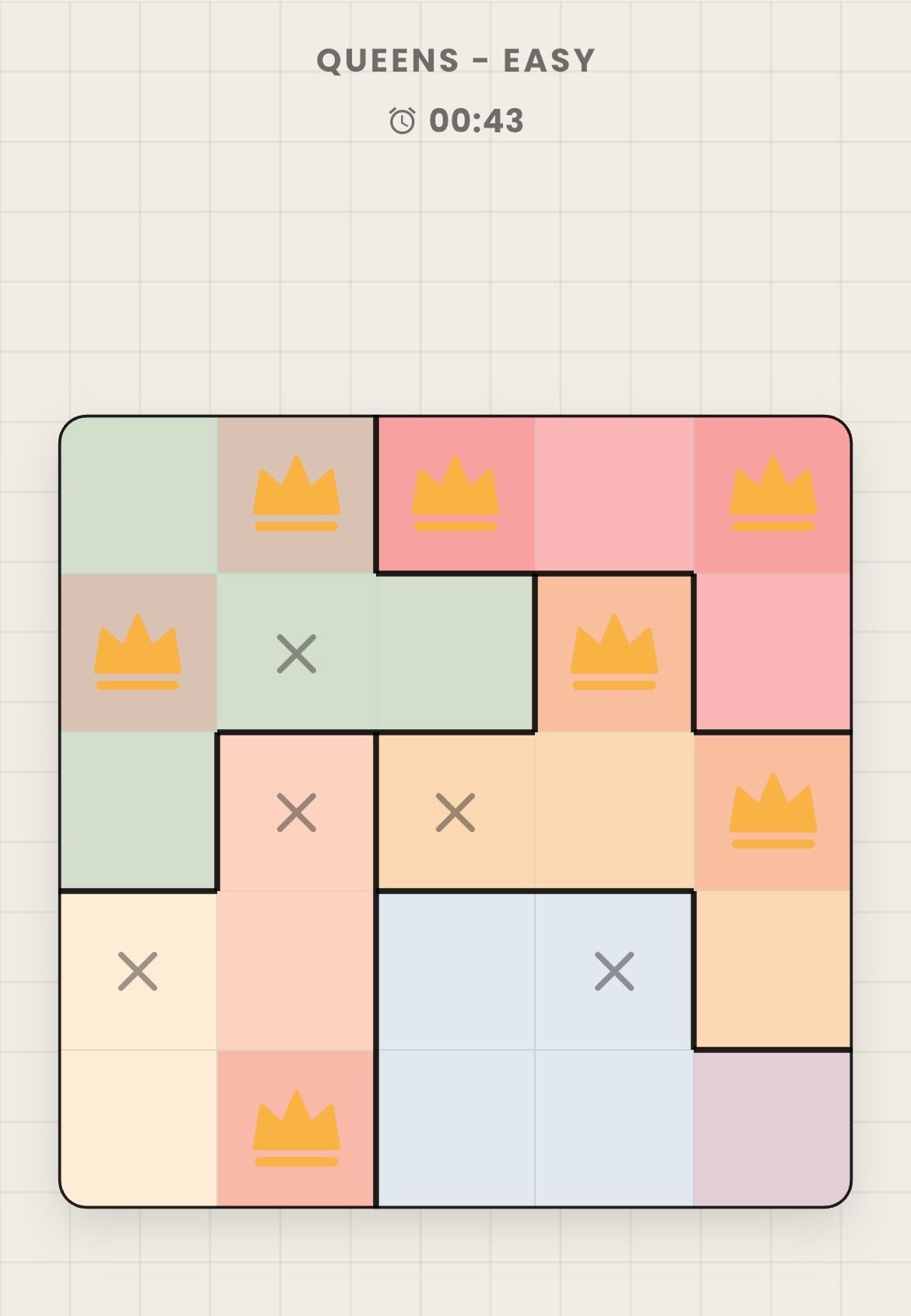
The modern puzzle version: In Calc Quest, the Queens Puzzle is adapted into a logic puzzle format a grid divided into coloured regions, where you must place exactly one queen in each region, with no two queens in the same row, column, or adjacent square. The colour regions add a third constraint that makes each puzzle unique and progressively more demanding.
The rules fit in two sentences. The implications of those rules take considerably longer to exhaust which is why the Queens Puzzle has remained a compelling challenge for everyone from casual puzzle players to professional computer scientists.
💡 The original Eight Queens Problem was first proposed in 1848 by chess composer Max Bezzel. It has since been studied by some of the greatest mathematical minds in history including Carl Friedrich Gauss, who attempted to find all solutions and initially undercounted. There are exactly 92 distinct solutions on an 8×8 board. Finding even one, without help, is harder than it sounds.
Why It's Easier to Learn Than You Think
The Rules Are Genuinely Simple
Unlike puzzles that require you to memorise multiple rule types or learn a specialised vocabulary before you can begin, the Queens Puzzle has exactly one core constraint: no two queens can threaten each other. On a standard grid, that means no two queens in the same row, column, or diagonal. In the colour-region version, it also means no two queens in the same coloured area.
That's it. You can hold the entire ruleset in your head from the very first move which means your cognitive energy goes entirely into solving, not into remembering what you're allowed to do.
The First Move Almost Makes Itself
In most Queens Puzzle configurations, there are cells that are clearly impossible from the very beginning positions that would immediately conflict with a constraint. Eliminating those cells first gives you a smaller, cleaner problem to work with, and often reveals an obvious starting move that opens the rest of the grid.
That accessible entry point is important. A puzzle that has no clear starting move feels arbitrary and frustrating. The Queens Puzzle almost always has one which means beginners can make genuine progress from the very first session without feeling lost.
💡 Tip: Start by identifying cells you definitely cannot use. Mark them out. The cells that remain are your working space and a much smaller working space almost always reveals your first queen placement immediately.
Why It's Harder to Master Than You Expect
Every Placement Has Cascading Consequence
This is the core of what makes the Queens Puzzle genuinely difficult. When you place a queen in a cell, you're not just filling one square you're eliminating every square in that queen's row, column, and both diagonals. On a large grid, a single queen placement can rule out fifteen, twenty, or more cells simultaneously.
That cascading elimination is powerful when it works in your favour it rapidly narrows down where the remaining queens must go. But when it works against you, a queen placed three moves ago can close off the last valid position for a queen you're trying to place now. And tracing the problem back to its source requires holding the entire chain of decisions in your head simultaneously.
The Colour Regions Add a Third Layer of Constraint
In the classic version, the only constraints are rows, columns, and diagonals. The colour-region version adds a third: each coloured area must contain exactly one queen. This additional constraint interacts with the row and column rules in ways that are non-obvious and require simultaneous reasoning across multiple dimensions.
A region might have only two cells remaining but both cells might be in the same row as a queen you've already placed. A region might look unconstrained until you realise that placing a queen anywhere in it would eliminate the only valid cell for the region adjacent to it. These multi-layered interactions are what push the Queens Puzzle from "tricky" to "genuinely hard to master."
"The colour regions don't just add difficulty they transform each puzzle into a unique logical fingerprint. No two Queens Puzzles with different region layouts feel the same to solve."
There Are Dead Ends That Look Like Progress
One of the most disorienting experiences in the Queens Puzzle is placing several queens successfully feeling confident, building momentum and then discovering that the remaining queens have no valid positions. You haven't made an obvious error. Every placement followed the rules. And yet the grid is broken.
This happens because the Queens Puzzle has false paths sequences of individually valid moves that collectively lead to an unsolvable state. Recognising when you're on a false path, and backtracking cleanly to the decision that started it, requires a kind of logical patience that most people have to consciously develop.
💡 Did you know? In computer science, the Queens Puzzle is used as a classic example of a "constraint satisfaction problem" a category of problems solved by systematic backtracking. The algorithms used to solve it efficiently are the same techniques that underpin scheduling software, logistics planning, and artificial intelligence reasoning systems.
The Logic Behind Solving It
Think in Eliminations, Not Placements
Most beginners approach the Queens Puzzle by asking: "Where can I place the next queen?" Experienced solvers ask a different question: "Where can the next queen not go?" That shift from looking for possibilities to eliminating impossibilities is the single most important strategic change you can make.
Elimination is faster, more certain, and more productive than placement searching. Every queen you place gives you new elimination information. Use it immediately. The more aggressively you eliminate, the faster the valid positions become obvious.
Work the Most Constrained Region First
The coloured region with the fewest valid cells is always your next move not the region that looks easiest or the one in the most convenient location. Fewer valid cells means less uncertainty, which means your placement is more likely to be correct and more likely to generate useful eliminations for the regions around it.
This "most constrained first" principle is a foundational strategy in logic puzzle solving and applies directly to Sudoku, KenKen, and almost every constraint-based puzzle. Queens is one of the cleanest environments in which to practise it.
When You're Stuck, Backtrack Early
Beginners tend to backtrack reluctantly only when there is absolutely no valid move remaining. Experienced solvers backtrack earlier, at the first sign that the remaining options look unexpectedly limited. Early backtracking costs you one or two moves. Late backtracking can cost you ten.
The discipline of backtracking early before you're forced to is one of the hardest habits to build and one of the most valuable. It requires overcoming the psychological resistance to "undoing" progress you've already made. But in the Queens Puzzle, an early backtrack almost always leads to a faster solution than pressing on into a dead end.
⭐ Fun fact: The Queens Puzzle scales dramatically with grid size. On an 8×8 board there are 92 solutions. On a 9×9 board there are 352. On a 27×27 board there are over 200 trillion. The puzzle doesn't just get harder as the grid grows it gets exponentially more complex in ways that still challenge modern computing.
What the Queens Puzzle Builds in Your Brain
Constraint Reasoning
The Queens Puzzle is almost purely a constraint reasoning exercise the ability to manage multiple simultaneous rules and find arrangements that satisfy all of them at once. This skill underpins logical thinking across almost every domain: legal reasoning, strategic planning, coding, design, negotiation. The Queens Puzzle trains it in one of the most concentrated and transferable forms available in any puzzle format.
Spatial Reasoning
Tracking rows, columns, diagonals, and colour regions across a grid simultaneously is a genuine spatial reasoning task. Your brain has to hold a dynamic mental map of the grid updating it with each new placement and elimination which exercises the visuospatial systems that support navigation, visualisation, and geometric thinking.
Strategic Patience
The Queens Puzzle cannot be rushed. Impulsive placements lead to dead ends. Early eliminations save time but require discipline to execute before they feel necessary. Backtracking at the right moment requires accepting a short-term setback for a long-term gain. Every one of these demands builds a form of strategic patience the ability to think beyond the immediate move that is genuinely rare and genuinely valuable.
"The Queens Puzzle doesn't reward the fastest thinker. It rewards the most patient one the player willing to eliminate carefully, backtrack willingly, and trust the logic all the way to the end."
How to Approach Your First Queens Puzzle
Step 1 — Scan for obvious eliminations. Before placing a single queen, look for cells that are clearly impossible cells in the same row, column, or diagonal as a forced placement, or cells that belong to a region with only one valid option. Mark these out first.
Step 2 — Identify the most constrained region. Which coloured region has the fewest valid cells after your eliminations? Start there. Place your first queen in the position that leaves the most options open for surrounding regions.
Step 3 — Eliminate immediately after each placement. Every queen you place rules out cells in its row, column, diagonals, and region. Do this elimination step before looking for your next placement it almost always reveals something useful.
Step 4 — Watch for regions being squeezed. As you place queens, keep an eye on regions that are losing valid cells quickly. If a region is down to one valid cell, that's a forced move fill it in immediately and use the new eliminations it generates.
Step 5 — Backtrack at the first sign of trouble. If a region runs out of valid cells before you've placed its queen, the error is somewhere behind you. Go back to the most recent decision that had more than one option and try the alternative. Early, clean backtracking is the mark of an experienced Queens solver.
The Puzzle That Has Outlasted Everything
The Queens Puzzle has been around since 1848. It has been studied by Gauss, programmed into the earliest computers, used to teach constraint reasoning in universities, and played by millions of casual puzzle enthusiasts who have no idea about any of that history. It has survived because it works as a mathematical curiosity, as a logic exercise, and as a genuinely satisfying puzzle that rewards careful thinking with a clean, elegant solution.
Easy to explain. Immediately engaging. Genuinely difficult to master. That combination doesn't come along often and when it does, the puzzle tends to last a very long time.
The board is set. The queens are waiting. Place the first one.