Rootdown: The Fastest Way to Master Square Roots
how to learn square roots fast, square root fluency, perfect squares list, square roots for students, rootdown calc quest, how to memorise square roots, square root practice game, square root automaticity, mental math square roots, square roots in maths, perfect squares 1 to 20, square root tips, math fluency app, square root brain training, Calc Quest rootdown
Square roots have a reputation for being intimidating. Rootdown exists to fix that one fast round at a time.
For most people, square roots sit in an uncomfortable category: not quite memorised, not quite understood, never quite automatic. You know √9 is 3 and √25 is 5 those are easy. But √144? √196? √289? Those require a moment of thought. Sometimes more than a moment. And in situations where numbers need to move quickly exams, mental estimation, problem solving under pressure that hesitation costs you.
Rootdown is designed to close that gap. Not through drilling tables or memorising lists but through a game format that builds square root fluency the same way any skill gets built: through active, repeated, feedback-rich practice that feels far less like studying than it should.
"Square root fluency isn't about memorising answers. It's about building the number sense that makes the right answer feel obvious and Rootdown builds that number sense faster than any other method available."
What Is Rootdown?
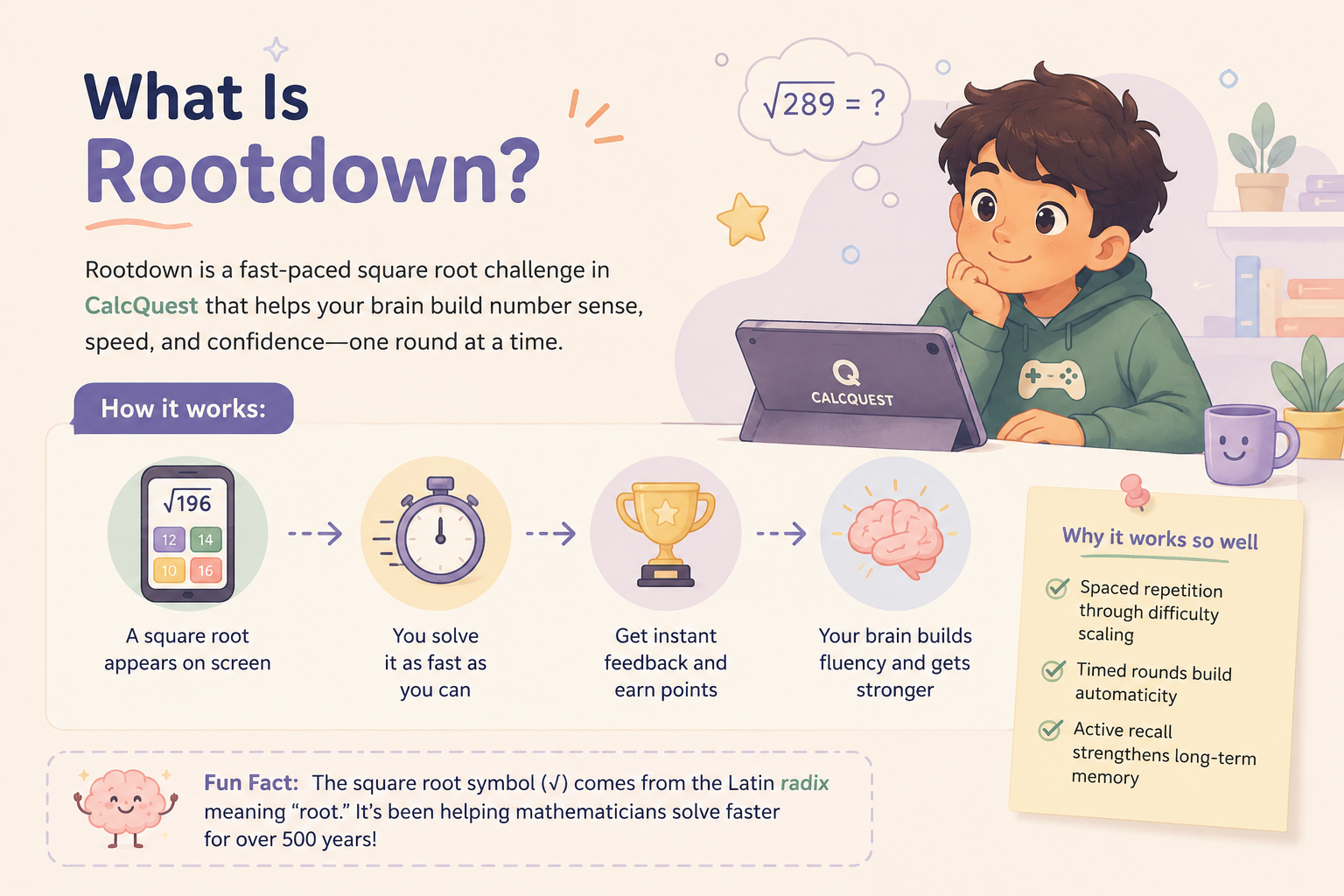
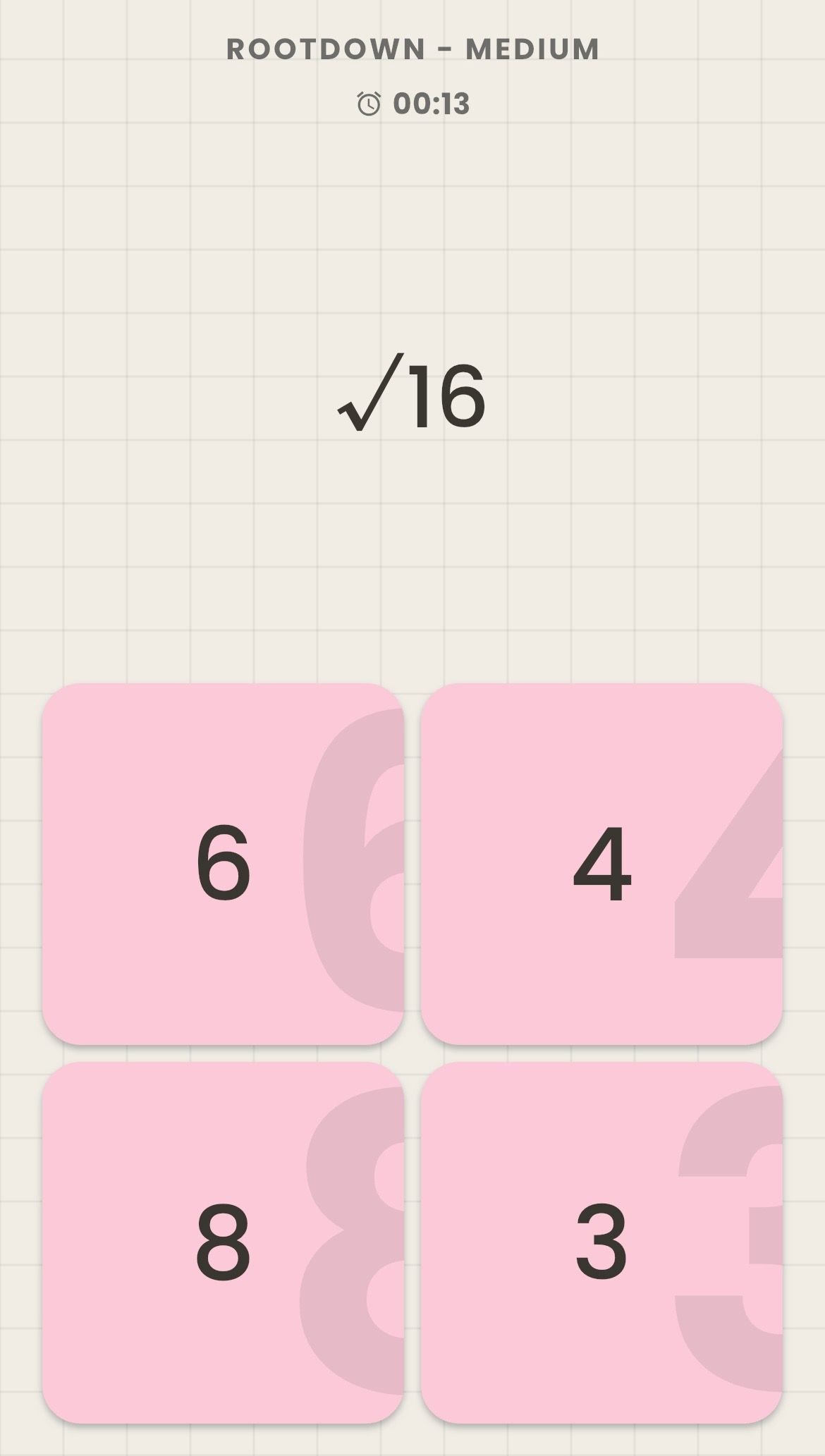
What it is: Rootdown is a fast-paced square root challenge inside Calc Quest. A number appears on screen. You identify its square root as quickly as possible. Rounds are timed. Difficulty scales as your accuracy and speed improve. Every session builds the automatic recognition that separates students who struggle with square roots from those who handle them without thinking.
What makes it different: Most square root practice is passive looking at a table, copying values, reviewing answers someone else worked out. Rootdown is active. You produce the answer. You receive immediate feedback. Your brain makes a prediction, checks it against the correct result, and updates accordingly. That active cycle is what builds fluency. Passive review almost never does.
The format is simple enough to start immediately and deep enough to keep challenging you as your knowledge grows. Beginners build confidence with perfect squares. Intermediate players develop speed across the full range of common values. Advanced players work with larger and less familiar numbers that require estimation and number sense rather than pure recall.
💡 Perfect squares numbers that have whole-number square roots are far more common in mathematics than most students realise. They appear in geometry, algebra, trigonometry, statistics, physics, and engineering. Building automatic recognition of them isn't a niche skill. It's foundational number literacy.
Why Square Roots Matter More Than You Think
They Appear Everywhere in Mathematics
Square roots aren't an isolated topic that appears once in a curriculum and disappears. They're woven through mathematics at every level. The Pythagorean theorem produces square roots. The quadratic formula contains a square root. Standard deviation in statistics is a square root calculation. Distance formulas in geometry use square roots. The area of a circle connects to square roots through its radius.
Every time a student hesitates on a square root mid-problem, that hesitation breaks the flow of their thinking pulling attention away from the problem's actual challenge and onto a subsidiary calculation. Building automatic square root recognition eliminates that interruption entirely, freeing cognitive bandwidth for the harder thinking the problem actually requires.
They're Essential for Mental Estimation
Even when exact square roots aren't needed, knowing the approximate square root of a number is a powerful estimation tool. Knowing that √50 sits between 7 and 7.5, that √200 is close to 14, that √1000 is approximately 31.6 these estimates are immediately useful in engineering, science, finance, and everyday problem solving.
That estimation ability knowing where a square root lies without calculating it precisel requires a mental map of the perfect squares and a feel for the gaps between them. Rootdown builds exactly this map, session by session, through the kind of active exposure that creates genuine number sense rather than superficial memorisation.
They Signal Mathematical Confidence
There's a psychological dimension to square root fluency that goes beyond calculation. Students who handle square roots automatically who don't need to pause, count, or reach for a calculator carry themselves differently in mathematical contexts. They engage with harder problems more willingly. They feel less intimidated by unfamiliar notation. They trust their own thinking more.
That confidence isn't separate from their skill it's built by it. Every time a square root is handled without hesitation, it's a small piece of evidence that mathematical fluency is real and growing. Rootdown creates those moments consistently, which is exactly how mathematical confidence is built.
"Mathematical confidence isn't a personality trait. It's the accumulated result of handling numbers correctly, repeatedly, until they stop feeling threatening. Square root fluency is one of the fastest ways to build it."
How Rootdown Builds Fluency The Science Behind It
Active Recall Beats Passive Review
Decades of memory research consistently show that actively retrieving information producing an answer rather than recognising it builds long-term retention dramatically faster than passive review. Reading a list of square roots and their values builds surface familiarity. Being shown a number and having to produce the square root builds genuine retrieval fluency the kind that works under pressure, mid-problem, when you can't stop to think.
Rootdown is pure active recall. Every session asks you to produce answers, not recognise them. That format alone makes it more effective than any table-based study method, regardless of how much time is spent.
Spaced Repetition Through Difficulty Scaling
The values you answer quickly and correctly appear less frequently in subsequent rounds. The values you hesitate on or get wrong appear more often. This implicit spaced repetition concentrating practice on the values you know least is the most efficient possible allocation of study time.
It means every Rootdown session is automatically calibrated to your current knowledge. You don't spend time on what you already know well. You spend it on what you don't which is exactly where the growth happens.
Time Pressure Builds Automaticity
The timed format of Rootdown isn't just about making the game more exciting. It's a deliberate learning mechanism. Time pressure forces your brain to retrieve answers from memory rather than reconstruct them from reasoning and retrieval from memory, practised repeatedly under time pressure, is what builds the automatic recognition that distinguishes fluent from non-fluent knowledge.
A student who can work out √196 by thinking "what number times itself gives 196?" is competent. A student who sees √196 and immediately knows 14 is fluent. The difference is automaticity and time pressure is what builds it.
💡 The shift from competence to automaticity is called "automatisation" in cognitive psychology the same process that turns effortful reading into effortless reading, halting driving into smooth driving, and deliberate square root calculation into instant recognition. Rootdown's timed format is specifically designed to accelerate this shift.
Who Benefits From Rootdown
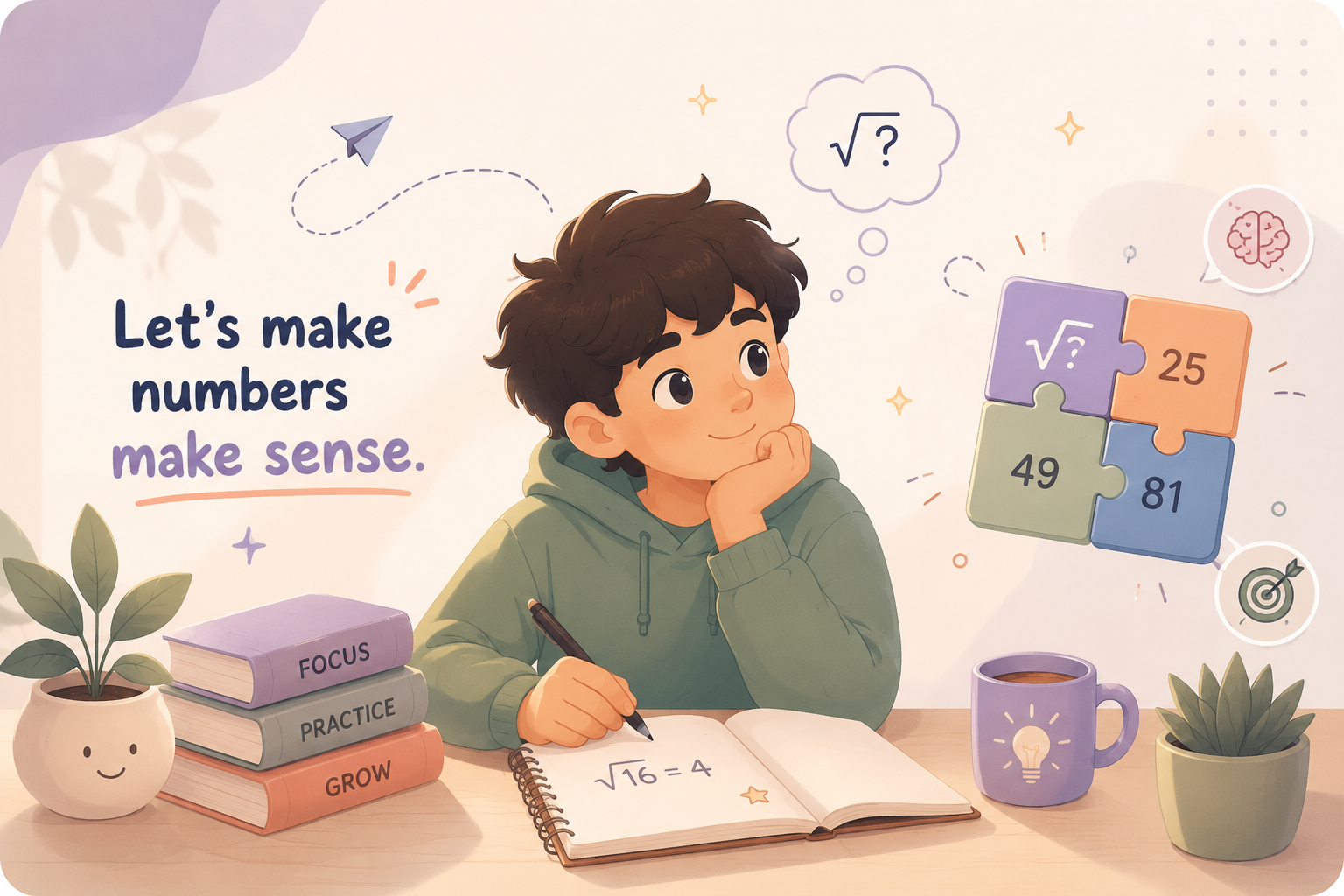
Students preparing for exams: Square roots appear in standardised tests, entrance exams, and mathematics assessments at every level. Students who handle them automatically have a measurable advantage not just on square root questions directly, but on every multi-step problem where a square root appears as one component. Removing that friction mid-problem changes the experience of the entire exam.
Students currently studying algebra or geometry: The Pythagorean theorem, the quadratic formula, distance calculations, and area problems all involve square roots as a regular component. Students with automatic square root recognition move through these topics faster, make fewer errors, and develop stronger intuition for the relationships involved.
Adults who work with numbers professionally: Engineers, architects, data analysts, scientists, and financial professionals encounter square roots regularly in calculations, in formulas, and in estimations. Professional fluency with square roots is a practical advantage that pays dividends across thousands of working hours.
Anyone building general mathematical confidence: Square root fluency is one of the fastest routes to feeling genuinely comfortable with numbers. It's a bounded, achievable domain twenty values to automate, clear feedback on progress, measurable improvement within days. For anyone rebuilding a relationship with mathematics after a difficult history with it, Rootdown provides exactly the kind of quick, visible wins that restore confidence.
⭐ Fun fact: The symbol for square root — √ — is called a "radical" and comes from the Latin word "radix" meaning root. It was first used by mathematician Christoph Rudolff in 1525. Nearly 500 years later, the same concept remains one of the most frequently encountered operations in mathematics which is exactly why fluency with it is still worth building.
How to Get the Most From Rootdown
- Start with the values you don't know automatically. Be honest about which perfect squares you can retrieve instantly and which require thought. The values that require thought are where your practice time should concentrate and Rootdown's difficulty scaling will naturally direct you there.
- Don't slow down to be accurate speed up to build memory. It feels counterintuitive, but attempting to retrieve answers quickly even when you're uncertain builds automaticity faster than careful deliberate recall. Errors under speed are valuable: they identify exactly which values need more repetition.
- Play short sessions daily rather than long sessions occasionally. Square root automaticity is built through repeated retrieval over time, not through single intensive sessions. Ten minutes every day for two weeks produces more durable fluency than two hours in a single sitting. Consistency is the variable that matters most.
- Build the two-way connection. After a Rootdown session, spend a few minutes running the relationship in reverse: see a square root value and identify its perfect square. Fluency in both directions from perfect square to root and from root to perfect square builds a richer, more flexible number sense than one-directional drill alone.
- Notice when you shift from calculating to recognising. At some point in your Rootdown practice, a value that once required thought will simply appear. You won't have calculated it you'll have recognised it. Notice that moment. It's the clearest evidence that automaticity has arrived for that value and it will arrive for each value in turn.
From Hesitation to Instant Recognition
The distance between where most people are with square roots competent but slow, correct but effortful and where fluency feels like is shorter than it appears. The perfect squares from 1 to 20 are twenty values. With daily active practice, automatic recognition of the full range typically develops within two to four weeks. That's a measurable, achievable transformation in a short and defined time.
What's on the other side of that transformation is something that changes how mathematics feels. Not just square root questions every problem that contains a square root. Every formula. Every calculation. Every moment where a number needs to be estimated quickly and you know, without thinking, approximately where its root lies.
That's what Rootdown builds. Not a party trick. Not a narrow exam skill. A genuine piece of mathematical fluency that makes every calculation it touches faster, smoother, and more confident.
"The best time to build square root fluency was when you first encountered them. The second best time is now with a method that actually works, in sessions short enough to fit into any day."
Start your first round. The roots are waiting.