The 7-Day Brain Speed Challenge
7 day brain challenge, brain speed training, mental math challenge, improve mental speed, brain training exercises, daily brain exercises, mental math practice, improve focus and memory, pattern recognition exercises, logic puzzles for adults, brain training app, Calc Quest, mental math for kids, cognitive speed training
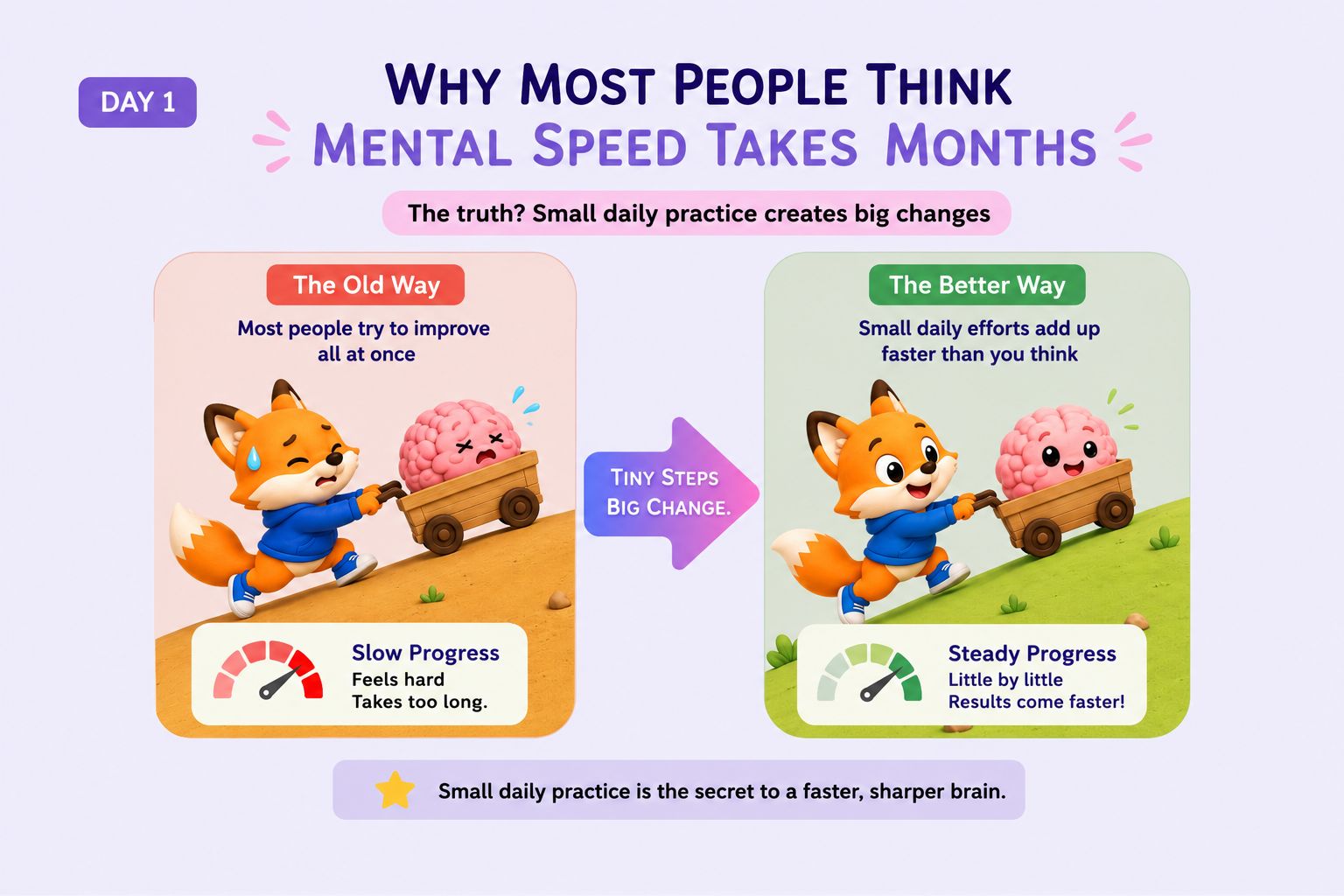
Most people assume that improving mental speed takes months. It doesn't.
Just like physical fitness improves through consistent training, your brain responds to small daily challenges. The key isn't spending hours solving problems. It's showing up every day and gradually pushing yourself a little harder.
That's exactly what this 7-Day Brain Speed Challenge is designed to do.
For the next week, you'll spend just a few minutes each day testing different skills: calculation, memory, pattern recognition, logic, and focus. No equipment needed. No prior experience required. Just you, a timer, and a willingness to show up.
"A brain trained in small daily bursts outperforms one drilled in long, exhausting sessions. Consistency beats intensity every time."
Ready? Let's begin.
The 7-Day Challenge
Day 1 — Speed Calculation
Start simple. Set a timer for 60 seconds and solve as many mental math problems as you can. Don't worry about perfection today's only goal is to establish a baseline so you have something to beat by Day 7.
Try these:
- 25 × 4
- 18 + 27
- 75 ÷ 5
- 15% of 200
Write down how many you solved correctly. That number is your starting point. Keep it you'll need it on Day 7.
💡 Ask yourself: how many questions can I solve accurately in one minute?
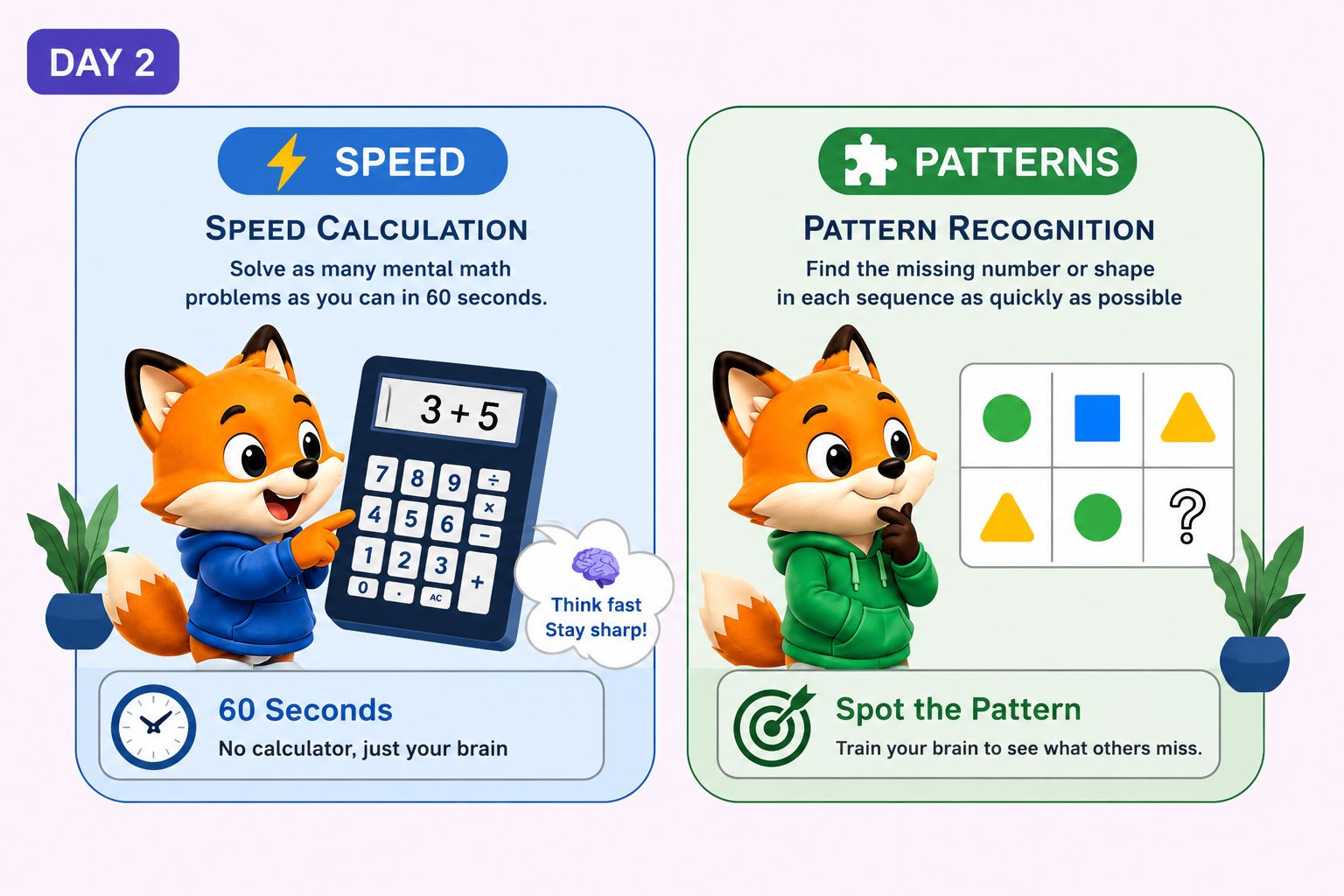
Day 2 — Pattern Recognition
Today is all about spotting relationships between numbers. Look at each sequence and find the missing number as quickly as you can.
- 2, 4, 8, 16, ___
- 3, 6, 12, 24, ___
- 5, 10, 20, 40, ___
The faster you identify patterns, the less effort your brain spends calculating from scratch. Pattern recognition is one of the most valuable and most trainable skills in math and problem solving.
Tip: you're not solving you're recognizing the shape of each sequence. That shift in mindset is everything.
Day 3 — Memory Sprint
Look at the number sequence below for exactly 10 seconds. Then cover it and try to recall every digit in the correct order.
8 — 3 — 5 — 1 — 9 — 2
Got it? Repeat the exercise with longer sequences 7 digits, then 8, then 9. Each time you successfully recall a sequence, add one more digit.
Memory isn't just about storing information. It's about holding information long enough to actually use it which is exactly what mental math requires.
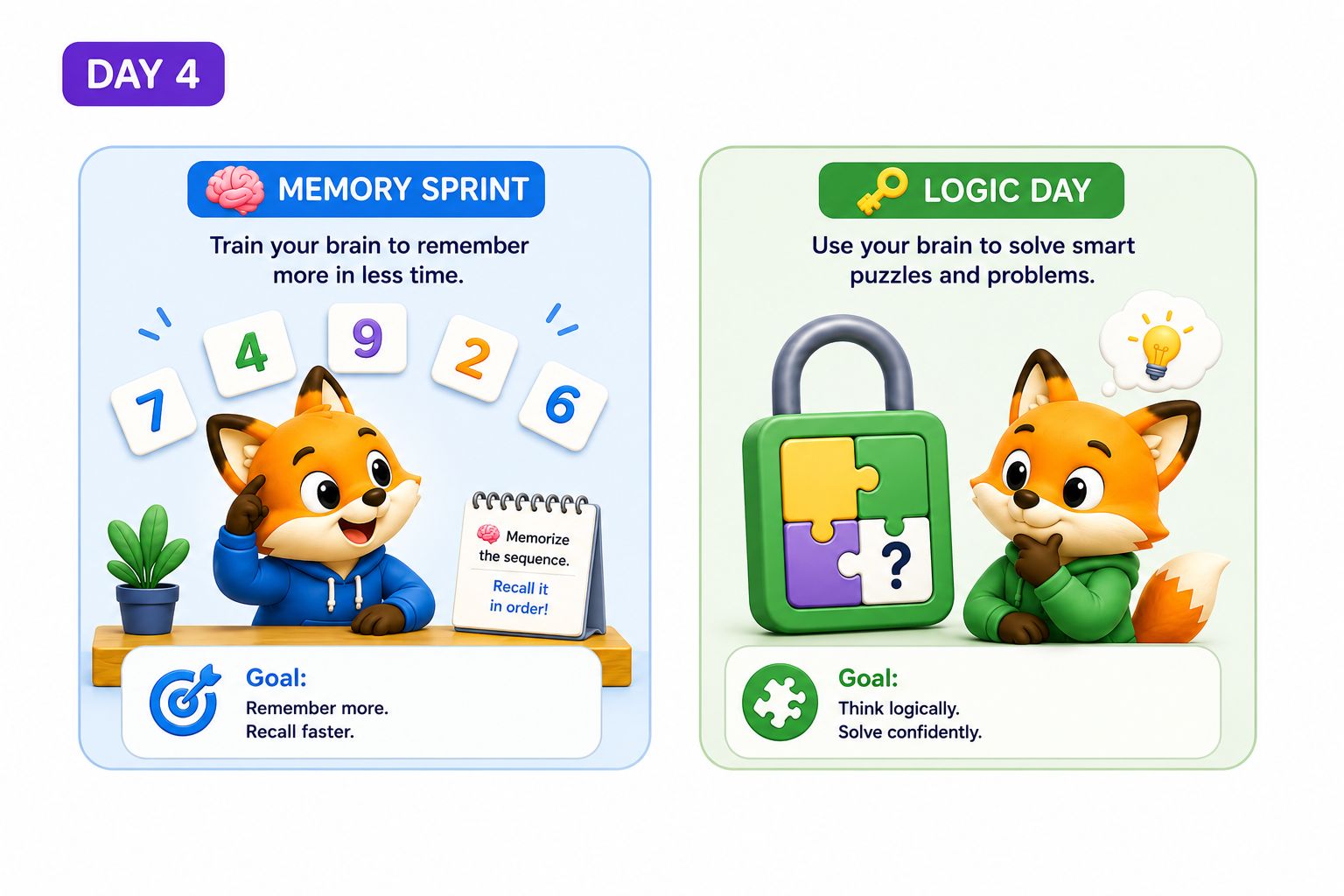
Day 4 — Logic Day
Put down the numbers. Today's challenge is pure logic.
The puzzle:
A farmer needs to cross a river with a fox, a chicken, and a bag of grain. His boat can only carry him and one item at a time. The fox will eat the chicken if left alone together. The chicken will eat the grain if left alone together. How does he get everything across safely?
Take your time. Logic puzzles like this force your brain to slow down, think in sequences, and plan ahead instead of reacting automatically. That's a different mental muscle than calculation and just as important.
💡 Answer: Take the chicken first. Go back, take the fox, bring the chicken back. Take the grain. Go back for the chicken. Done.
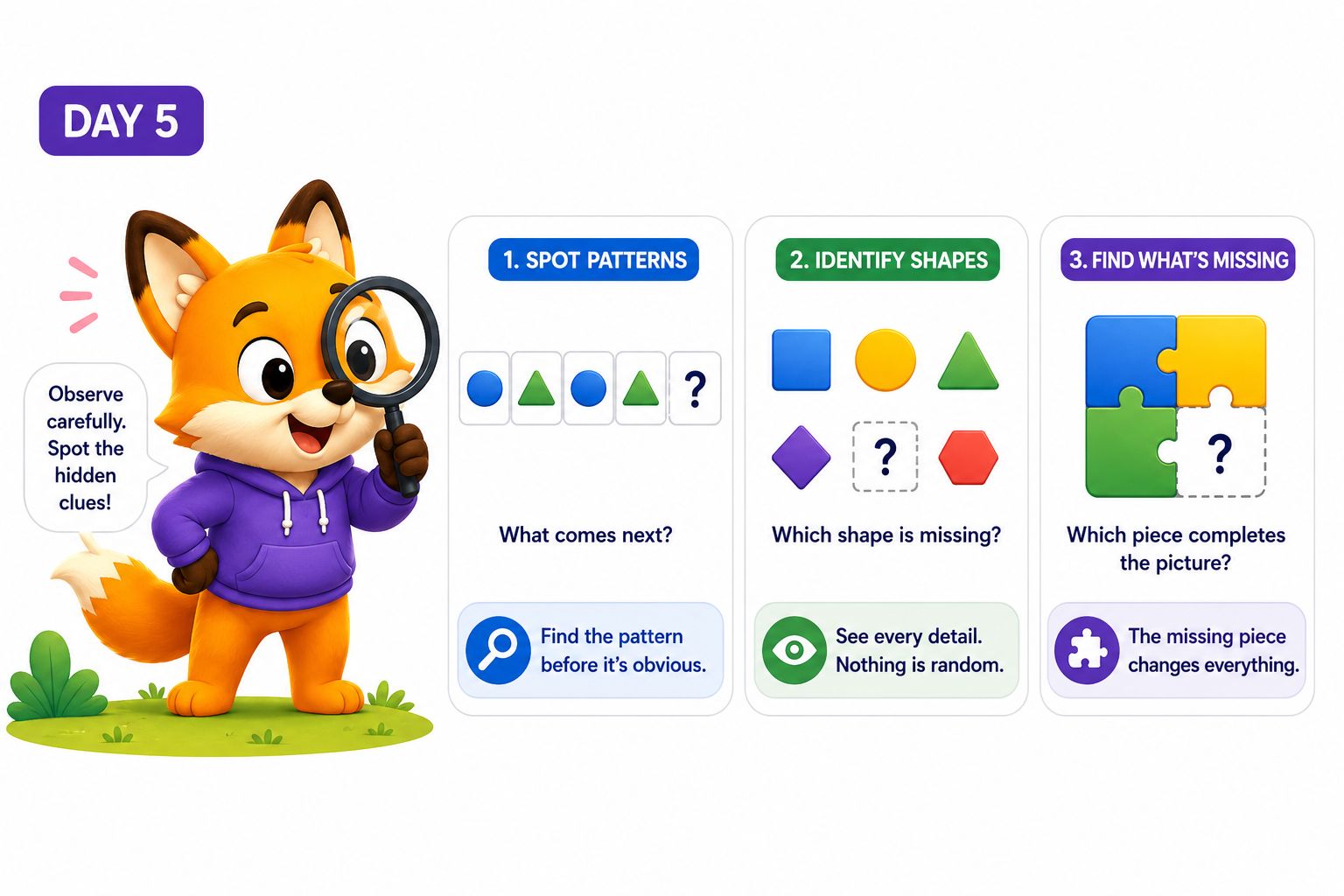
Day 5 — Visual Thinking
Not all math is numbers. Today's challenge is about training your eye to see structure patterns, symmetry, and relationships in visual form.
Look for:
- Hidden patterns in arrangements of shapes
- Lines of symmetry
- Missing pieces in a visual sequence
- Shape relationships (which one doesn't belong?)
Games like Nonograms, picture puzzles, and Sudoku-style challenges are excellent for this. They strengthen the visual reasoning side of your brain that pure calculation drills don't touch.
Day 6 — Timed Challenge
Today you combine everything you've practiced so far. Calculation, patterns, logic all in one session, under pressure.
The rules:
- 30 seconds
- 5 mixed questions
- No calculator
- No pausing
Mix calculation questions, number patterns, and one logic step together. The goal isn't just solving problems it's solving them while the clock is running. Pressure is the training tool today.
"Solving under pressure is a skill in itself. Today you're not just training your brain you're training your brain not to freeze."
Day 7 — The Final Test
Go back to Day 1. Same format. Same timer. 60 seconds, same style of questions, no calculator.
Now compare.
- Did you answer more questions than Day 1?
- Did you make fewer mistakes?
- Did the problems feel easier even slightly?
- Did you feel more confident starting?
Most people notice real improvement after just one week of focused practice. Not because they've memorized answers because they've trained their brain to recognize patterns faster. That's the difference between calculating and seeing.
Why This Actually Works!?
Your brain loves repetition but only when that repetition is varied and slightly challenging. When you repeatedly solve similar types of problems across different formats (calculation, memory, logic, visual), your mind starts recognizing structures instead of working through each problem from scratch.
Experienced puzzle solvers don't always think faster. They simply recognize familiar patterns sooner. What looks like speed is really pattern memory and that's something anyone can build.
"Speed is just familiarity. The more you've seen a type of problem, the faster your brain routes around it."
Keep the Momentum Going
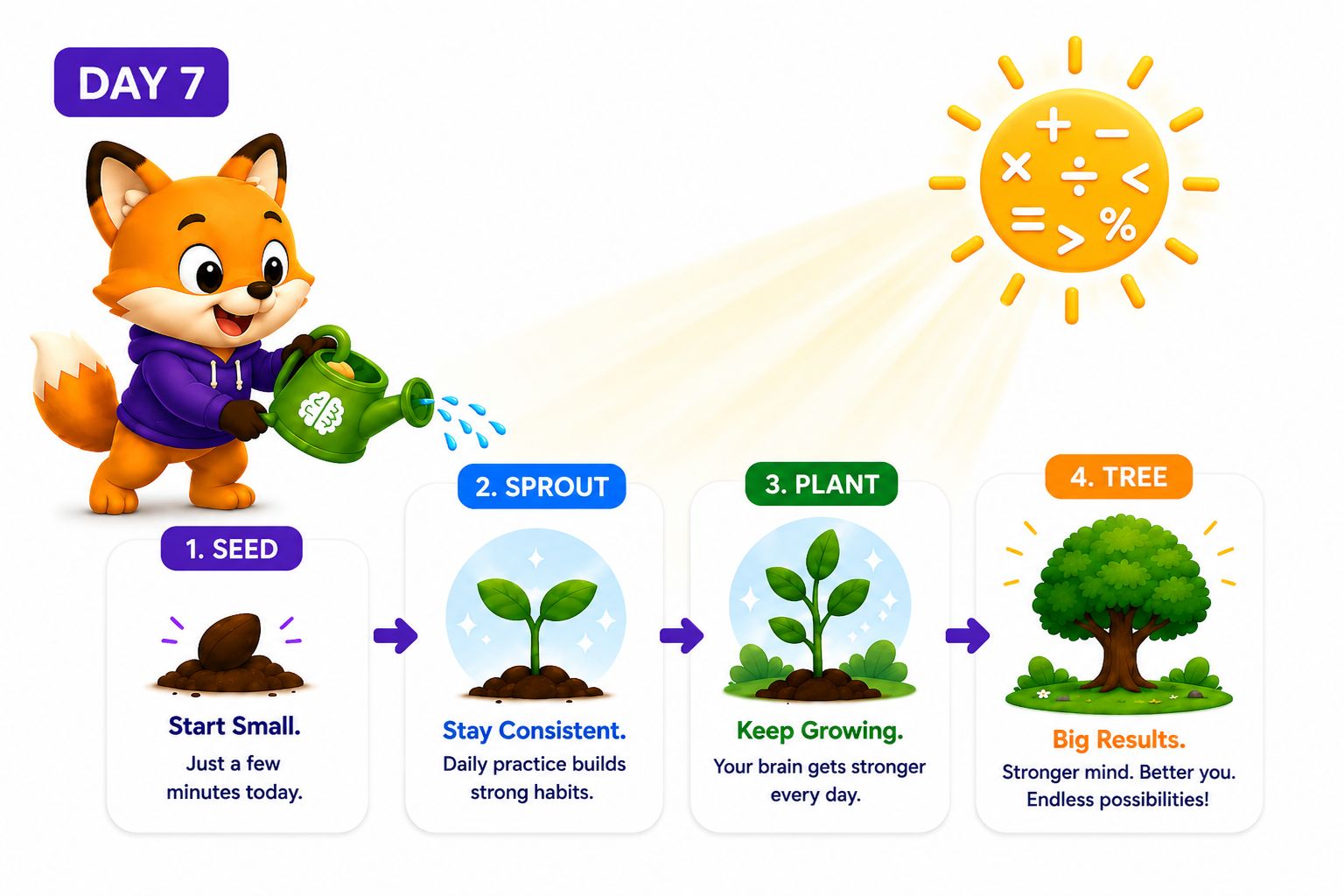
Seven days is a strong start. The real benefits come from making this a habit not a one-week experiment. Just a few minutes of daily brain training, consistently applied, can sharpen:
- Focus and attention under pressure
- Pattern recognition across math and logic
- Mental calculation speed
- Problem-solving confidence
The goal was never to become a math genius. The goal is to think a little faster today than you did yesterday. Do that for a month, and the results will surprise you.
⭐ Fun fact: Brain training studies show that people who practice mental challenges for just 5–10 minutes daily show measurable improvements in processing speed within two to four weeks.
Ready for Day 8?
The 7-day challenge ends here but your training doesn't have to. Calc Quest is built around exactly this principle: short, daily challenges that cover calculation, patterns, logic, and speed, with difficulty that scales as you improve.
Every day is a new challenge. Every session makes you a little sharper.