The Hidden Skills Every CalcQuest Game Is Training
what skills do puzzle games build, cognitive benefits of puzzle games, brain training through games, mental math practice app, logic puzzles and brain development, working memory games, focus and concentration games, problem solving games for kids, learning through play, Calc Quest skills, educational puzzle app, brain games that actually work, cognitive skill building app, puzzle games for brain health, daily brain training benefits
Every game in Calc Quest feels like fun. That's intentional. What's happening underneath is more interesting than it looks.
Most apps that claim to "train your brain" feel like what they are thinly disguised homework with a progress bar attached. You know you're supposed to be improving. You can feel the effort. And that self-consciousness about the process often gets in the way of the process itself.
Calc Quest was built differently. The games are genuinely fun designed to pull you in through curiosity, competition, and the satisfaction of solving something hard. But behind every puzzle, every timed challenge, and every logic sequence is a specific cognitive skill being trained deliberately.
This post is about that layer. The one underneath the fun. The one that explains why the time you spend in Calc Quest isn't just enjoyable it's building something real.
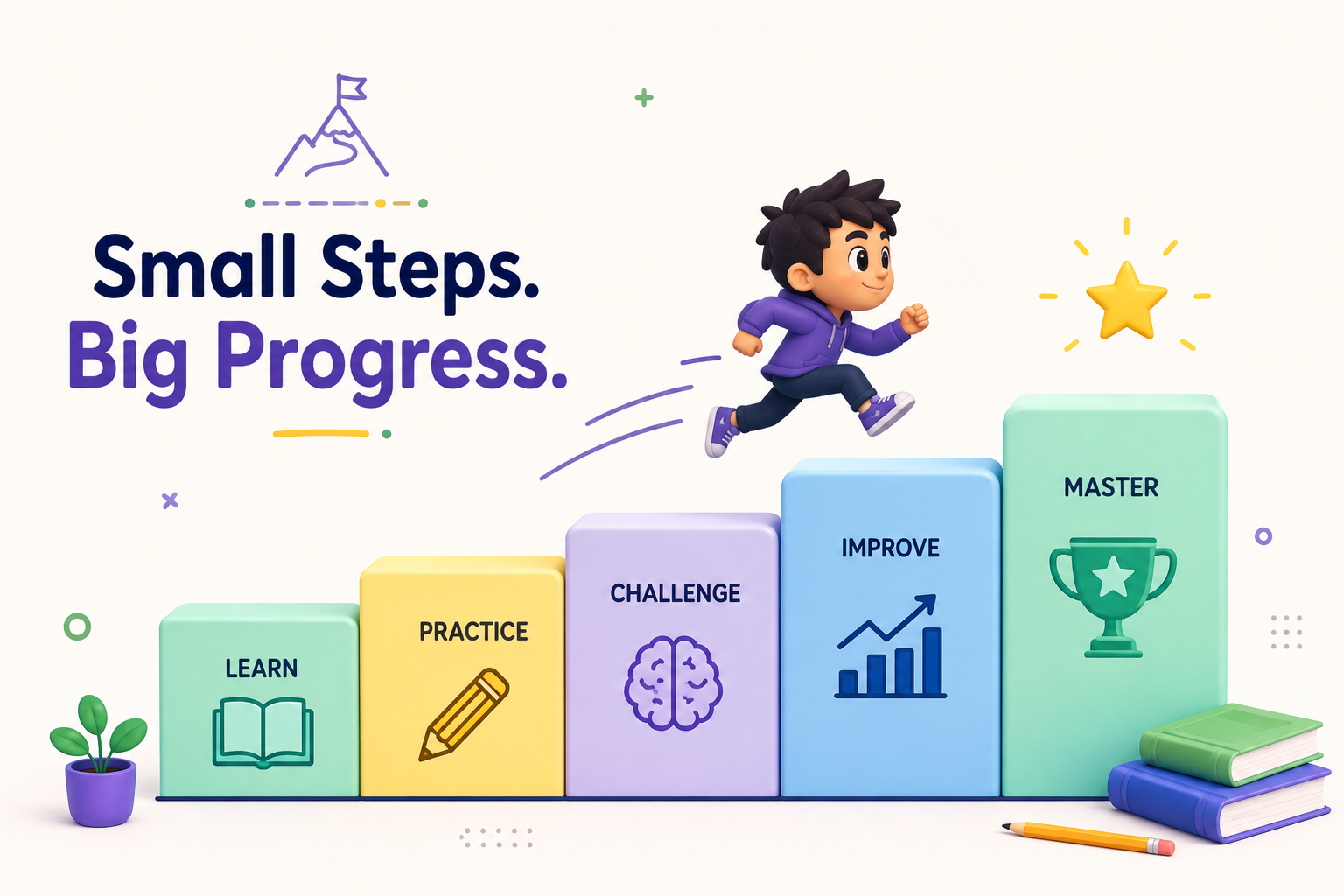
"The best learning happens when people don't feel like they're learning. Calc Quest was designed around that principle from the very first game."
The Skills Being Built - One by One
Mental Math Speed
Quick Calculation challenges, Number Pyramids, and timed arithmetic games all have one thing in common: they push you to process numbers faster than feels comfortable. That discomfort is the point. Every time your brain is asked to produce an arithmetic result slightly faster than it can do easily, it adapts building the neural pathways that make the same calculation feel automatic next time.
Over weeks of regular play, something changes. Calculations that once required conscious effort start happening automatically. You stop calculating 25 × 4 and start recognising 100. You stop working out 15% of 200 step by step and start seeing 30 directly. That shift from calculating to recognising is mental math speed improving in a way you can actually feel.
💡 This shift is called "automatisation" in cognitive psychology the process by which practised skills move from conscious effort to automatic processing. It frees up mental bandwidth for harder problems, which is exactly why fluent mental math makes every other kind of thinking faster too.
Logical Thinking
Every logic puzzle in Calc Quest Sudoku, Binairo, the Queens Puzzle, Shikaku, Tango is fundamentally an exercise in the same skill: given a set of constraints, find the arrangement that satisfies all of them simultaneously. That's logical thinking in its most direct, most trainable form.
What makes puzzle-based logical training so effective is that it's immediate and concrete. You make a deduction. You place a number. You see whether it works. That tight feedback loop reasoning, action, result is far more effective at building logical instinct than abstract exercises that separate the thinking from the consequence.
Players who practice logic puzzles regularly develop a stronger ability to reason from constraints in all areas of life breaking down complex problems, identifying what's actually fixed versus what's flexible, and finding solutions that satisfy multiple competing requirements at the same time. These are not puzzle skills. They're thinking skills.
"Logical thinking isn't a talent some people have and others don't. It's a skill and like every skill, it develops through the right kind of practice. Logic puzzles are that practice."
Working Memory
Working memory is the mental scratchpad your brain uses to hold and manipulate information in real time. It's what you use when you follow a multi-step instruction, hold a thought while someone finishes their sentence, keep track of several things at once, or remember what you were doing after being interrupted.
Almost every game in Calc Quest exercises working memory directly. Memory Matrix asks you to hold a visual pattern after it disappears. Simon Sequence asks you to retain an growing series of elements in order. Number Pyramids require you to track cascading sums across multiple rows simultaneously. Binairo requires you to maintain a running count of symbols across every row and column at once.
That variety matters. Different games stress different aspects of working memory visual, sequential, numerical, spatial and rotating between them builds a more complete and resilient memory system than any single exercise could.
💡 Did you know? Working memory capacity is one of the strongest predictors of academic and professional performance across almost every field. It underpins reading comprehension, mathematical reasoning, learning new skills, and complex decision-making. Improving it through regular practice has effects that reach far beyond the game.
Focus and Sustained Attention
This is the benefit most people notice first and the one that surprises them most. Within a few weeks of daily puzzle solving, many players report finding it easier to concentrate on tasks that previously felt difficult to sit with. Meetings feel more manageable. Reading feels more fluid. Work tasks that required frequent breaks feel more absorbing.
What's happening is straightforward. Puzzles demand full, unbroken attention. Unlike social media, which is designed to fragment your attention into shorter and shorter bursts, a logic puzzle is designed to hold it continuously. Every session is a workout in sustained concentration and sustained concentration, like every other cognitive skill, strengthens with use and weakens without it.
In a world specifically engineered to shorten attention spans, fifteen minutes of daily puzzle solving is one of the most effective counters available. Not because it's a cure but because it's consistent, active practice in the opposite direction.
"Attention is a muscle. Social media trains it to fragment. Puzzles train it to hold. Calc Quest gives you fifteen minutes a day of the latter and over time, the difference becomes noticeable."
Problem Solving
There's a crucial difference between knowing how to solve a specific problem and knowing how to approach problems in general. The first is memorisation. The second is a skill. Calc Quest builds the second.
Every puzzle in the app is a new problem with a new structure. You can't memorise your way through a Nonogram. You can't apply a fixed formula to a Magic Triangle. You have to look at what's given, identify what's constrained, find the entry point, and work through the logic from there. That process repeated across hundreds of different puzzles builds a general problem-solving instinct that transfers directly to challenges well outside the app.
Students find it in maths class. Professionals find it in complex work decisions. Parents find it in the patience and methodical thinking they bring to everyday problems. The puzzle is the training ground. The rest of life is where the skill gets used.
💡 Research on transfer learning the extent to which skills learned in one context improve performance in another consistently shows that varied, constraint-based problem solving produces the strongest transfer effects. Rotating between different puzzle types in Calc Quest is not just more fun than doing the same puzzle repeatedly. It's more effective.
Confidence
This is the benefit that shows up latest and lasts longest. Confidence with thinking the quiet, durable belief that you can work through hard problems is built through exactly the kind of experience Calc Quest provides: regular exposure to challenges that are difficult, sustained effort to solve them, and the repeated experience of succeeding.
Not succeeding every time. Not finding every puzzle easy. Succeeding often enough, against challenges hard enough, that the evidence accumulates: I can figure difficult things out. That evidence, repeated across hundreds of puzzles over weeks and months, builds a form of intellectual confidence that generalises well beyond the app.
Younger players build it as mathematical confidence that shows up in the classroom. Older players build it as cognitive self-assurance the feeling that their thinking is sharp and getting sharper. Both are real. Both matter.
"Confidence isn't something you can develop by being told you're capable. It's built through the experience of being capable repeatedly, against real challenges. That's exactly what daily puzzle solving provides."
Why Consistency Matters More Than Intensity
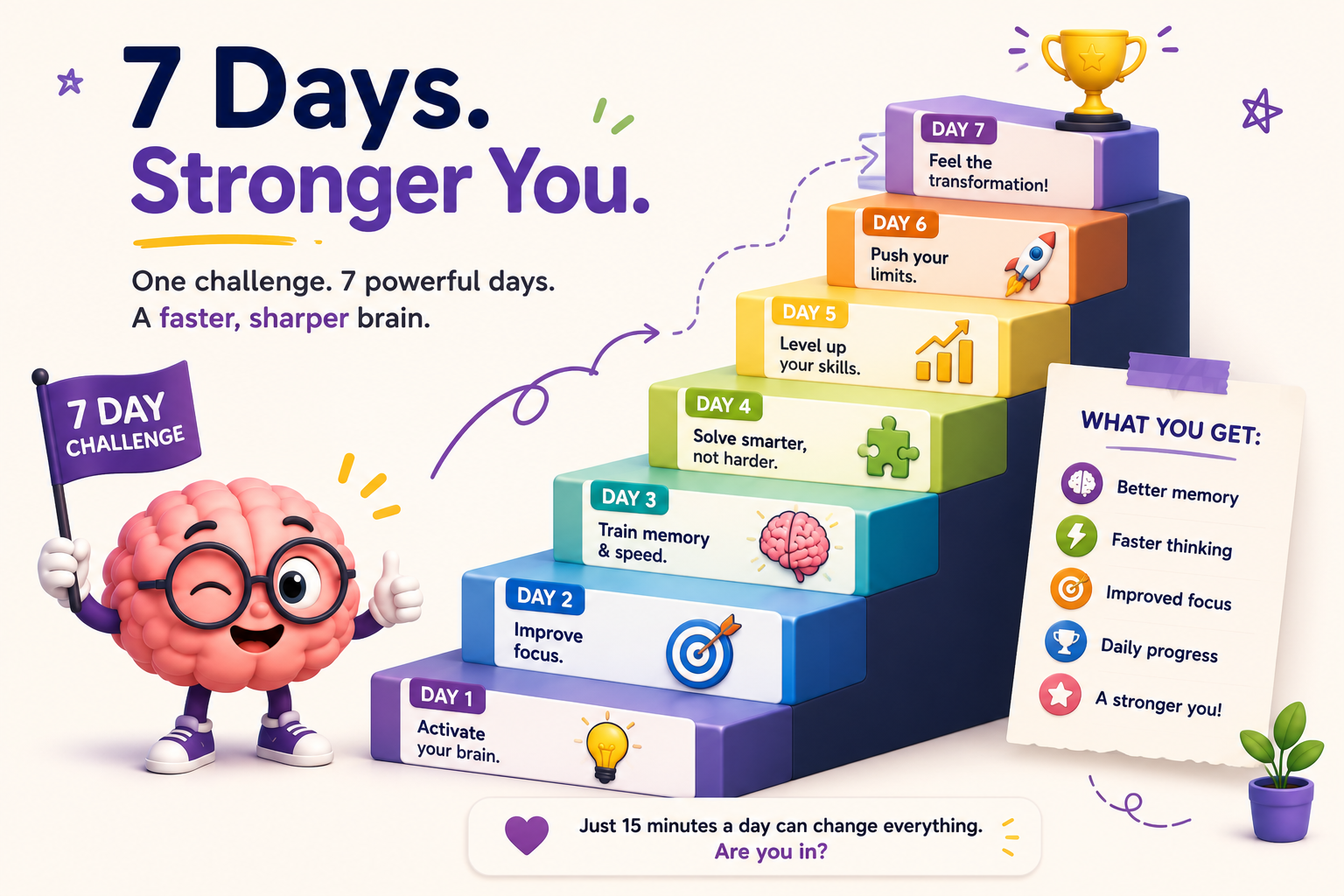
Every skill described above builds through repetition and specifically through frequent, regular repetition rather than occasional intensive effort. This is one of the most consistent findings in learning science: short daily sessions produce significantly better long-term outcomes than long infrequent sessions of equivalent total time.
The reason is biological. Skills consolidate during rest particularly during sleep not during the practice session itself. More frequent practice sessions mean more consolidation events, which means faster and more durable skill development. Ten minutes every day for a week produces more improvement than seventy minutes once a week. Every time.
⭐ Fun fact: The optimal session length for cognitive skill building has been studied extensively. Most research points to 10–20 minutes of focused practice as the sweet spot long enough to produce meaningful training stimulus, short enough to maintain the quality of attention that makes the practice effective. Calc Quest sessions sit exactly in that range.
Learning Through Play - Why It Works So Well
There's a reason children learn faster than adults in many domains and it isn't because their brains are more capable. It's because children learn through play, which means they practice without the self-consciousness, the fear of failure, and the resistance to effort that adults bring to learning activities.
Games recreate that state for adults. When you're genuinely engaged in a puzzle when you're focused on solving it rather than on the fact that you're supposed to be learning the cognitive engagement is deeper, the effort is more sustained, and the resulting skill development is more durable. You're not performing learning. You're doing the thing that produces it.
That's what Calc Quest is designed to do. Not to feel like brain training. To feel like play that happens to train your brain which, as it turns out, is the most effective form of brain training available.
"The most powerful learning experiences feel nothing like learning. They feel like absorption complete focus on something intrinsically engaging. Games produce that state more reliably than almost anything else."
Every Puzzle Is a Step Forward
Every Number Pyramid you complete strengthens your systematic thinking. Every Nonogram you solve sharpens your visual pattern recognition. Every Binairo grid you finish builds your logical reasoning. Every Simon Sequence you extend improves your working memory. Every Quick Calculation session makes your mental arithmetic faster.
None of these improvements are dramatic in any single session. But they compound session by session, week by week into something that is. The version of you that plays Calc Quest for a month thinks faster, focuses longer, reasons more clearly, and approaches hard problems with more confidence than the version that didn't.
That's not a promise. It's just what consistent cognitive practice produces and always has.
Every game is another step. Start taking them.