What Happens To Your Brain After 15 Minutes Of Puzzle Solving Daily?
what happens to your brain when you solve puzzles, brain benefits of puzzle solving, daily puzzle solving benefits, 15 minutes brain training, puzzle solving and brain health, cognitive benefits of puzzles, brain training daily habit, improve memory with puzzles, puzzle solving and focus, neuroplasticity brain training, Calc Quest, mental math brain benefits, logic puzzles brain health, puzzle solving for adults, daily brain exercise
Fifteen minutes doesn't sound like much. But for your brain, it's more than enough to start something real.
Most people assume meaningful brain training requires hours of effort a dedicated study session, a structured course, or some expensive app with a complex programme. The research says otherwise.
Fifteen minutes of focused puzzle solving each day is enough to produce measurable changes in how your brain processes information, handles challenges, and recovers from mental fatigue. Not eventually. Fairly quickly.
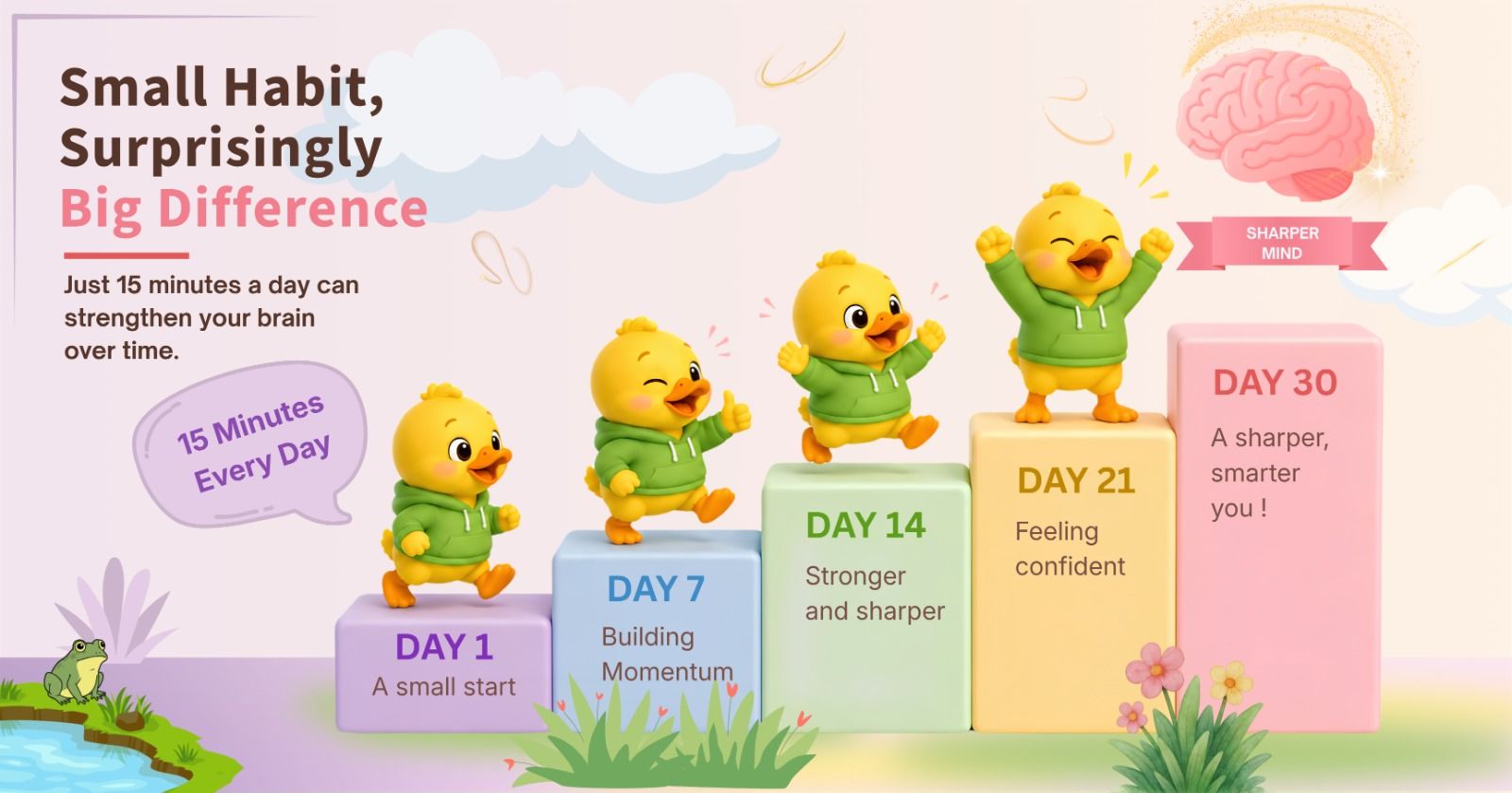
Here's what actually happens day by day, week by week when you make puzzle solving a daily habit.
"The brain doesn't need long sessions to improve. It needs consistent ones. Fifteen focused minutes beats two distracted hours every time."
In the First Few Days
Your Brain Starts Paying Attention Differently
The first thing most daily puzzle solvers notice usually within two or three days is a subtle shift in focus. Puzzles demand full attention. You can't half-solve a Number Pyramid while watching something else. The moment your attention drifts, you lose your place and have to start over.
That demand trains your brain to sustain concentration in a way that most daily activities simply don't require. And like any trained behavior, it begins to generalize showing up as slightly sharper focus in conversations, at work, and during tasks that used to feel difficult to sit with.
Your Frustration Tolerance Goes Up
Every puzzle has a moment where you don't know what to do next. That moment the stuck point is uncomfortable. Most people instinctively want to quit or guess their way through it.
Daily puzzle solving trains you to sit with that discomfort instead. To look at the problem from a different angle. To backtrack without giving up. After just a few days of this, the automatic "I can't do this" response starts getting quieter. Not gone just quieter. And that matters more than it sounds.
💡 Psychologists call this "productive struggle" the ability to persist through difficulty without shutting down. It's one of the strongest predictors of long-term learning success, and it's built through exactly the kind of daily low-stakes challenge that puzzles provide.
After One Week
Pattern Recognition Sharpens Noticeably
After a week of daily puzzle solving, most people notice that problems which felt hard at the start of the week feel noticeably easier by the end. This isn't because the puzzles have changed it's because your brain has started recognizing their structure.
Pattern recognition is the core skill that separates slow thinking from fast thinking. When your brain encounters a familiar structure, it stops calculating from scratch and starts retrieving which is dramatically faster and requires far less mental effort. One week of consistent puzzles is enough to start building that library of recognized patterns.
Your Working Memory Gets Stronger
Working memory is the mental scratchpad your brain uses to hold information while you're actively using it. Solving a logic puzzle, tracking a number sequence, or holding a partially completed Sudoku grid in your head all exercise this system intensively.
After a week of daily training, most people notice small but real improvements being able to hold more information in mind during conversations, making fewer "I forgot what I was doing" errors, and finding it easier to follow complex instructions without needing them repeated.
💡 Did you know? Working memory capacity is one of the strongest predictors of academic and professional performance across almost every field. Improving it through daily practice has effects that reach far beyond the puzzle itself.
After Two to Four Weeks
Problem-Solving Becomes More Instinctive
At the two-week mark, something shifts. Problems stop triggering the "where do I even start?" response and start triggering a quieter, more confident reaction: "Let me find the entry point."
That shift from paralysis to instinct is the result of your brain having built a reliable toolkit. You've seen enough stuck points, tried enough approaches, and found enough solutions that the process itself starts to feel familiar. You don't always know the answer immediately. But you know how to start looking for it. And that confidence changes everything.
Mental Fatigue Hits Later in the Day
One of the less-talked-about benefits of daily brain training is cognitive endurance the ability to think clearly for longer before mental fatigue sets in. Regular puzzle solving essentially raises the threshold at which your brain starts to tire.
Most consistent puzzle solvers report noticing this around the three to four week mark finding that afternoon slumps are less severe, that they can concentrate for longer stretches without losing quality, and that mentally demanding tasks feel less draining overall.
Your Relationship With Mistakes Changes
This one surprises most people. After a few weeks of daily puzzle solving where mistakes are a normal, expected, recoverable part of every session many people find that their response to errors in other areas of life quietly shifts too.
A wrong answer in a puzzle doesn't feel like failure. It feels like information. Apply that mindset consistently over weeks, and it starts to show up at work, in learning, and in everyday problem solving. Mistakes become data points rather than verdicts.
"Daily puzzle solving doesn't just make you better at puzzles. It makes you better at being wrong which turns out to be one of the most useful skills there is."
After One Month and Beyond
Thinking Feels Less Effortful
The most consistent thing people report after a month of daily puzzle solving is a general sense that thinking feels easier. Not that problems have disappeared or that everything is suddenly simple but that the mental friction involved in tackling a challenge has reduced noticeably.
This is neurological, not motivational. Repeated mental exercise builds stronger neural pathways the brain's equivalent of well-worn trails through a forest. What once required effortful navigation starts happening more automatically.
You Start Seeing Patterns Everywhere
After a month of training your brain to find structure in puzzles, something interesting happens: you start finding it outside of them too. Numbers in everyday life start revealing relationships. Problems at work start showing their structure more clearly. Conversations that once felt complicated start having a logic you can follow more easily.
This isn't imagination it's transfer. The pattern recognition you've built in a puzzle context genuinely generalizes to other domains. Your brain has learned a way of seeing, and it applies that way of seeing broadly.
⭐ Fun fact: Neuroscience research on neuroplasticity the brain's ability to reorganize and strengthen itself consistently shows that the brain responds to mental challenge at any age. There is no age at which daily puzzle solving stops producing benefits. The timeline just varies.
What Kind of Puzzles Work Best?
The short answer: varied ones. Different puzzle types train different cognitive skills, and the brain responds most strongly to variety and progressive challenge not repetition of the same easy task.
- Calculation puzzles (Quick Math, Number Pyramids) → build speed, arithmetic fluency, and working memory
- Pattern puzzles (sequences, number series) → build recognition speed and logical reasoning Logic puzzles (Sudoku, grid deduction) → build strategic thinking and sustained concentration
- Visual puzzles (Nonograms, picture logic) → build spatial reasoning and attention to detail
- Memory challenges (number recall, sequence retention) → directly strengthen working memory capacity
Rotating between these types even within a single 15-minute session gives your brain a more complete workout than focusing on one format alone. Think of it like cross-training: each type builds something slightly different, and together they compound.
The Only Requirement Is Showing Up
None of what's described above requires talent, prior experience, or a background in mathematics. It requires consistency the decision to sit down for 15 minutes today, and again tomorrow, and the day after that.
The puzzles don't need to be hard. They don't need to be the same every day. They just need to be slightly challenging enough to make your brain work, not so much that it shuts down. That sweet spot is easier to find than most people expect. And once you find it, 15 minutes a day stops feeling like practice and starts feeling like something you actually look forward to.
"The best brain training routine is the one you'll actually do tomorrow. Keep it short. Keep it daily. Let the results do the convincing."
Start Today, Not Next Week
Every day you don't start is a day of compounding you don't get. The benefits described above aren't available to people who plan to start only to people who already have.
Fifteen minutes. Today. That's the whole ask.
Your brain will feel the difference before you even realize it's happening.