What Is KenKen? The Math Puzzle You’ll Wish You Found Earlier
what is kenken puzzle, how to play kenken, kenken for beginners, kenken vs sudoku, kenken math puzzle, kenken rules explained, kenken brain benefits, kenken for kids, kenken puzzle walkthrough, logic math puzzles, arithmetic puzzles, brain training puzzles, Calc Quest, kenken app, math puzzle for adults
Somewhere between Sudoku and a math test lives a puzzle that manages to be better than both. It's called KenKen and once you try it, you'll wonder where it's been your whole life.
KenKen looks familiar at first glance. A grid. Numbers. A rule about no repeats. If you've played Sudoku, you'll feel an immediate sense of recognition and then, about thirty seconds in, realise this is something different. Something that asks more of you. Something that rewards you more deeply for getting it right.
This is everything you need to know about KenKen what it is, how it works, why it's so good for your brain, and why so many people who discover it in adulthood immediately wish they'd found it earlier.
"KenKen combines the clean logic of Sudoku with the arithmetic of mental math and the result is one of the most complete brain workouts a single puzzle can deliver."
What Is KenKen?
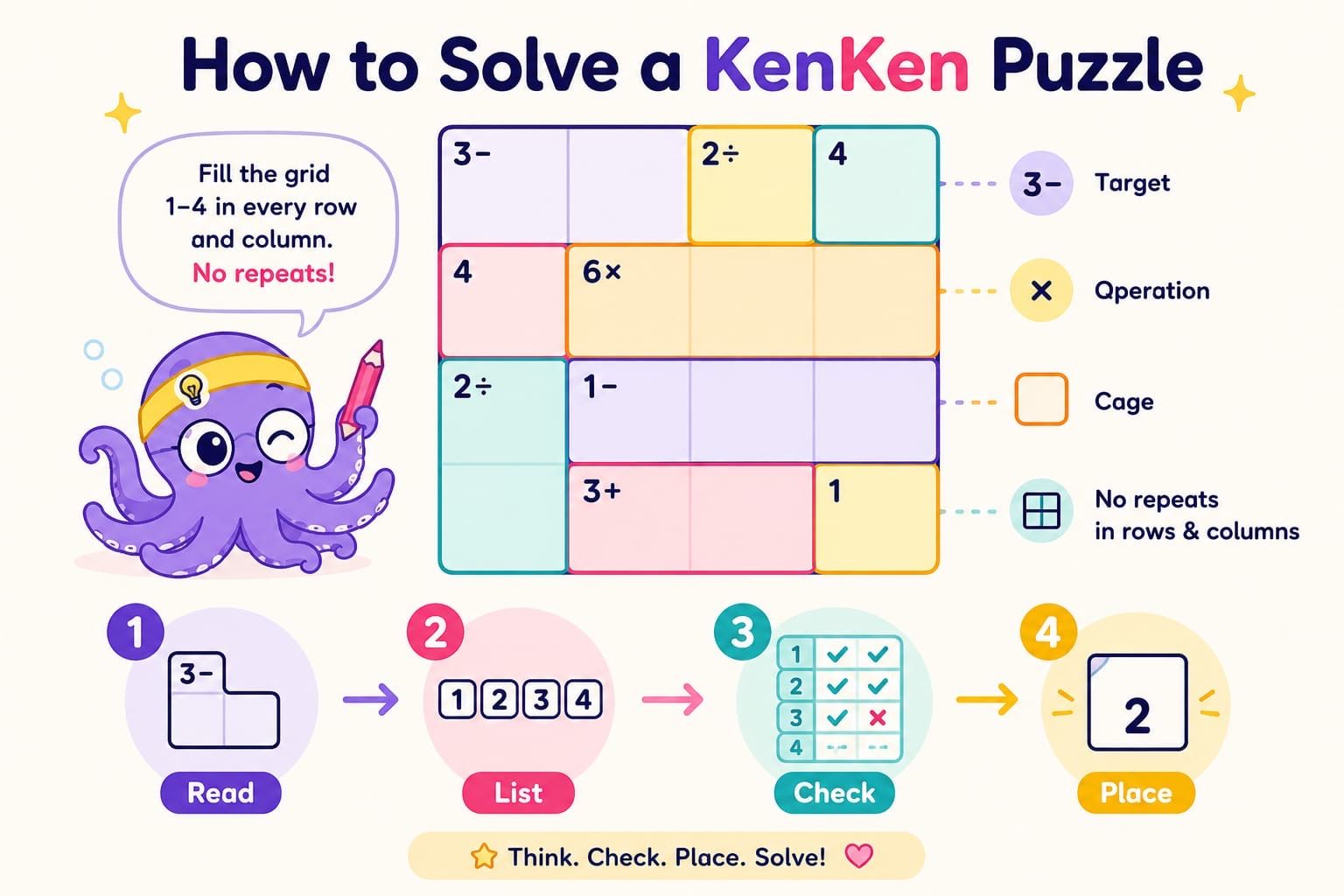
KenKen is a number puzzle played on a square grid typically 4×4, 6×6, or 9×9 where the goal is to fill every row and column with numbers without repeating any. So far, that sounds like Sudoku. Here's where it diverges.
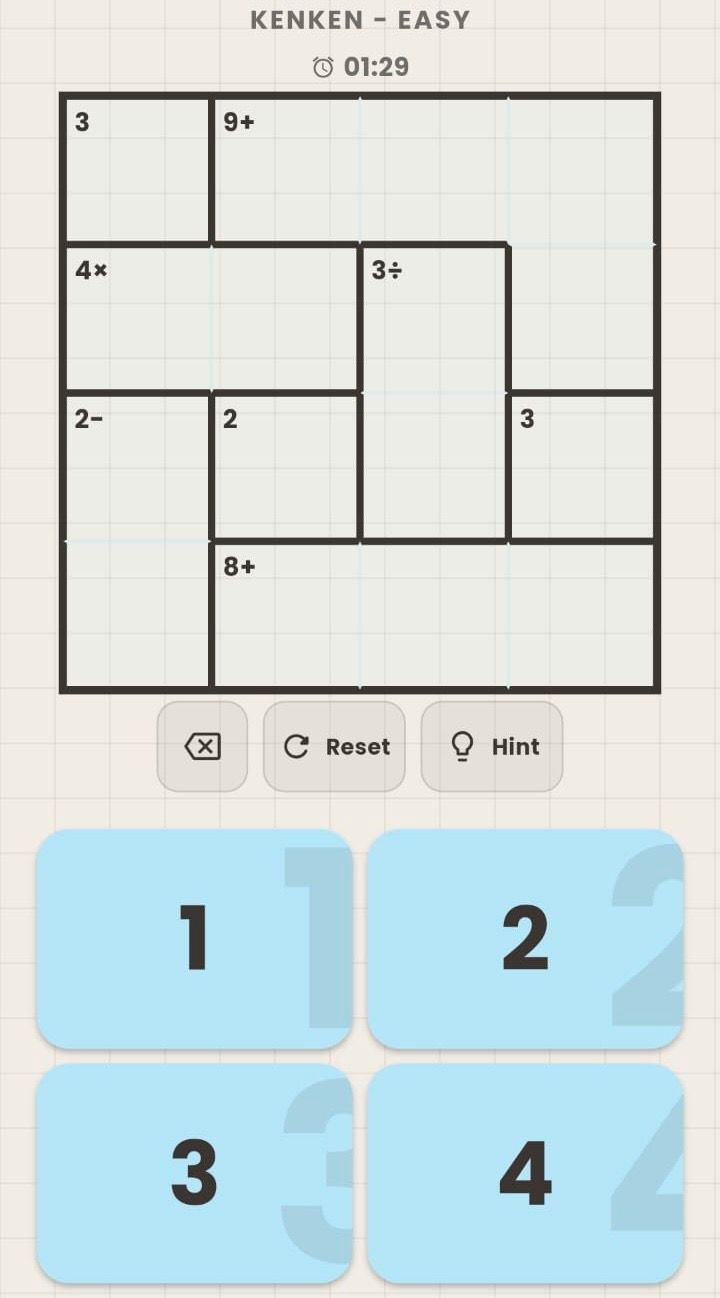
The grid is divided into outlined groups of cells called cages. Each cage has a target number and a mathematical operation addition, subtraction, multiplication, or division. The numbers you place inside a cage must combine using that operation to produce the target number.
For example: a cage containing two cells labelled "6×" means the two numbers in those cells must multiply to give 6. A cage labelled "3−" means the difference between the two numbers must be 3. A single-cell cage labelled "7" simply means that cell contains the number 7.
💡 The name "KenKen" comes from the Japanese word for "cleverness" or "square wisdom" 賢 (ken) meaning wise or clever. It was created by Japanese math teacher Tetsuya Miyamoto in 2004 as a tool to help students improve arithmetic without realising they were practising.
The Rules — Simpler Than They Sound
KenKen has three rules. Once these click, the rest is pure logic.
Rule 1 - No repeats in rows or columns. In a 4×4 grid, every row and every column must contain the numbers 1, 2, 3, and 4 each exactly once. In a 6×6 grid, every row and column uses 1 through 6. Same idea, bigger grid.
Rule 2 - Satisfy the cage targets. The numbers in each outlined cage must combine using the operation shown to produce the target number in the corner of that cage.
Rule 3 - Numbers can repeat within a cage. As long as they don't repeat within the same row or column, the same number can appear more than once inside a single cage. This rule surprises most beginners and it's the source of some of KenKen's most interesting logic.
💡 Tip: Single-cell cages are your free moves. Any cage containing just one cell tells you exactly what number goes there fill those in first and let them constrain everything around them.
How KenKen Differs From Sudoku
The comparison to Sudoku is natural both use grids, both forbid row and column repeats, both are solved through logical deduction. But KenKen adds a layer that Sudoku doesn't have: arithmetic.
In Sudoku, numbers are essentially symbols. You could replace 1 through 9 with letters or colours and the puzzle would work identically the values themselves don't matter, only their distinctness. In KenKen, the values matter completely. A cage labelled "12×" requires numbers that actually multiply to 12. A cage labelled "5+" requires numbers that actually add to 5.
This means KenKen trains two things simultaneously the logical deduction of Sudoku and the arithmetic fluency of mental math. That combination is what makes it feel so rewarding and why regular players report improvements not just in puzzle solving but in everyday number confidence.
"Sudoku trains logic. Mental math trains arithmetic. KenKen trains both at the same time which is why it feels twice as satisfying to solve."
Why KenKen Is So Good for Your Brain
It Uses Four Operations Not Just One
Most arithmetic practice focuses heavily on one or two operations. KenKen rotates through all four- addition, subtraction, multiplication, and division within a single puzzle. That variety keeps your brain actively engaged rather than falling into a comfortable routine with a single operation type.
Over time this builds what mathematicians call "operational fluency" the ability to move fluidly between different types of calculation without losing pace or confidence. It's the mental equivalent of being ambidextrous.
It Forces You to Think in Multiple Directions
Solving a KenKen cage requires working in two directions simultaneously: forwards (what combinations of numbers produce this target?) and backwards (given what I know about this row and column, which of those combinations are actually possible?).
That bidirectional thinking generating possibilities and eliminating them at the same time is one of the most sophisticated forms of logical reasoning a puzzle can demand. And KenKen does it at every cage, in every puzzle, at every difficulty level.
It Builds Number Intuition
After solving dozens of KenKen puzzles, something interesting happens: you start to instantly recognize which number combinations produce which results. You know that a "6×" cage in a 4×4 grid can only be 2×3 or 1×6 and since 6 isn't on the grid, it must be 2×3. You know that a "5+" cage with two cells in a 4×4 grid can only be 1+4 or 2+3.
That instant recognition number intuition built through repeated logical practice is exactly what separates fast mental math from slow mental math. KenKen builds it without you ever sitting down to memorize anything.
💡 Did you know? KenKen was introduced to American schools in 2008 through The New York Times and became one of the most rapidly adopted classroom math tools in recent history used by teachers who found it built genuine arithmetic fluency in students who claimed to hate math.
Who Is KenKen For?
The honest answer is: almost everyone but it lands differently depending on where you're starting from.
For children: KenKen builds all four arithmetic operations through genuine problem solving rather than rote practice. Children who play it regularly develop number intuition and calculation confidence that shows up directly in classroom performance without ever feeling like they're doing homework.
For students: KenKen sharpens the mental arithmetic and logical reasoning skills that appear throughout standardised tests and exams especially the ability to work backwards from a result, which is a core skill in algebra, geometry, and beyond.
For adults: KenKen is a genuinely satisfying mental challenge that improves with practice. Regular players report sharper calculation speed, better working memory, and a noticeable increase in the confidence with which they handle numbers in everyday life.
For puzzle lovers: If you've exhausted Sudoku and want something that asks more of you KenKen is the natural next challenge. Same clean logic, with arithmetic added as an extra dimension. Harder. More rewarding. Harder to put down.
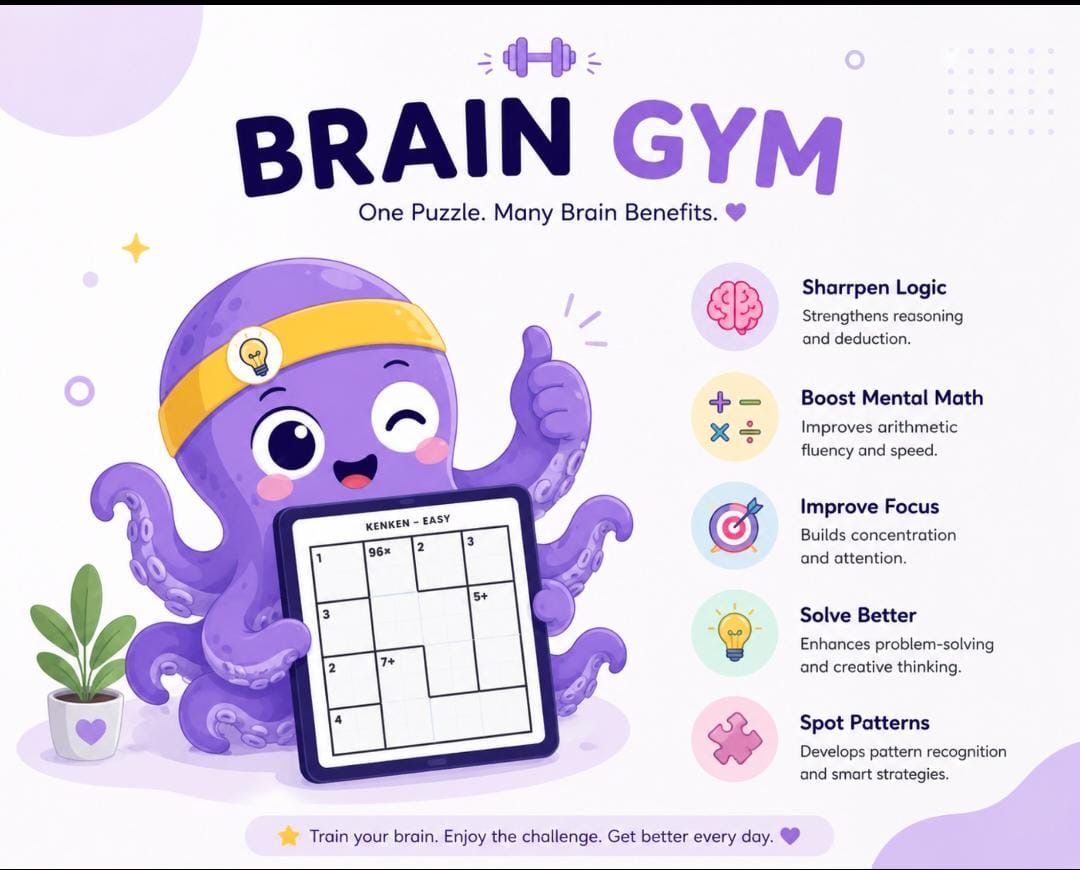
⭐ Fun fact: KenKen has been used as a daily brain exercise by adults in their 70s, 80s, and 90s as part of cognitive health programmes and has shown measurable positive effects on processing speed, working memory, and numerical reasoning in older adults.
How to Get Better at KenKen Faster
- Always fill single-cell cages first. They're free information use them immediately to constrain everything around them.
- List cage combinations before placing anything. For each cage, write out every possible combination of numbers that satisfies the target. Then use the no-repeats rule to eliminate impossible ones.
- Focus on the most constrained cage. The cage with the fewest valid combinations is your next move not the cage that looks easiest. Fewer possibilities means more certainty, and certainty is what unlocks the rest of the grid.
- Use rows and columns actively. Every number you place eliminates it as an option from every other cell in the same row and column. Make that elimination explicit it reveals your next move faster than trying to solve cages in isolation.
- Start with 4×4 grids and stay there until they feel easy. The jump from 4×4 to 6×6 is significant more cages, more combinations, more constraints to track simultaneously. Build the logic on the smaller grid first. The 6×6 will feel achievable when you're ready for it.
The Puzzle You'll Wish You Found Earlier
Most people who discover KenKen in adulthood have a similar reaction: mild frustration that nobody showed them this earlier. It's the kind of puzzle that makes math feel like what it actually is a system of elegant, logical relationships rather than a collection of procedures to memorize.
It's challenging without being intimidating. It rewards both logic and arithmetic. It scales gracefully from beginner to expert. And it produces, in every completed grid, the quiet satisfaction of having thought clearly and gotten something genuinely right.
"KenKen doesn't ask you to be good at math. It asks you to think carefully. Do that consistently, and the math takes care of itself."
Try one. The cleverness is waiting.