What Makes Nonograms So Addictive?
why are nonograms addictive, nonogram puzzles, how to solve nonograms, nonogram logic puzzle, picture logic puzzles, nonogram benefits, brain benefits of nonograms, puzzle games for brain training, nonograms for beginners, logic puzzles online, Calc Quest, nonogram app, flow state games, relaxing brain games
At first glance, Nonograms look almost too simple. A small grid. A few numbers. Some empty squares.
That's it. There's no flashy animation, no countdown timer screaming at you, no complicated rules to memorize. Just a quiet grid waiting to be solved.
And yet once you crack your first puzzle, something happens. You look up and twenty minutes have disappeared. You find yourself thinking "just one more." You start a new puzzle before you've fully processed finishing the last one.
So what exactly is going on?
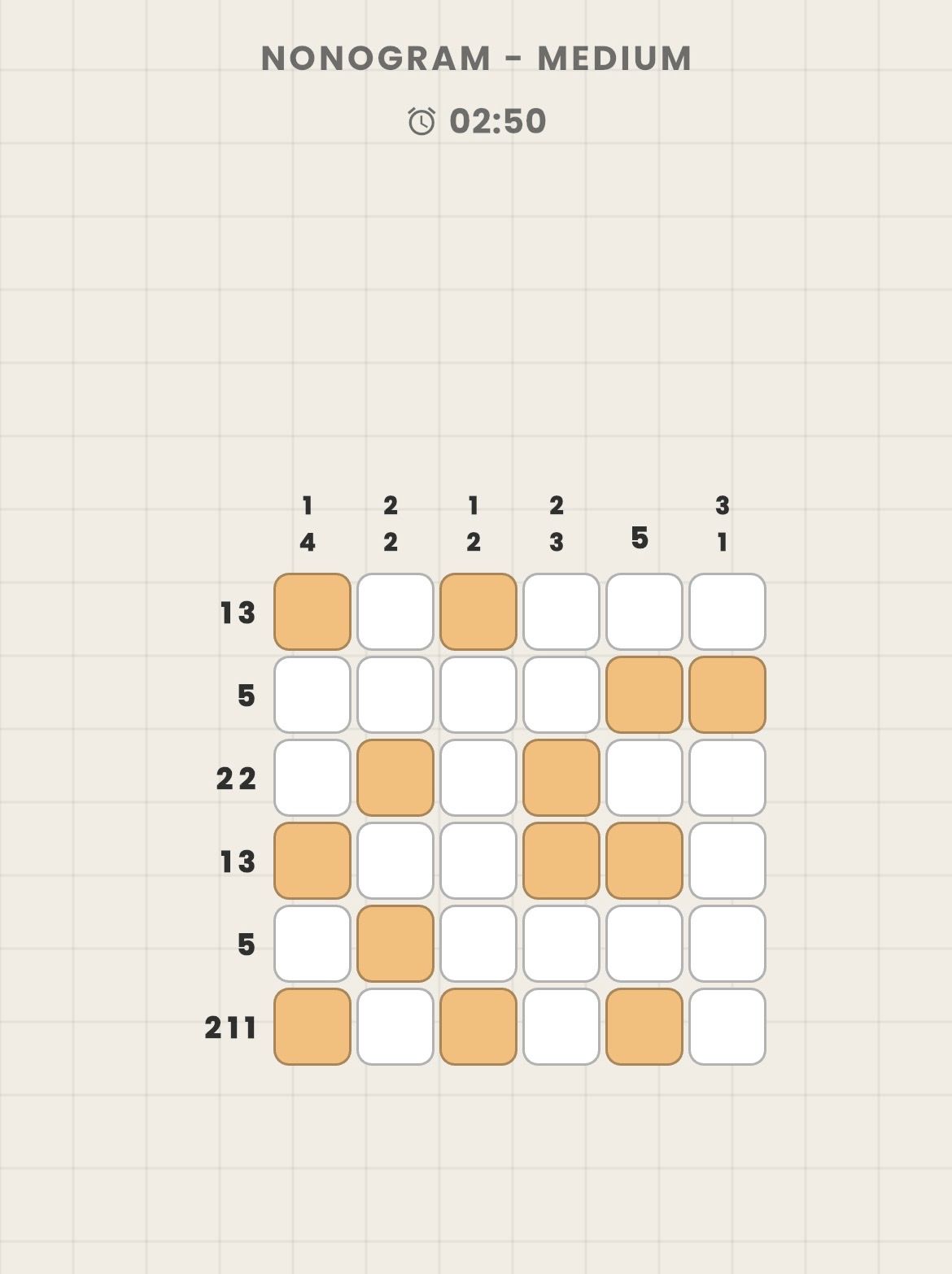
"Nonograms don't look like much. That's part of why they're so hard to put down."
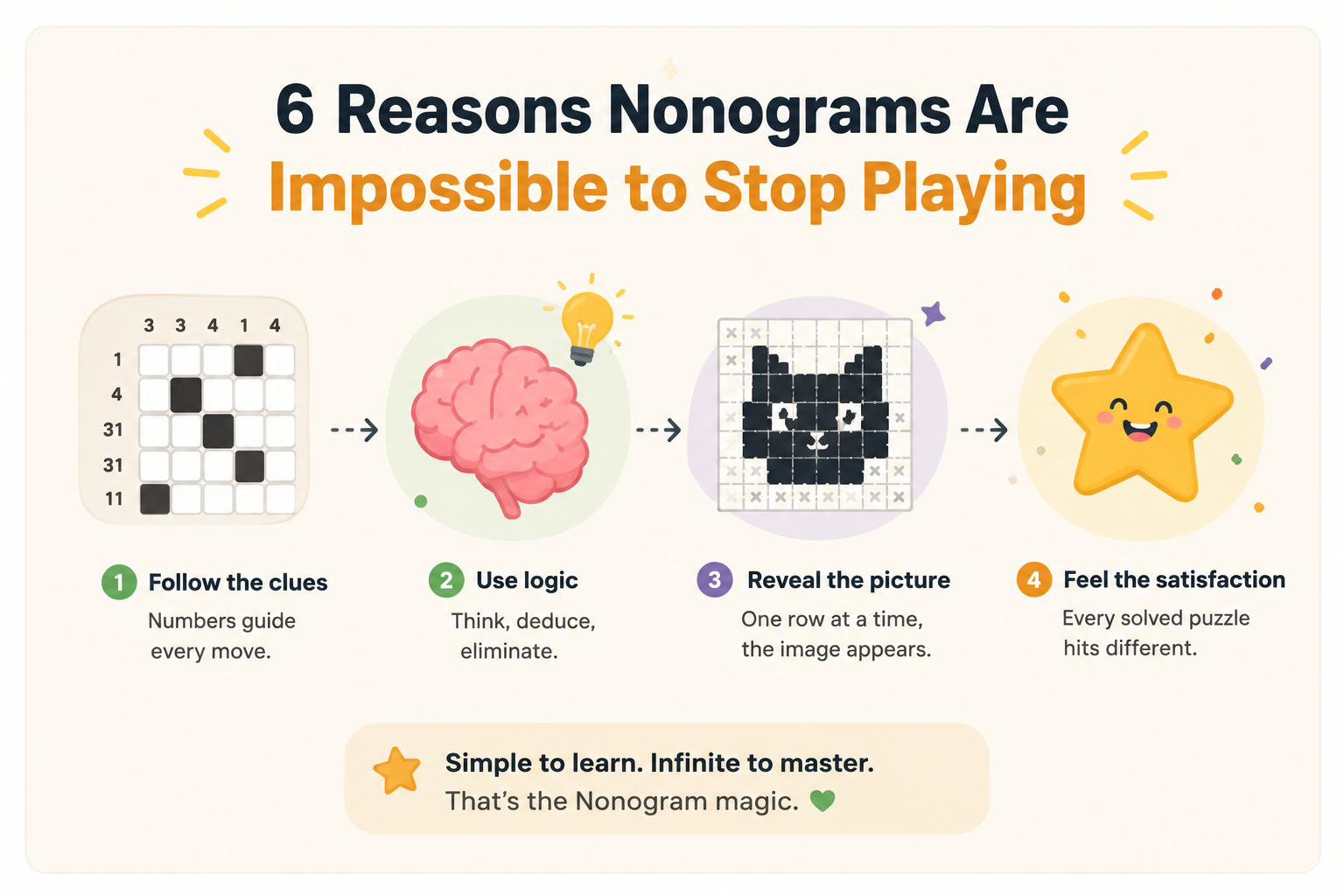
6 Reasons Nonograms Are Impossible to Stop Playing
1. Every Puzzle Feels Like a Mystery
Most math problems tell you exactly what you're building. Nonograms don't. You start with a set of clues and no picture just the promise that one is hiding inside the grid, waiting for you to find it.
Every correct square reveals a little more. Every row you complete brings the image slightly into focus. Your brain is wired to chase that feeling of discovery it releases dopamine with each small reveal, which is exactly why "just one more row" turns into "just one more puzzle."
💡 This is sometimes called the "progress principle" humans are more motivated by the feeling of moving toward a goal than by the reward itself. Nonograms are built on this from the very first square.
2. They Reward Logic, Not Luck
Guessing in a Nonogram almost never works. A wrong square doesn't just cost you a point it can create contradictions that ripple across the entire grid. The only reliable path to a solution is careful, methodical thinking.
That's what makes completing one feel genuinely earned. You didn't get lucky. You reasoned your way through. And your brain knows the difference the satisfaction of a logic-based win is qualitatively different from a lucky one. It lasts longer. It feels better.
Every completed Nonogram is a small piece of evidence that you figured it out. Those accumulate into real confidence over time.
3. They're Built on Tiny Wins
Every completed row is progress. Every section you solve closes off uncertainty and opens up new possibilities. Each of those moments is a micro-reward — small enough to feel effortless, satisfying enough to keep you going.
Game designers call this a "reward loop." Nonograms have one of the most natural and elegant reward loops of any puzzle format, because every single correct square counts. Nothing is wasted. Every move matters.
💡 Did you know? The "tiny wins" effect is well documented in behavioral psychology. Small, frequent rewards sustain motivation far more effectively than large, infrequent ones — which is why Nonograms keep people playing longer than puzzles with a single payoff at the end.
4. They Live in the Sweet Spot Between Relaxing and Challenging
Most games push you toward one extreme. Either they're too easy boring after a few minutes or too stressful, full of pressure, timers, and failure states that spike your anxiety.
Nonograms sit in a rare middle ground. They require real thought, but they don't rush you. There's no enemy. There's no countdown. There's just the grid, the clues, and you working through it at whatever pace feels right.
Psychologists call this state "flow" the feeling of being fully absorbed in a task that's challenging enough to hold your attention but not so hard that it overwhelms you. Nonograms hit that zone reliably, which is why so many people reach for them at the end of a long day.
"Nonograms are the puzzle equivalent of a long walk. Calm, focused, and oddly restorative."
5. You Get Visibly Better Over Time
One of the most satisfying things about Nonograms is that improvement is obvious. Puzzles that once took you 20 minutes start taking 10. Patterns you used to hunt for start jumping out immediately. Grids that looked overwhelming start revealing their structure within seconds.
That visible progress keeps the experience feeling fresh even after dozens of puzzles because you're not just solving the same puzzle faster. You're becoming a different kind of thinker.
The shift from calculating to seeing recognizing structure before consciously working through it is one of the best things puzzle solving can do for your brain.
6. They Combine Logic, Creativity, and Curiosity All at Once
Most puzzles exercise one part of your brain. Nonograms ask for several things simultaneously: logical deduction to eliminate possibilities, spatial reasoning to hold the grid in your mind, and creative thinking to find the non-obvious move when you're stuck.
That combination is rare. And it's part of why Nonograms feel mentally satisfying in a way that most other games don't you're not just winning. You're thinking well.
⭐ Fun fact: Nonograms originated in Japan in the late 1980s and were originally called "o-ekaki logic" roughly translated as "picture logic." They spread globally through puzzle magazines in the 1990s and haven't slowed down since.
Why People Keep Coming Back
A Nonogram doesn't just give you a puzzle to solve. It gives you something to uncover a hidden image that only exists because you reasoned your way to it. That sense of authorship, of having built something through thinking, is genuinely hard to replicate.
Finish one puzzle and the next grid is already waiting. The clues are fresh. The image is new. And your brain, having just experienced the full cycle of challenge, progress, and resolution, is ready to do it all again.
"One more puzzle" is how every great puzzle game earns its reputation. Nonograms have been earning it for decades.
Ready to See What All the Fuss Is About?
The next time you open a Nonogram, pay attention to how quickly time passes. You might sit down for five minutes and look up thirty minutes later, grid completed, already eyeing the next one.
That's not distraction. That's flow. And it's a surprisingly good way to spend time.
Give it five minutes. See what happens.