Which CalcQuest Puzzle Matches Your Personality?
which puzzle matches your personality, puzzle personality quiz, types of puzzle players, math puzzle personality, best puzzle for your brain type, nonogram vs sudoku, number pyramid puzzle, quick calculation game, logic puzzle personality, Calc Quest puzzles, brain training personality, puzzle games for adults, what kind of puzzle should I play, math games personality, puzzle app
Not all puzzle lovers are the same. And not all puzzles are either.
Some people love the rush of solving something fast. Others prefer sitting quietly with a complex problem until it finally gives way. Some think in pictures. Some think in patterns. Some just want something satisfying to do for ten minutes before bed.
The puzzle you're drawn to says something real about how your brain works — and knowing that can help you get more out of every session.
So which Calc Quest puzzle is actually yours? Read through the profiles below and find the one that sounds uncomfortably familiar.
"The puzzle you enjoy most isn't random. It's a mirror. It shows you exactly how your brain prefers to think."
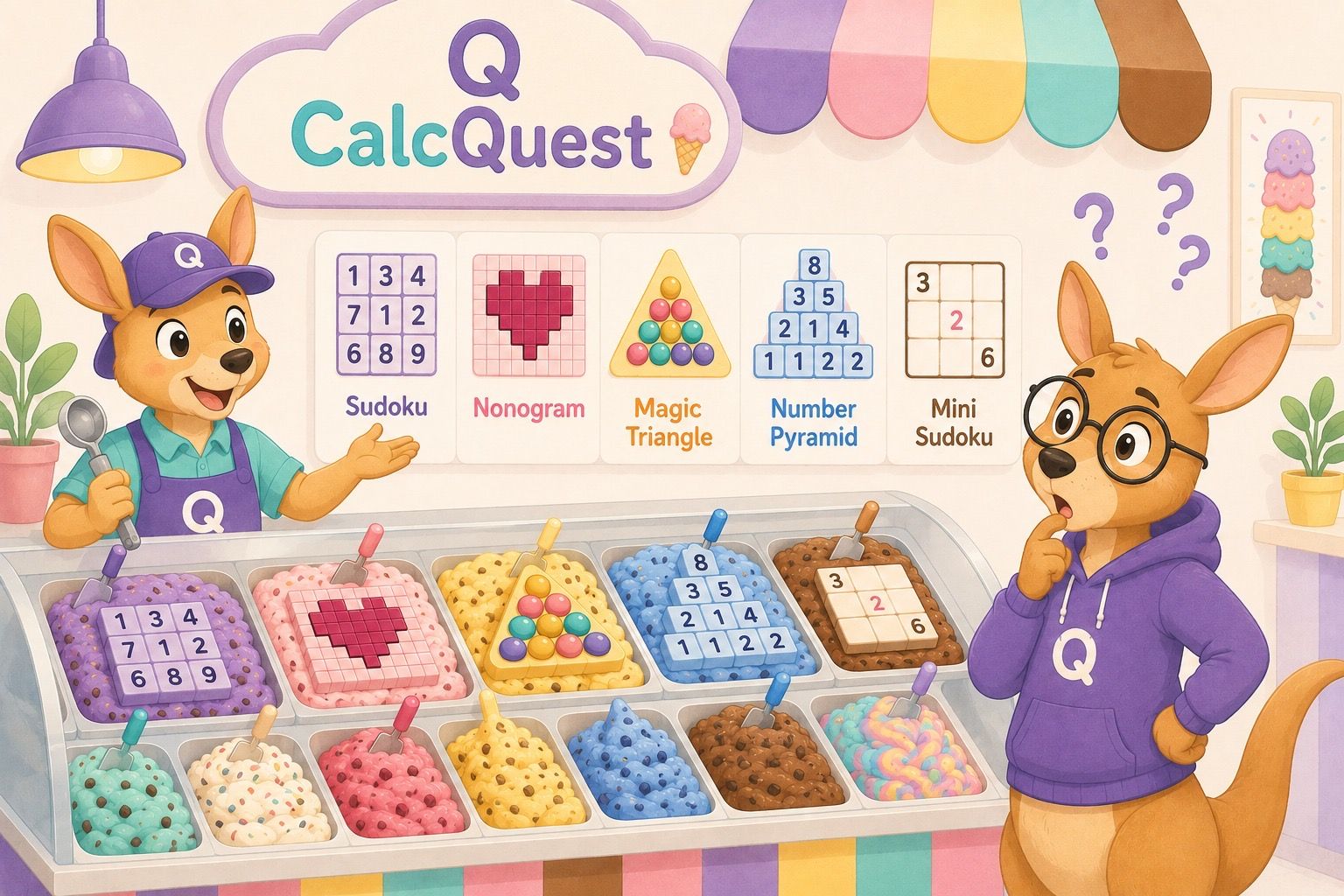
The Profiles
If You Love Moving Fast and Beating Your Own Score Quick Calculation Is Your Game
You're competitive. Not necessarily with other people mostly with yourself. You set a personal best and immediately start thinking about how to beat it. You like knowing your score. You like the timer. You find the pressure energizing rather than stressful.
You're also the kind of person who gets frustrated when things move slowly. Give you a clear goal, a countdown, and a measurable result, and you're completely in your element.
Quick Calculation challenges are built for exactly this brain. Fast questions. Instant feedback. A score you can improve on tomorrow. Every session is a race and you already want to run it again.
💡 Your superpower: Speed under pressure. You perform better when the stakes feel real even if the only thing at stake is your own previous best.
If You Like Figuring Things Out Step by Step Number Pyramids Are Your Game
You're methodical. You don't like guessing not because you're afraid to be wrong, but because a lucky answer feels hollow. You want to know why something works, not just that it does. You're the person who reads the instructions before starting, then ignores them once you've understood the logic.
You like progress you can see. A half-finished Number Pyramid with three rows solved and two to go feels satisfying in a way that an unsolved puzzle doesn't because you can see exactly where you are and exactly where you're going.
Number Pyramids reward this personality completely. Every solved row is visible progress. Every number you place narrows the possibilities above it. The whole puzzle builds from the bottom up just like you do.
💡 Your superpower: Systematic thinking. You build solutions layer by layer, and you almost never have to backtrack because you checked your work as you went.
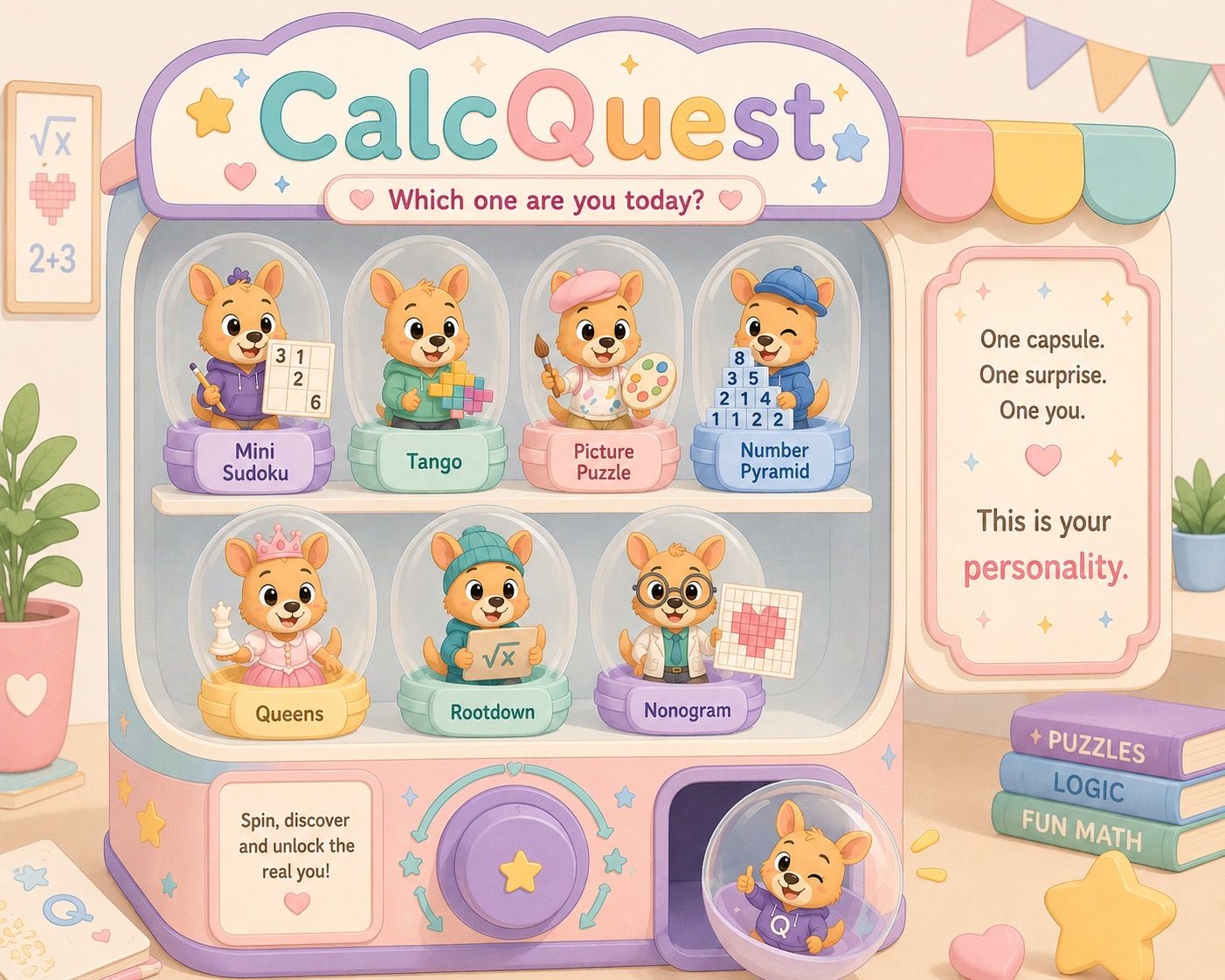
If You Think in Pictures and Spot Things Others Miss Nonograms Are Your Game
You're observant. You notice things before other people do a pattern in a crowd, a detail that doesn't fit, a shape that repeats. You think spatially. You find purely numerical problems a bit dry, but the moment a problem has a visual dimension, you come alive.
You're also patient in a specific way not plodding, but willing to sit with ambiguity while you build the picture gradually. You don't need to see the whole answer to start. You just need enough to take the next step.
Nonograms are made for you. Each correct square reveals a little more of a hidden image. The puzzle rewards visual pattern recognition above everything else and you have more of that than most people realize.
💡 Your superpower: Visual intelligence. You see structure in things that look random to everyone else. Nonograms just give that skill somewhere useful to go.
If You Like Rules and Pushing Them to Their Limits Sudoku Is Your Game
You respect structure. Not because you're rigid because you understand that good constraints actually create freedom. Given a clear set of rules, you don't feel limited. You feel focused. You know exactly what "winning" looks like, and you enjoy finding the most elegant path to get there.
You're also quietly persistent. You don't give up on a puzzle just because it gets hard. You get interested. You look at it from a different angle. You find the move that everyone else missed.
Sudoku is your natural habitat. One rule no repeats applied across rows, columns, and boxes simultaneously. The constraints build on each other endlessly, and so does your enjoyment.
💡 Your superpower: Constraint thinking. You find freedom within rules and the more complex the constraint, the more clearly you see the solution.
If You Like Puzzles That Feel Like Magic Tricks Magic Triangles Are Your Game
You're curious in a specific way you want to know the trick behind the trick. When something looks impossible, your first instinct isn't frustration. It's suspicion. There's a pattern here. There has to be. You just haven't found it yet.
You also have a strong memory without necessarily knowing it. You track multiple things simultaneously without feeling overloaded possibilities, constraints, numbers you've already tried. You think in networks rather than lines.
Magic Triangles reward exactly this. The corner sum formula the hidden logic that makes every arrangement solvable is a trick waiting to be discovered. And the moment it clicks, you'll wonder how you ever solved one without it.
💡 Your superpower: Pattern memory. You hold more in your head than you realize and Magic Triangles are one of the few puzzles that actually ask you to use all of it.
If You Like Feeling Clever Without Feeling Rushed Mini Sudoku Is Your Game
You enjoy the feeling of solving something but you don't enjoy pressure. You want to think clearly, take your time, and arrive at the right answer with confidence rather than luck. You find timed challenges more stressful than fun, but you also don't want something so easy it requires no thought.
You're looking for a sweet spot: genuinely satisfying, but on your own terms.
Mini Sudoku lives in that sweet spot. All the logic of the full grid but compact enough to hold completely in your head, short enough to finish in a few minutes, and satisfying in a way that's entirely yours. No race. No pressure. Just a small, elegant puzzle solved correctly.
💡 Your superpower: Calm precision. You don't rush and because you don't rush, you almost never make careless mistakes. Mini Sudoku rewards that quality more than any other puzzle type.
If You Like Puzzles That Teach You Something New Every Time Number Patterns Are Your Game
You're a learner at heart. You're not just interested in solving you're interested in understanding. Every puzzle is an opportunity to spot something you haven't seen before, add a new pattern to your mental library, and leave slightly smarter than you arrived.
You also have a natural curiosity about how things connect. You see relationships between numbers. You notice when a sequence feels familiar even if you can't immediately name why.
Number Pattern puzzles are built for this personality. Each sequence has a rule waiting to be found. Find it, and you've learned something that makes the next sequence faster to crack. Over time, your mental library of patterns grows and so does your speed.
💡 Your superpower: Relational thinking. You don't see numbers in isolation you see the relationships between them. That's the core skill in pattern recognition, and you already have it.
So Which One Are You?
If you found yourself nodding at more than one profile good. Most people have a primary puzzle personality and a secondary one, and rotating between two puzzle types gives your brain a more complete workout than sticking to just one.
But if one profile felt like it was written specifically about you that's your starting point. Begin there. Build the habit. Then branch out when you're ready.
"The puzzle that matches your personality is the one you'll actually come back to tomorrow. Start there. The rest follows."
A Quick Summary
- Love speed and scoring → Quick Calculation
- Think step by step → Number Pyramids
- Think in pictures → Nonograms
- Love rules and logic → Sudoku
- Love hidden patterns → Magic
- Triangles Prefer calm and precision → Mini Sudoku
- Love learning something new → Number Patterns
All of these puzzles and more are inside Calc Quest. Whether you're a speed demon, a methodical builder, a visual thinker, or a quiet pattern hunter, there's a challenge in there that was made for the way your brain works.
Find yours. It's waiting.