Why Kids and Adults Both Love Logic Games?
why kids love logic games, why adults love puzzles, logic games for all ages, benefits of logic puzzles for kids, brain games for adults, logic puzzles for children, family puzzle games, math games for kids and adults, cognitive benefits of puzzles, logic games and brain health, Calc Quest, puzzle app for all ages, number puzzles for families, educational games for kids, brain training for adults
Most games are designed for a specific age. Logic games somehow work for everyone and that's not an accident.
A seven-year-old and a forty-five-year-old can sit down with the same Sudoku puzzle, the same Number Pyramid, the same Magic Triangle and both walk away genuinely challenged, genuinely satisfied, and genuinely wanting to try another one.
That almost never happens with other types of games. So what is it about logic puzzles that makes them age-proof?
The answer goes deeper than "they're fun." Logic games tap into something fundamental about how human brains work something that doesn't change much between childhood and adulthood. Understanding what that is changes how you think about puzzles entirely.
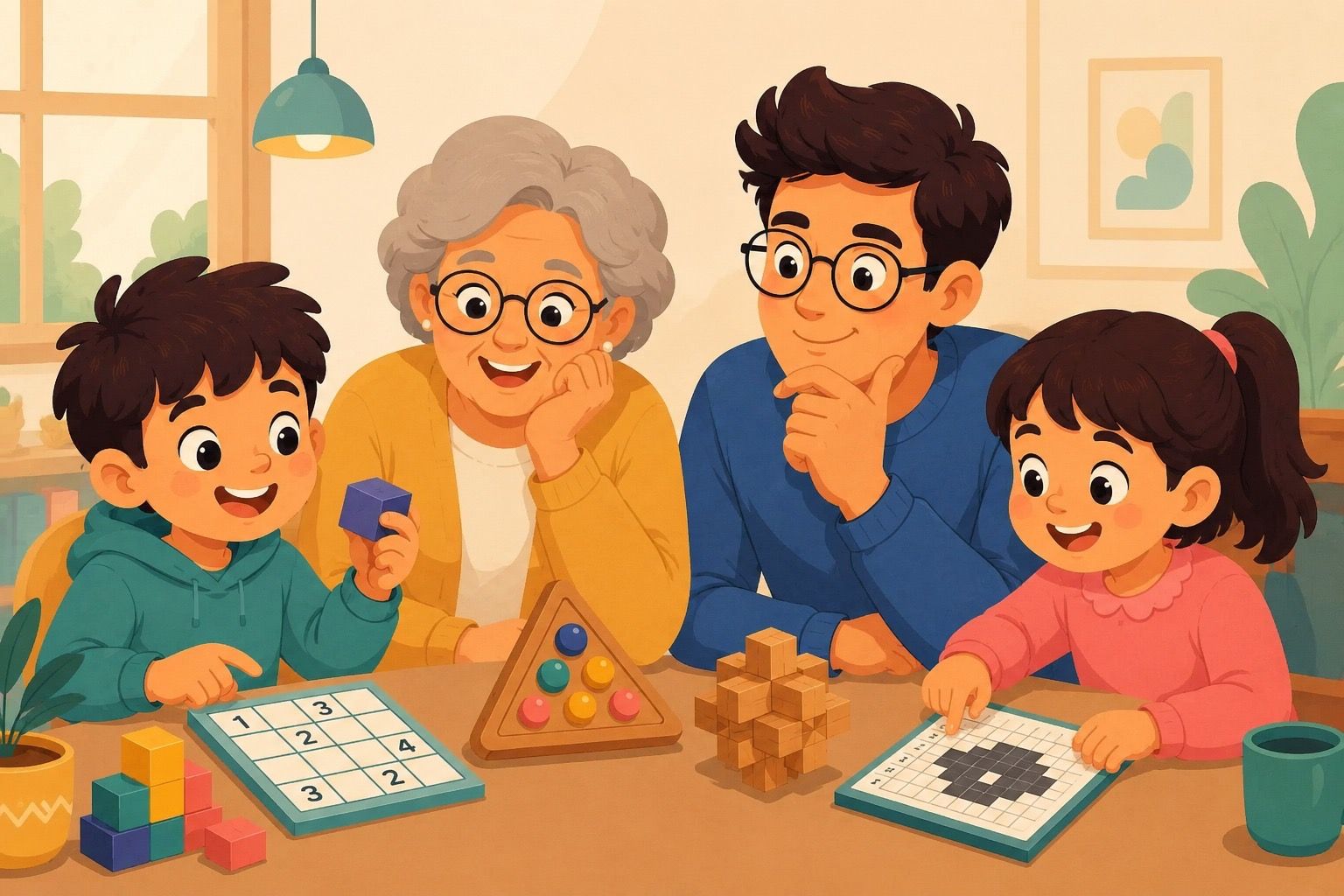
"Logic games are one of the only activities on the planet where a child and a grandparent can be equally challenged by the same problem. That's not a small thing."
The Thing That Never Changes
From the moment a child starts making sense of the world, their brain is doing one thing constantly: looking for patterns. What comes next? What belongs here? What doesn't fit? This drive to find order, to solve, to make sense of things is as strong at seven as it is at seventy.
Logic games speak directly to that drive. They don't require you to know history, master a physical skill, or understand cultural references. They just ask: can you see the pattern? Can you find the rule? Can you figure out what belongs where?
That question is universal. And a question that's universal will always find an audience across every age group.
"Pattern recognition is the brain's oldest skill. Logic games are the purest way to exercise it at any age."
Why Kids Love Logic Games
They Feel Like Play, Not Study
For a child, the framing of an activity matters enormously. The exact same mental challenge completing a number sequence, placing digits in a grid, filling in a pyramid feels completely different depending on whether it's presented as homework or as a game.
Logic games get this right instinctively. There's no worksheet. There's no red pen. There's just a puzzle, a goal, and the satisfying click when the pieces fall into place. Children don't feel like they're practicing math. They feel like they're playing. And they are they're just also building real skills while they do it.
💡 Research consistently shows that children learn more effectively when they don't know they're learning. Logic games are one of the most efficient delivery mechanisms for genuine mathematical thinking ever designed precisely because they don't feel like math.
Every Win Feels Earned
Children have a finely tuned sense of fairness. They know when they've been given an answer versus when they've found it themselves. Logic puzzles always fall into the second category you can't be told the solution to a Nonogram or a Magic Triangle in a way that counts. You have to work it out.
That earned quality is enormously motivating for young players. It builds a belief that their thinking produced a real result not luck, not help, not a shortcut. That belief, repeated across hundreds of small puzzles, is one of the most valuable things a child can develop.
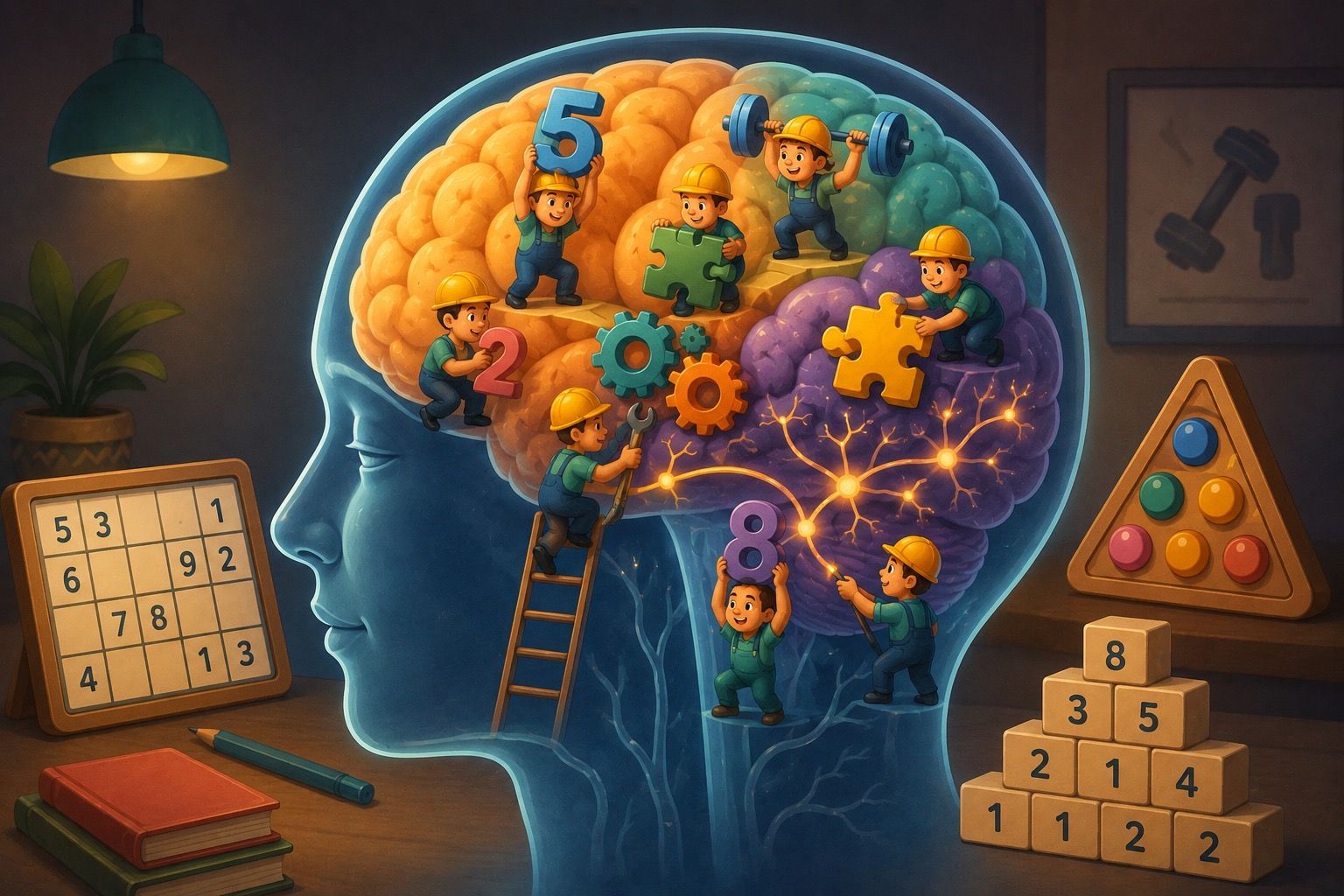
They Build Confidence Without Pressure
School math comes with grades, comparisons, and the constant awareness of who's ahead and who's behind. Logic games remove all of that. There's no class ranking. No one watching. No consequence for a wrong answer beyond "try again."
That low-pressure environment is where children take the most intellectual risks and intellectual risk-taking is exactly what builds mathematical confidence over time. Kids who play logic games regularly tend to develop a "let me try" response to hard problems rather than an "I can't do this" one. That shift is worth more than any specific skill.
💡 Did you know? Studies on math anxiety show that it often develops not from difficulty with the subject itself, but from the social pressure of performing in front of others. Logic games, played independently and at your own pace, are one of the most effective antidotes to math anxiety ever identified.
Why Adults Love Logic Games
They Offer Genuine Mental Challenge
Most adult leisure activities are passive. Watching, scrolling, listening none of these ask anything of your brain beyond basic attention. Logic games are one of the few leisure activities that actively engage your cognitive resources pattern recognition, working memory, logical reasoning, strategic planning all at once.
For adults who spend their days in mentally demanding work, that active engagement can feel like stretching muscles that have been sedentary. For those in less cognitively demanding roles, it fills a real need for challenge that everyday life doesn't always provide.
They're a Clean Break From Everything Else
There's something uniquely restful about a logic puzzle, despite the fact that it requires genuine mental effort. Unlike work problems, puzzles have a defined boundary you know where they start, you know where they end, and there's no ambiguity about whether you've succeeded.
That clarity is rare for adults. Most real-world problems don't have clean solutions. They trail off, they get complicated by other people, they come back the next day. A puzzle that you can start, finish, and walk away from feeling genuinely resolved is quietly valuable in a way that's hard to replicate elsewhere.
"A solved puzzle is one of the few things in adult life that stays solved. That completeness is more satisfying than it sounds."
They Keep the Brain Sharp Over Time
The research on cognitive aging consistently points in one direction: brains that are regularly challenged stay sharper for longer. Not just in the areas being trained regular mental challenge appears to build what researchers call "cognitive reserve," a kind of buffer that makes the brain more resilient to age-related decline.
Logic games are one of the most accessible and enjoyable ways to provide that challenge. They scale in difficulty, they stay fresh because each puzzle is new, and they require active engagement rather than passive consumption. For adults thinking about long-term brain health, fifteen minutes of logic puzzles daily is one of the highest-value habits available.
💡 Did you know? Research from the University of Exeter found that adults who regularly engage in number-based puzzles show brain function equivalent to people ten years younger in tests of short-term memory, accuracy, and reasoning speed. Ten years from puzzles.
The Things That Make Logic Games Work for Everyone
They Scale Naturally With Ability
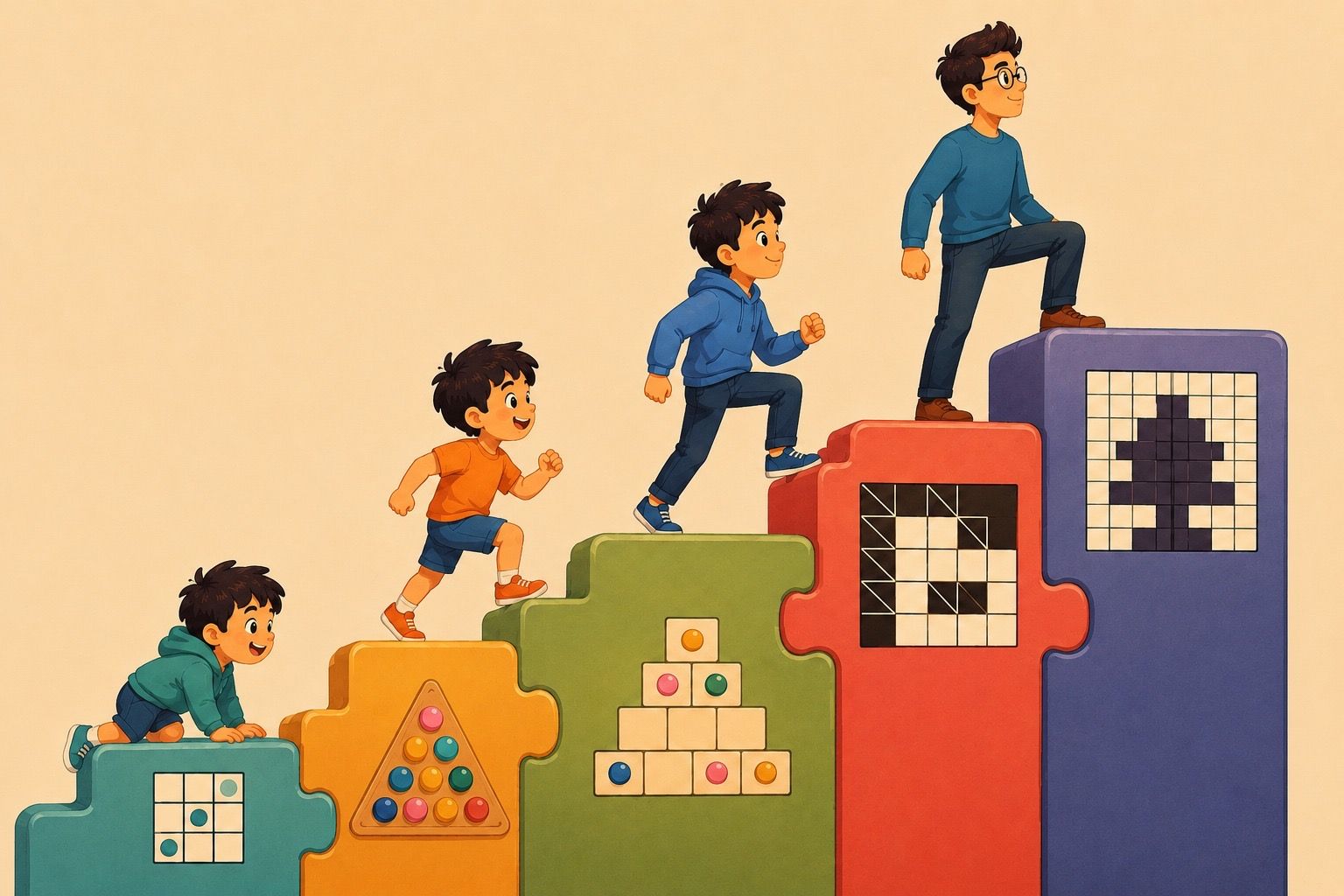
A beginner Mini Sudoku and an expert-level 9×9 Sudoku use the exact same rule. A simple three-row Number Pyramid and a complex five-row one have the same structure. Logic games contain their own difficulty curve which means a seven-year-old and a forty-year-old can both be appropriately challenged by the same type of puzzle, just at different levels.
That scalability is what makes family puzzle sessions genuinely work. Nobody is bored. Nobody is lost. Everyone is challenged at the right level and everyone experiences the same satisfaction when they crack it.
The Reward Feels the Same at Every Age
The moment a logic puzzle clicks when the last number slots in, when the hidden image appears, when the triangle finally balances feels identical whether you're eight or eighty. The brain releases the same reward signal. The satisfaction is the same quality.
That consistency is unusual. Most pleasures shift with age what a child finds exciting bores an adult; what an adult appreciates goes over a child's head. Logic games are one of the rare exceptions. The reward is fundamental enough to the human brain that it doesn't require a particular age to feel it.
They Require Nothing But Thinking
No physical coordination. No prior knowledge. No cultural context. No language barrier. No expensive equipment. Just a puzzle and a brain willing to engage with it.
That simplicity is a feature, not a limitation. It means a child just learning to add and an adult with decades of experience can meet on equal footing because neither their age nor their background gives them an unfair advantage. Only their thinking does.
⭐ Fun fact: Logic puzzles are used in classrooms across more than 50 countries as a universal teaching tool not because every culture teaches math the same way, but because the underlying logic is the same in every language. A Number Pyramid needs no translation.
Playing Together Makes It Better
One of the underrated pleasures of logic games is what happens when people play them together not competitively, but collaboratively. A parent and child working through a Number Pyramid together. Two friends comparing approaches to the same Nonogram. A classroom debating the best entry point for a Sudoku grid.
These conversations are genuinely valuable. Explaining your reasoning to someone else is one of the fastest ways to deepen your own understanding. And hearing a different approach especially from a child who hasn't learned the "correct" method yet often reveals shortcuts and perspectives that experience alone would never produce.
"Children solve puzzles in ways adults have forgotten to try. That's not a weakness it's a reminder that there's always more than one way through."
The Simple Truth
Logic games aren't popular across age groups because they've been cleverly marketed to everyone. They're popular because they tap into something the human brain never outgrows: the drive to find order, solve problems, and feel the quiet satisfaction of having figured something out.
That drive doesn't shrink with age. It doesn't need encouragement or incentives. It just needs a good puzzle to work with.
Calc Quest has one waiting for you whatever age you happen to be.