Why Memory Matrix Is More Challenging Than It Looks?
memory matrix puzzle, what is memory matrix, memory matrix brain training, visuospatial memory training, working memory exercises, memory matrix tips, spatial memory game, brain training memory game, memory matrix difficulty, Calc Quest memory game, cognitive training app, improve working memory, memory games for adults, memory games for kids, Corsi block test game
It looks like the simplest game in the world. Remember which squares were highlighted. Tap them back. Done.
Most people assume they'll breeze through Memory Matrix on their first try. A few squares light up, they disappear, you tap them back in the right order. How hard can it be?
Then the grid gets slightly bigger. The sequence gets slightly longer. And something interesting happens the task that felt trivial thirty seconds ago becomes genuinely demanding. Your confidence quietly evaporates. Your brain scrambles.
That gap between how simple Memory Matrix looks and how challenging it actually is tells you something important about how memory works and why training it matters far more than most people realise.
"Memory Matrix is the puzzle equivalent of a quiet room that turns out to have no floor. The drop comes later than you expect and it's further than you thought."
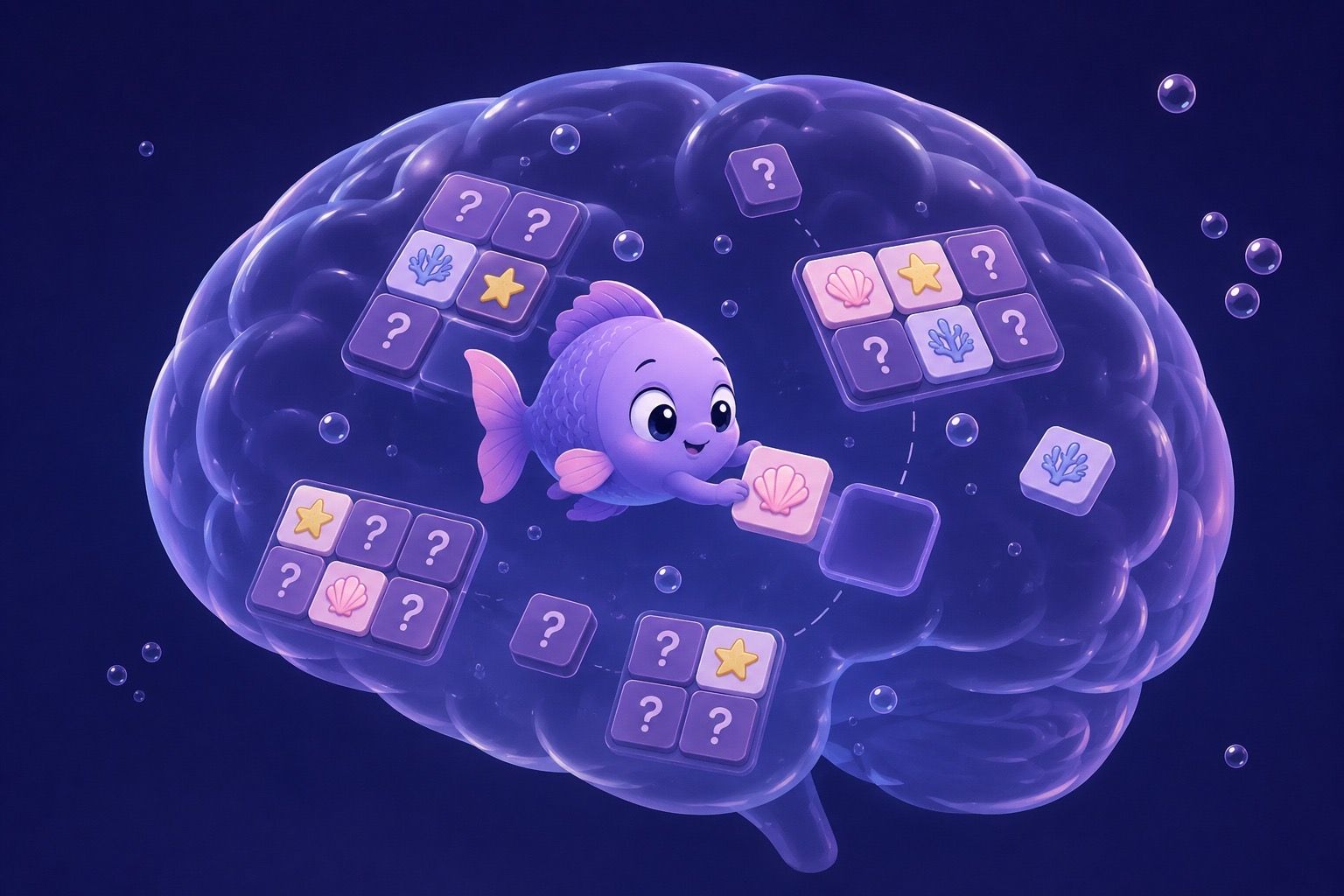
What Is Memory Matrix?
What it is: A grid of squares typically starting at 3×3 and growing larger as you progress where a pattern of cells is briefly highlighted. The pattern disappears. You then have to recreate it by tapping the correct cells from memory.
What makes it harder than it sounds: The highlighted pattern is only visible for a short window of time. Once it disappears, you're working entirely from memory with no clues, no partial information, and no way to check your thinking before committing to an answer.
As the grid grows from 3×3 to 4×4 to 5×5, the number of possible positions increases dramatically. A 3×3 grid has 9 cells. A 5×5 grid has 25. The same number of highlighted squares becomes proportionally harder to locate correctly as the grid expands because your brain has more positions to map, more potential errors to make, and less relative structure to anchor to.
💡 This is why Memory Matrix feels deceptively easy at the start and genuinely difficult within just a few levels. The difficulty doesn't increase linearly it compounds. Each additional row and column multiplies the challenge rather than simply adding to it.
Why Your Brain Finds This Hard
Working Memory Has a Strict Capacity Limit
The part of your brain that Memory Matrix exercises working memory is the mental system responsible for holding and manipulating information in the short term. It's what you use when you remember a phone number long enough to dial it, hold a thought while someone finishes their sentence, or track the running total of items in your shopping basket.
Working memory is powerful but strictly limited. Most adults can hold between five and nine pieces of information simultaneously a range famously described by cognitive psychologist George Miller as "the magical number seven, plus or minus two." Memory Matrix pushes directly against that limit, and the moment you exceed it, the whole pattern collapses.
💡 Did you know? When working memory is overloaded, it doesn't degrade gradually it tends to fail suddenly. One moment you have the pattern. The next, it's gone entirely. That all-or-nothing quality is exactly what makes Memory Matrix feel so unforgiving at higher levels.
Spatial Memory Is a Separate Skill From General Memory
Many people who consider themselves to have a "good memory" are surprised by how quickly Memory Matrix challenges them. That's because the game specifically targets spatial memory the ability to remember where things are in physical or visual space which is a distinct system from the verbal or factual memory most people think of when they say they have a good memory.
You might remember names, dates, and conversations effortlessly while struggling to recall the position of five highlighted squares on a grid. That's not a contradiction it's just two different memory systems operating independently.
Memory Matrix trains the spatial system specifically the same one used for navigation, visualising objects in your mind, and understanding how physical spaces relate to each other. Strengthening it through regular practice has effects that reach well beyond the game.

The Disappearing Pattern Creates Genuine Cognitive Pressure
There's something psychologically distinct about having to recall information that has physically disappeared from your screen. When the highlighted pattern is visible, your brain treats it as a perception task you're seeing something and registering it. The moment it disappears, the task shifts entirely to reconstruction you have to rebuild the pattern from scratch using only what your memory stored.
That shift from perception to reconstruction happens in a fraction of a second, and it's the moment most players feel the game change beneath them. The information you thought you had solidly registered suddenly feels uncertain. Did that square light up in the third column or the fourth?
"The moment the grid goes dark is when Memory Matrix actually begins. Everything before it is just registration. Everything after is the real test."
What Memory Matrix Actually Trains
Visuospatial Working Memory
This is the core skill Memory Matrix builds the ability to hold a visual pattern in your mind and work with it accurately. Visuospatial working memory is used constantly in everyday life: reading a map, following directions, assembling furniture, playing any sport that requires tracking moving objects, and any task that requires you to picture something that isn't physically in front of you.
Regular practice with Memory Matrix measurably strengthens this system not just within the game, but in real-world applications that rely on the same mental machinery.
Attention to Detail
Performing well at Memory Matrix requires a specific quality of attention during the brief window when the pattern is visible. You can't just glance at the grid and hope for the best you have to actively encode the pattern, noticing the exact position of each highlighted square rather than just a general impression of the arrangement.
That deliberate, detail-oriented attention is a trainable skill. Players who regularly practice Memory Matrix often report improvements in their ability to observe and retain visual information in other areas reading, navigation, and tasks that require careful visual inspection.

Pattern Chunking Under Pressure
One of the most interesting things that happens as players improve at Memory Matrix is the development of chunking the ability to group individual squares into larger recognisable patterns rather than trying to remember each square independently.
A beginner sees five separate squares. An experienced player sees an L-shape, a diagonal, a corner group. That reframing from individual pieces to meaningful chunks is one of the most powerful memory strategies available, and Memory Matrix forces you to discover it naturally through practice.
💡 Chunking is the same strategy expert chess players use to remember board positions and musicians use to memorise long pieces. It works by reducing the number of things you need to hold in memory at once which is exactly what lets you handle bigger Memory Matrix grids without your working memory collapsing.
The Difficulty Curve - What to Expect
The First Few Levels Feel Easy
On a 3×3 grid with two or three highlighted squares, Memory Matrix feels almost trivial. Your working memory has plenty of capacity for this and the limited number of positions makes correct recall nearly automatic. Most players breeze through the early levels and assume the game will stay this manageable.
The Middle Levels Are Where It Gets Interesting
As the grid expands to 4×4 and the number of highlighted squares increases, the game begins to reveal itself. You start making mistakes you didn't expect to make. Squares you were sure about turn out to be one position off. Patterns you thought you'd locked in have blurred at the edges.
This is the zone where the real training happens. Not in the levels you find easy, and not in the levels that feel impossible but in the range where you're right about half the time and wrong in instructive ways. This is where working memory gets genuinely stretched.
The Advanced Levels Require Strategy
On a 5×5 or larger grid with six or more highlighted squares, intuition alone is no longer enough. Players who progress to this level have usually developed a personal strategy a way of chunking the pattern, scanning the grid systematically, or mentally labelling positions that compensates for the raw limits of working memory.
Reaching this level doesn't mean your memory is exceptional. It means your strategy is. And that strategy built through dozens of sessions of trial, error, and refinement is itself a form of intelligence that transfers beyond the game.
⭐ Fun fact: The Memory Matrix format is based on the Corsi Block Tapping Test a clinical tool developed in the 1970s to measure visuospatial working memory capacity. Neuropsychologists still use it today to assess memory function. What feels like a casual puzzle is actually a validated cognitive assessment in disguise.
How to Get Better at Memory Matrix
- Chunk the pattern immediately. The moment the grid lights up, don't try to remember individual squares look for shapes. An L-shape. A row. A diagonal. Giving the pattern a name or a structure dramatically reduces how much your working memory has to hold.
- Scan systematically, not randomly. Instead of letting your eyes jump around the grid, train yourself to scan row by row or column by column during the viewing window. Systematic scanning ensures you don't miss a square in the corner that a random glance would overlook.
- Verbalise the pattern quietly. Some players find it helpful to narrate the pattern to themselves during the viewing window "top-left, middle, bottom-right" converting the visual information into verbal memory as a backup system. This uses a different memory pathway and can significantly improve recall.
- Don't rush the recall phase. Memory Matrix doesn't penalise you for taking time during the recall phase only for incorrect taps. Slow down, reconstruct the pattern deliberately before tapping, and confirm your mental image before committing to each square.
- Play at the edge of your ability. The levels that are slightly too hard for you where you fail about half the time are the levels that build the most improvement. Don't stay in your comfort zone. The training happens at the boundary.
Why It's Worth the Challenge
Memory Matrix is difficult in a specific and productive way. It doesn't punish you for not knowing facts. It doesn't require special skills or prior knowledge. It simply asks your brain to do something it finds genuinely hard hold a spatial pattern accurately under time pressure and gets measurably better at it through consistent practice.
The skills built through regular Memory Matrix sessions visuospatial memory, attentional focus, pattern chunking, cognitive endurance are among the most broadly transferable cognitive skills available. They show up in navigation, in learning, in sport, in any task that requires holding and manipulating visual information accurately.
And there's something quietly satisfying about a game that reveals exactly where your limits are and then, over time, moves those limits further out than you thought possible.
"Memory Matrix doesn't make you feel clever. It makes you feel capable which is a more useful feeling and a harder one to earn."
The grid is waiting. See how far you get.