Why Mini Sudoku Is Perfect For Beginners?
mini sudoku for beginners, what is mini sudoku, how to play mini sudoku, sudoku for kids, easy sudoku puzzles, 4x4 sudoku, 6x6 sudoku, sudoku tips for beginners, learn sudoku, logic puzzles for beginners, brain games for beginners, Calc Quest, sudoku app, puzzle games for kids, beginner logic puzzles
Sudoku has a reputation for being intimidating. Mini Sudoku quietly fixes that.
If you've ever picked up a standard Sudoku puzzle, stared at a 9×9 grid full of empty squares, and quietly put it back down you're not alone. For a lot of people, the classic version feels like jumping into the deep end before learning to swim.
Mini Sudoku is the shallow end. Same logic. Same satisfaction. A fraction of the overwhelm.
And here's the thing: starting small isn't a compromise. It's actually the smarter way to build a skill that sticks. Once the logic clicks on a 4×4 or 6×6 grid, the full 9×9 version stops looking scary and starts looking like a natural next step.
"The biggest barrier to learning Sudoku isn't intelligence it's the visual weight of a full grid before you've understood the rules. Mini Sudoku removes that barrier entirely."
What Makes Mini Sudoku Different
It's a Smaller Grid But the Same Logic
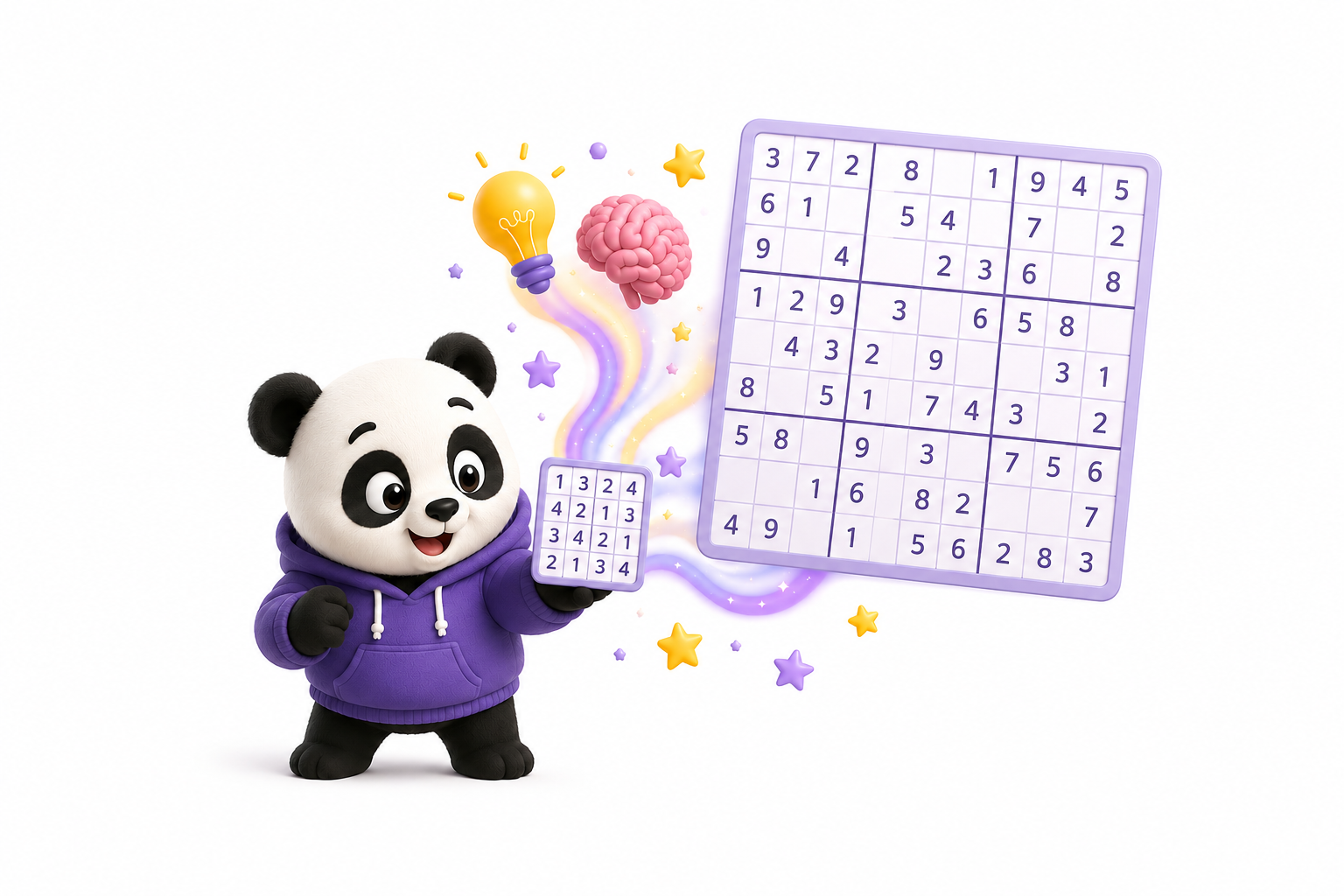
Mini Sudoku typically uses a 4×4 or 6×6 grid instead of the standard 9×9. The rules are identical: every row, every column, and every box must contain each number exactly once no repeats, no gaps.
The smaller grid means fewer cells to track, fewer possibilities to consider, and a much shorter path from "I don't know where to start" to "I can see exactly what goes here." The logic is the same. The cognitive load is dramatically lower.
💡 Think of it like learning to drive in a quiet car park before joining a motorway. The skill is identical. The environment just gives you room to learn it.
You Can See the Whole Puzzle at Once
One of the most underrated advantages of a smaller grid is visual clarity. With a 4×4 Mini Sudoku, you can take in the entire puzzle in a single glance. Nothing is hidden off to the side. No section feels disconnected from another.
That overview changes everything for a beginner. Instead of feeling lost in a sea of empty squares, you can see relationships between rows and columns immediately. Patterns become visible faster. And visible patterns lead to confident moves which is exactly the feeling that makes a puzzle fun instead of frustrating.
Puzzles Are Faster to Complete
A standard 9×9 Sudoku can take anywhere from 10 minutes to over an hour depending on difficulty. For a beginner still learning the logic, that time can feel grueling especially if you get stuck halfway through.
Mini Sudoku puzzles typically take two to five minutes to complete. That speed matters more than it sounds. A quick, satisfying completion builds confidence and motivation in a way that an abandoned half-finished puzzle never can.
Short sessions also mean lower stakes. If you make a mistake, you haven't lost 40 minutes of work. You've lost two minute and you already know more than you did when you started.
💡 Did you know? Completing a puzzle activates the brain's reward system in the same way regardless of the puzzle's size. A finished Mini Sudoku feels just as satisfying as a finished full grid and for beginners, it happens far more often.
5 Reasons Mini Sudoku Is Perfect for Beginners
1. The Rules Click Faster
When you're learning Sudoku, the hardest part isn't solving it's understanding what you're even trying to do. A 4×4 grid makes the rules concrete almost immediately. With only four numbers and four rows, you can see the "no repeats" rule working in real time within your first few moves.
By the time you've completed two or three Mini Sudokus, the logic isn't something you're remembering it's something you understand. That's the difference between fragile knowledge and real skill.
2. Mistakes Are Easy to Learn From
In a full 9×9 grid, a single wrong number can create a chain of incorrect deductions that takes ten minutes to untangle. Beginners often can't even identify where the mistake happened which turns a learning opportunity into a frustrating dead end.
In a Mini Sudoku, mistakes are small and traceable. You can spot the contradiction quickly, understand why it happened, and apply that lesson to your next attempt. That tight feedback loop is what actually builds skill.
3. It Builds Pattern Recognition Naturally
The core skill in Sudoku and in a huge range of math and logic problems is pattern recognition: the ability to look at a partial arrangement and immediately see what's missing or what must come next.
Mini Sudoku trains this skill in its most concentrated form. With fewer cells and fewer variables, patterns become visible faster and more clearly. Beginners start recognizing common configurations a row missing only one number, a box where only one position is possible almost without trying. Those patterns then transfer directly to larger grids.
💡 Pattern recognition built in simple puzzles doesn't stay there. It generalizes. Students who practice Mini Sudoku regularly show improvements in logical reasoning across subjects not just in puzzle-solving.
4. There's No Pressure
One of the quiet enemies of learning is anxiety. When a task feels too big or too hard, the brain shifts into avoidance mode and avoidance is the opposite of practice.
Mini Sudoku removes the pressure almost entirely. The grid is small. The time commitment is low. There's no complex scoring system to worry about, no feeling that you're "supposed" to be better at this by now. It's just a small puzzle, waiting to be solved. That low-pressure environment is exactly where learning happens most naturally.
5. It's a Genuine Gateway to Harder Puzzles
The goal of Mini Sudoku was never to stay small forever. It's a launchpad. Once the 4×4 grid feels comfortable, the 6×6 version adds a new layer of complexity without overwhelming you. And once that clicks, the full 9×9 grid the one that once looked impossible starts to look like exactly what it is: a bigger version of something you already know how to do.
That progression from small wins to bigger challenges, with confidence built at every step is the most effective way to develop any skill. Mini Sudoku just happens to make that progression unusually clear and unusually satisfying.
"Every expert Sudoku solver was once a beginner staring at a grid they didn't understand. The ones who stuck with it almost always started small."
How to Approach Your First Mini Sudoku
If you've never tried one before, here's the only thing you need to know to get started:
Look for the easiest cell first. Find a row, column, or box that already has most of its numbers filled in. The missing number is your starting move. Make that one. Then find the next easiest. Repeat.
You don't need a strategy. You don't need to plan ahead. You just need to find the most constrained cell the one with the fewest possibilities and work from there. The puzzle will open up faster than you expect.
⭐ Fun fact: The word "Sudoku" comes from the Japanese "Sūji wa dokushin ni kagiru" meaning "the digits must remain single." Mini Sudoku keeps that original rule perfectly intact, just in a smaller space.
Start Small. Think Big.
Mini Sudoku isn't a simplified version of a real puzzle. It is a real puzzle one that teaches genuine logic, builds real pattern recognition, and delivers the same satisfaction as its larger cousin, in a format that actually welcomes beginners instead of intimidating them.
If you've ever wanted to get into Sudoku but didn't know where to start this is where you start. Small grid. Real logic. Surprisingly hard to put down.
Give it one puzzle. See what happens.