Why Pattern Recognition Is a Superpower?
why pattern recognition matters, what is pattern recognition, pattern recognition brain, how to improve pattern recognition, pattern recognition and intelligence, pattern recognition superpower, cognitive skills pattern recognition, pattern recognition puzzles, chunking and pattern recognition, deliberate practice pattern recognition, Calc Quest pattern recognition, brain training pattern recognition, pattern recognition in math, expert pattern recognition, pattern recognition skill building
The most useful cognitive skill most people don't know they're developing and how puzzles build it faster than almost anything else.
Some people seem to see things faster than everyone else. They spot the error in a spreadsheet before anyone else has finished reading it. They find the flaw in a plan while others are still nodding along. They solve problems quickly not because they think faster, but because they recognise more.
That ability has a name. It's called pattern recognition. And it's not a talent you're born with or without. It's a skill. One that can be trained, strengthened, and applied across almost every domain of life.
This post is about what pattern recognition actually is, why it matters more than most people realise, who has it and how they got it and the most effective way to build it yourself.
"The difference between an expert and a beginner in almost any field isn't raw intelligence. It's the size of their pattern library. Experts see structure where beginners see chaos because they've seen that structure before."
What Pattern Recognition Actually Is?
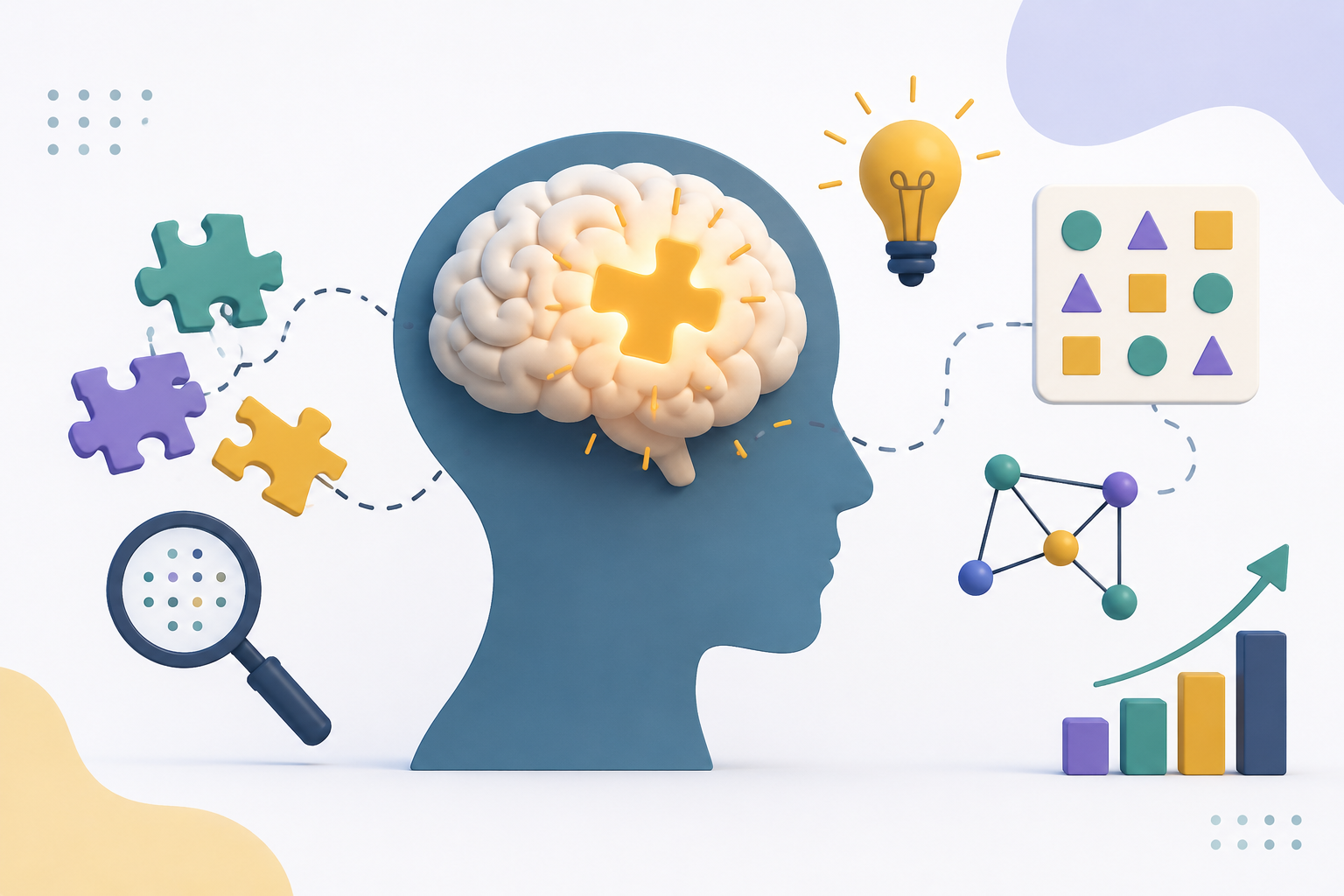
Pattern recognition is the brain's ability to identify regularities, structures, and relationships in information and to use that identification to make faster, more accurate judgements about new situations. It's what allows you to read a word without consciously decoding each letter, recognise a friend's face in a crowd, or know that a business proposal has a problem before you can articulate exactly why.
At its core, pattern recognition is about compression. Instead of processing every piece of information in a situation from scratch, a brain with a rich pattern library compresses familiar configurations into single recognisable units and processes those units almost instantly. The unfamiliar requires effort. The recognised requires almost none.
This compression is why experts appear to think faster than novices. They're not processing more quickly they're processing less, because they're recognising more. And recognition is orders of magnitude faster than analysis.
💡 Cognitive scientists call these compressed patterns "chunks" units of information that have been grouped through experience into single recognisable structures. A chess grandmaster doesn't memorise individual piece positions. They recognise board configurations as chunks and can recall and evaluate dozens of them in the time a novice is still counting pieces.
Where Pattern Recognition Shows Up
In Mathematics
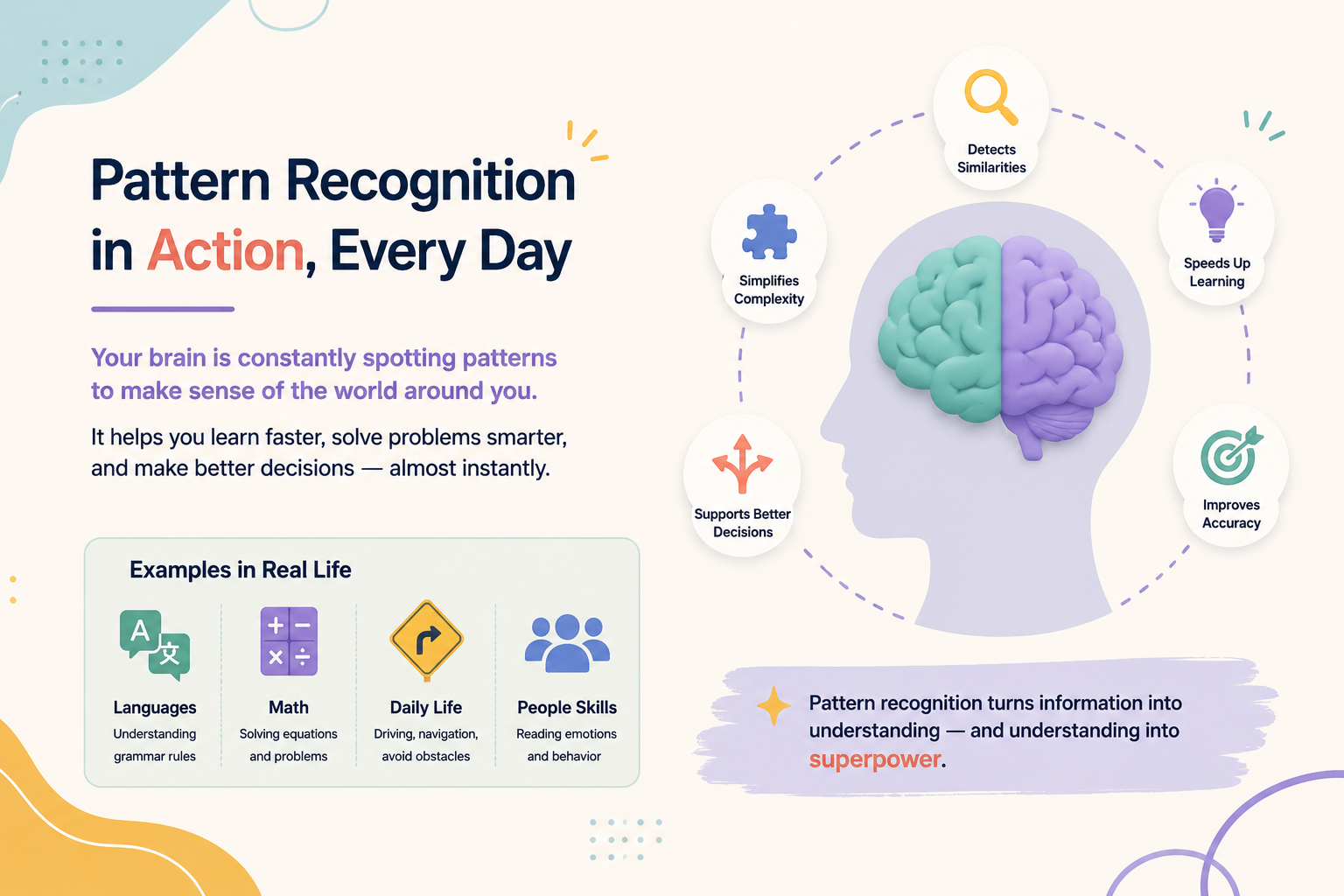
Mathematical fluency is almost entirely pattern recognition. A student who "just sees" that 99 × 99 should be treated as (100 − 1)² isn't smarter than one who tries to multiply directly they've simply recognised a pattern that makes the calculation easier. Mental arithmetic shortcuts, algebraic identities, geometric relationships all of these are patterns that, once recognised, transform hard problems into trivial ones.
This is why students who practise varied mathematical problem solving outperform those who drill single techniques repeatedly. Variety builds pattern libraries. Pattern libraries build mathematical intuition. And mathematical intuition is what distinguishes genuine mathematical ability from the ability to follow procedures.
In Reading and Language
Fluent reading is pattern recognition operating at speed. Skilled readers don't decode individual letters they recognise whole words, then phrases, then sentence structures, processing meaning at each level simultaneously. The more patterns a reader has internalised, the faster and more deeply they read. Vocabulary acquisition, grammatical intuition, and the ability to understand complex text all rest on pattern recognition built through exposure.
In Music
Musicians with strong pattern recognition hear harmonic progressions, rhythmic structures, and melodic shapes as units not as individual notes. A jazz improviser recognises a ii-V-I chord progression instantly and knows exactly which notes and phrases belong in that context. A classical musician recognises a sonata form and understands where they are in the structure without consulting a score. Pattern recognition is what turns technical ability into musical intelligence.
In Science and Medicine
Experienced doctors diagnose through pattern recognition recognising the configuration of symptoms, history, and test results as a familiar clinical picture. Experienced scientists recognise experimental results that don't fit the expected pattern, which is where discoveries tend to begin. In both fields, the ability to see structure in complex data to find the signal in the noise is the primary cognitive tool of expertise.
In Business and Strategy
Experienced business leaders and strategists process market situations, competitive dynamics, and organisational problems through pattern recognition built from years of exposure. They recognise deal structures that have failed before. They spot competitive strategies that mirror ones they've seen play out. They sense when a plan has the shape of one that worked or one that didn't. That sensing isn't intuition in any mystical sense. It's pattern recognition operating below conscious awareness.
"What experts call intuition, cognitive scientists call pattern recognition. The feeling of 'just knowing' isn't magic it's your pattern library working faster than your conscious mind can articulate."
How Pattern Recognition Is Built
Through Exposure But Not Just Any Exposure
Pattern recognition is built through exposure to a domain but the quality of that exposure matters enormously. Passive exposure reading about chess, watching someone solve puzzles, observing a process without engaging with it builds pattern recognition slowly and shallowly. Active exposure actually playing, solving, making decisions, experiencing consequences builds it dramatically faster.
The reason is straightforward: active engagement forces the brain to make predictions, check them against outcomes, and update its pattern library based on the results. Each prediction-check cycle either confirms an existing pattern (strengthening it) or reveals a gap in the pattern library (filling it). Passive observation provides neither the brain processes information but doesn't make the predictions that drive pattern library growth.
Through Variety Not Just Repetition
Repeating the same problem type builds fluency within that type but doesn't expand the pattern library. Varied problems different structures, different contexts, different levels of difficulty are what actually grow the range of patterns your brain can recognise.
This is one of the most important findings in learning science and one of the most counterintuitive. Students who practise varied problem sets even when the variety makes each session feel harder consistently outperform those who practise blocked repetition of single types. The short-term difficulty of variety produces long-term pattern library growth that repetition alone never achieves.
Through Feedback - Immediate and Clear
Pattern recognition develops fastest when feedback is immediate and unambiguous. When your brain makes a prediction "this is the right move" and gets an instant clear response right or wrong it can update its pattern library immediately. Delayed or ambiguous feedback slows this update cycle dramatically.
This is one of the reasons puzzles are such effective pattern recognition trainers. Every move is immediately verifiable either it works within the puzzle's rules or it doesn't. That tightness of feedback loop, maintained across hundreds of moves per session, accelerates pattern library development far beyond what most other learning environments provide.
💡 The learning principle that emerges from feedback research is called "deliberate practice" the combination of active engagement, varied challenge, and immediate feedback that produces the fastest skill development in any domain. Puzzle solving naturally implements all three components simultaneously.
Why Puzzles Build Pattern Recognition So Effectively
They Present Pure Pattern Problems
Most real-world pattern recognition problems are noisy embedded in complex, ambiguous situations where multiple patterns are active simultaneously and the signal is hard to separate from the noise. Puzzles are different. They present pattern problems in their purest, cleanest form isolated from irrelevant context, with clear rules and unambiguous solutions.
That purity is what makes puzzles such efficient pattern recognition trainers. Every session is dedicated pattern work no noise, no ambiguity, no irrelevant complexity. The patterns your brain extracts from puzzle solving are clean, well-defined, and highly transferable to the messier pattern problems of the real world.
Each Puzzle Type Builds a Different Pattern Library
Different puzzle formats build different pattern libraries and the libraries interact in ways that compound the benefit of variety.
- Number Patterns → builds numerical relationship recognition: doubling sequences, Fibonacci structures, arithmetic progressions
- Sudoku and Binairo → builds constraint pattern recognition: forced placements, balance configurations, uniqueness structures
- Nonograms → builds visual pattern recognition: row-column intersections, block placement logic, image structure
- Number Pyramids → builds additive relationship recognition: cascading sums, entry point identification, bidirectional solving
- Simon Sequence → builds sequential pattern recognition: order retention, chunking strategies, rhythmic encoding Magic
- Triangles and Shikaku → builds spatial constraint recognition: corner sum logic, rectangle dimension relationships
Rotating between these types doesn't just keep practice interesting it builds a broader and more flexible pattern library than any single format could. The patterns from one domain reinforce and extend the patterns from others, producing a general pattern recognition ability that's more powerful than the sum of its parts.
"Each puzzle type in Calc Quest was chosen because it builds a distinct pattern library. Together, they build a brain that recognises structure faster across every domain not just in puzzles."
What Pattern Recognition Feels Like as It Develops
In the Beginning
Early in puzzle practice, most problems feel genuinely hard. You process each element consciously, check each rule explicitly, and make decisions slowly. Progress is real but feels effortful. This is normal your pattern library is small and your brain is doing significant analytical work to compensate.
After a Few Weeks
After consistent practice, something shifts. Problems that once required careful analysis start feeling more familiar. You find yourself making moves more quickly not because you've stopped thinking, but because you've started recognising. You see a configuration and know what it means before consciously working through why. Your pattern library is growing, and its growth is measurable in your solving speed and your confidence.
With Regular Long-Term Practice
With months of consistent varied practice, pattern recognition begins to generalise beyond the puzzle context. You notice patterns in other domains more quickly in data at work, in arguments in conversation, in structures in texts you read. The specific patterns built in puzzles transfer as general pattern-finding ability: a sharpened tendency to look for structure, to find regularities, and to notice when something breaks the expected pattern.
This generalisation is the deepest benefit of puzzle-based pattern recognition training and the one that makes the investment in daily practice genuinely worthwhile beyond the puzzles themselves.
⭐ Fun fact: Cognitive scientists who study expert performance across domains chess, medicine, music, sport, science consistently find that the primary marker of expertise is not domain-specific knowledge but pattern recognition speed and depth. Experts aren't smarter. They have bigger, better-organised pattern libraries. And those libraries were built the same way in every domain: through active, varied, feedback-rich practice over time.
How to Start Building Your Pattern Library Today
- Be active, not passive. Reading about puzzles, watching others solve them, or studying solutions after the fact builds pattern recognition slowly. Actually solving making predictions, placing numbers, experiencing the feedback builds it fast. The engagement is the training. Observation is not.
- Practice variety, not just repetition. Once a puzzle type feels comfortable, add another. Rotate between formats. The short-term difficulty of switching to an unfamiliar pattern type is exactly the stimulus that drives pattern library growth.
- Play at the edge of your ability. Easy puzzles confirm existing patterns but don't extend them. Puzzles that are slightly too hard where you fail or struggle regularly are the ones that reveal gaps in your pattern library and force your brain to fill them.
- Be consistent rather than intensive. Pattern libraries are built through repeated exposure over time, not through single long sessions. Fifteen minutes every day outperforms two hours once a week. The frequency of practice sessions matters more than their length.
- Notice the patterns you find. When a puzzle reveals a new structure a constraint configuration you haven't seen before, a relationship between numbers that clicks for the first time pause and register it. Consciously noting a new pattern accelerates its consolidation into long-term memory compared to passing over it without acknowledgement.
"Pattern recognition is the closest thing to a general cognitive superpower available to humans. It underlies expertise in every field, speed in every cognitive task, and intuition in every domain. And it's built the same way everywhere: through active, varied, consistent practice. Puzzles are one of the most efficient vehicles for that practice ever designed."
Your Pattern Library Is Waiting to Grow
Every puzzle you solve adds to your pattern library. Every new puzzle type you try extends it into a new domain. Every session at the edge of your ability pushes its boundaries further. And every day you practise consistently, the library grows quietly, cumulatively, in ways that eventually show up not just in faster puzzle solving but in sharper thinking across every part of your life.
The superpower isn't mysterious. It isn't reserved for geniuses. It's built one pattern at a time, one puzzle at a time, one session at a time.
Start building yours.