Why Your Brain Loves Solving Puzzles?
why does your brain love puzzles, neuroscience of puzzle solving, dopamine and puzzles, why puzzles are addictive, brain benefits of puzzle solving, flow state and puzzles, cognitive benefits of puzzles, pattern recognition brain, why puzzles feel good, puzzle solving brain science, working memory puzzles, neuroplasticity and puzzles, Calc Quest brain benefits, puzzle solving for adults, brain training science
You sit down for five minutes. You look up forty minutes later. The puzzle is finished. What just happened?
It wasn't willpower that kept you there. It wasn't discipline. You didn't decide to keep going you just did. The puzzle pulled you forward move by move, and before you noticed, it was done and you were already eyeing the next one.
This isn't a coincidence. It isn't even really about the puzzle. It's about your brain and the fact that puzzle solving triggers some of the most deeply wired reward systems in human neuroscience. Understanding why your brain loves puzzles doesn't make them less enjoyable. It makes the experience make sense.
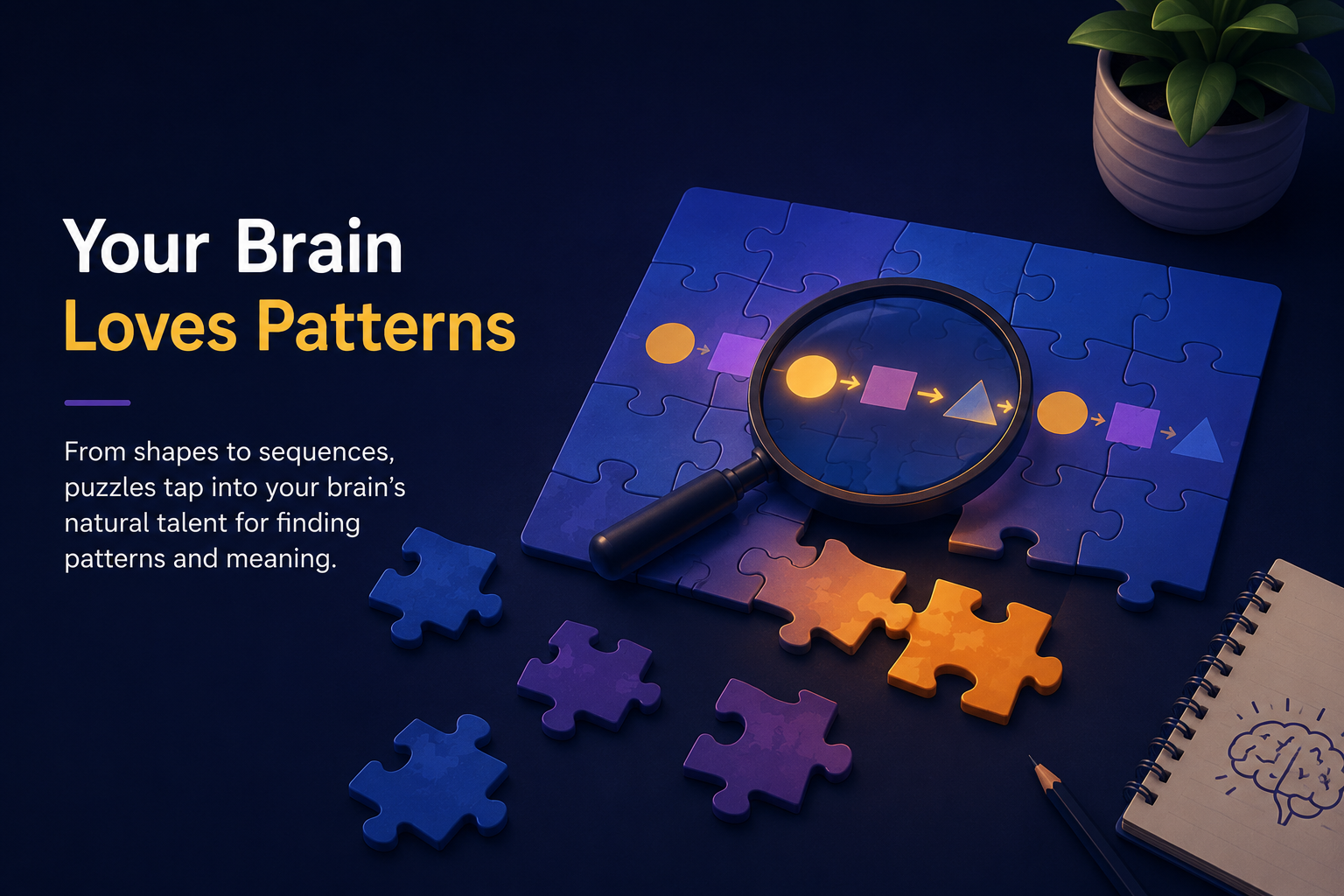
"Puzzle solving feels fun because it is fun. But the reason it's fun goes deeper than most people realise all the way down to how the human brain was built to work."
The Neuroscience Behind the Pull
Every Solved Step Releases Dopamine
Dopamine is the brain's primary reward chemical the signal it sends when something good has happened and it wants you to do that thing again. Most people associate dopamine with big rewards: finishing a meal, receiving praise, completing a major goal. But dopamine also fires for small wins and this is where puzzle solving becomes particularly powerful.
Every correct placement in a Sudoku grid is a small win. Every row completed in a Number Pyramid is a small win. Every square revealed in a Nonogram is a small win. Each one triggers a small dopamine release. And because puzzles are built from dozens of these small steps each one leading to the next they create a near-continuous reward signal that keeps your brain engaged far longer than activities with a single payoff at the end.
💡 This is why puzzle solving feels effortless even when it's genuinely hard. The dopamine reward isn't waiting at the end it's distributed across the entire process. Your brain is being rewarded for every step, which is why every step feels worth taking.
Your Brain Is Wired to Find Patterns
From the moment humans evolved, survival depended on pattern recognition. Spotting the shape of a predator in the undergrowth. Recognising which plants were safe to eat. Reading the weather from cloud formations. The human brain became extraordinarily good at finding patterns and it developed a powerful reward response to doing so successfully.
Puzzles activate this ancient system directly. A number sequence with a missing term is a pattern waiting to be found. A Nonogram grid is a hidden structure waiting to be revealed. A Sudoku puzzle is a constraint system waiting to be resolved into order. Every time you find the pattern every time the structure clicks into place your brain responds with the same satisfaction it was built to feel when pattern recognition meant something vital.
The context has changed completely. The reward response hasn't.
"The human brain didn't evolve to solve Sudoku. It evolved to find patterns in a complex, unpredictable world. Sudoku just happens to be an extraordinarily pure exercise for that same system."
Curiosity Has Its Own Reward System
Neuroscientists have identified curiosity as a distinct motivational state one that activates the brain's reward circuits even before any answer is found. The feeling of not-yet-knowing-but-wanting-to-know is itself pleasurable. It drives information-seeking behaviour with the same urgency as hunger or thirst not as intense, but just as persistent.
Puzzles are essentially curiosity engines. A Nonogram asks: what image is hidden in this grid? A Magic Triangle asks: what arrangement satisfies every side? A Number Pattern asks: what rule connects these numbers? Each of these questions opens a curiosity loop and your brain, wired to close curiosity loops, will keep working until it does.
This is why it's so difficult to walk away from an unfinished puzzle. It's not stubbornness. It's your brain's curiosity system doing exactly what it was designed to do.
💡 Researchers at UC Davis found that curiosity the state of wanting to know something activates the hippocampus and the brain's reward pathways simultaneously. This means curious brains not only enjoy the process of finding out more they also retain information better. Puzzles make you curious and then reward you for being curious. That combination is unusually powerful for learning.
The "Almost" Effect Keeps You Playing
There is a specific psychological state that game designers work hard to create and that puzzles produce naturally: the feeling of being almost there. One more move. One more row. One more step and the solution will be visible.
Psychologists call this the "goal gradient effect" the well-documented finding that motivation increases as you get closer to a goal. The closer you are to finishing, the harder you work and the more reluctant you are to stop. This effect is built into the structure of every puzzle as you fill in more cells, place more numbers, or reveal more of a hidden image, the remaining gap becomes smaller and the pull to close it becomes stronger.
This is why "just one more puzzle" is such a universal experience. It's not weakness. It's the goal gradient effect working exactly as designed and puzzles produce it more reliably than almost any other activity.
"The closer a puzzle gets to solved, the harder it is to stop. That's not a design flaw it's human neuroscience. And it's exactly why puzzle solving sessions always end later than planned."
What Happens to Your Brain During a Puzzle
Multiple Brain Regions Activate Simultaneously
Brain imaging studies consistently show that puzzle solving is one of the most cognitively demanding leisure activities available not because it's stressful, but because it recruits multiple brain regions at the same time. The prefrontal cortex handles logical reasoning and planning. The parietal lobe manages spatial processing. The hippocampus supports memory and pattern storage. The reward circuits run continuously in the background.
That simultaneous activation across multiple systems is what makes puzzle solving such effective cognitive exercise. You're not just using one mental muscle you're training the connections between many of them. And connections between brain regions, strengthened through use, are the neurological foundation of what we call intelligence.
You Enter a State of Flow
Psychologist Mihaly Csikszentmihalyi coined the term "flow" to describe the state of complete absorption in a task that's challenging enough to require full attention but achievable enough to not overwhelm. Flow feels effortless. Time passes without being noticed. The self-consciousness that normally accompanies effort disappears entirely.
Puzzles are one of the most reliable routes to flow available. They're self-contained with a clear start, middle, and end. They scale in difficulty with beginner levels accessible and advanced levels genuinely challenging. They provide immediate feedback every placement tells you something. And they require just enough attention to block out everything else.
When you look up from a puzzle and realise forty minutes have passed, you've been in flow. That experience of being completely absorbed, performing well, losing track of time is one of the most pleasurable states the human brain can occupy. Puzzles produce it with remarkable consistency.
💡 Flow states are associated with peak performance, deep learning, and significant improvements in mood and wellbeing. The fact that puzzles reliably produce them means that regular puzzle solving is, among other things, one of the most accessible and sustainable mood-improvement tools available.
Your Brain Keeps Working After You Stop
One of the most interesting things about puzzle solving is what happens after the session ends. When you're stuck on a problem and step away to make tea, go for a walk, or sleep your brain often continues processing the problem in the background. The solution arrives seemingly from nowhere: in the shower, mid-conversation, upon waking.
This phenomenon called "incubation" in cognitive psychology is the result of unconscious processing continuing after conscious attention has moved on. Your brain doesn't stop working when you step away from a puzzle. It keeps running the problem in parallel with everything else you're doing and when the answer surfaces, it does so with a particular clarity that feels almost magical.
"Walking away from a stuck puzzle isn't giving up. It's giving your unconscious brain the space to solve it. The answer that arrives in the shower isn't luck it's the result of background processing that started the moment you stopped trying."
Why Some People Think They're "Not Puzzle People" - And Why They're Wrong
A significant number of adults have decided usually based on a frustrating early experience that they're simply not puzzle people. The puzzle was too hard. They got stuck. They felt stupid. They gave up. And they concluded that puzzles just aren't for them.
What they actually experienced was a mismatch between the puzzle's difficulty and their current skill level. That's a design problem, not an intelligence problem. A puzzle that's too hard produces frustration. A puzzle at the right level produces flow. The neurological reward systems that make puzzle solving enjoyable are present in every brain they just need a puzzle that's appropriately calibrated to activate them.
The difference between someone who loves puzzles and someone who thinks they don't is usually just the difference between finding the right starting point and not finding it. Everyone has the brain for puzzles. Not everyone has found their level yet.
"There are no puzzle people and non-puzzle people. There are people who've found their level and people who haven't yet. The reward systems are the same. The starting point just needs to match."
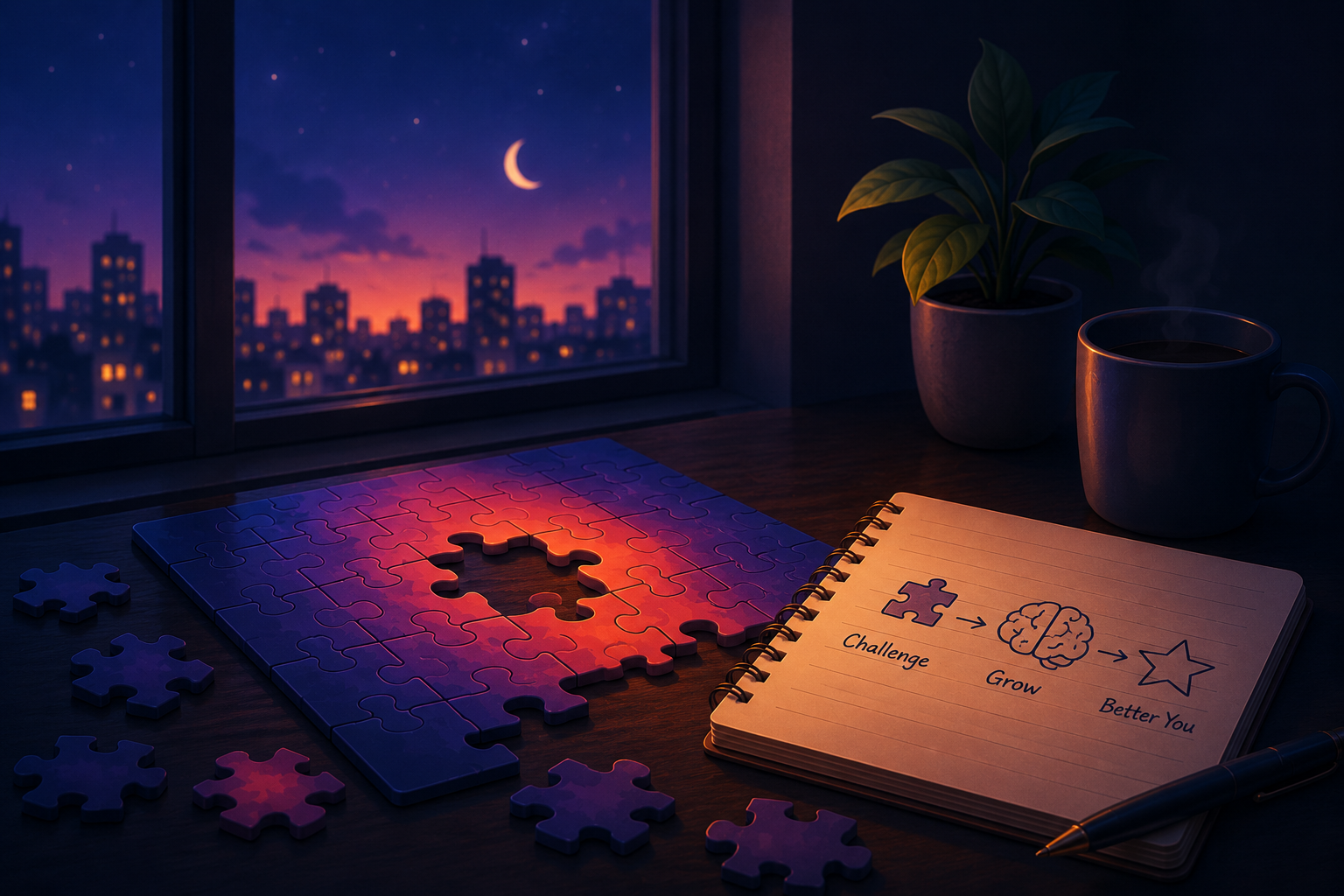
The Long-Term Effects of Regular Puzzle Solving
Cognitive Reserve
Neuroscientists use the term "cognitive reserve" to describe the brain's resilience to age-related decline its ability to maintain function even as physical changes occur. Cognitive reserve is built through mentally stimulating activity: learning, problem solving, and consistently, across multiple studies regular puzzle solving.
People with higher cognitive reserve show fewer symptoms of cognitive decline even when brain imaging reveals the same physical changes as those who are more severely affected. The reserve acts as a buffer. And it's built, in part, through the same daily puzzle practice that also happens to be genuinely enjoyable.
Stronger Neural Connections
Every puzzle solving session strengthens the neural connections between the brain regions it activates the logical reasoning systems, the pattern recognition systems, the working memory systems, the reward circuits. Stronger connections mean faster communication between regions, which means quicker thinking, better integration of different types of information, and more flexible problem solving.
This is neuroplasticity in its most practical form: the brain physically changing in response to what it's asked to do. Regular puzzle solving is one of the most accessible ways to direct that change intentionally.
Lasting Mood Benefits
The dopamine released during puzzle solving, the flow states it produces, the sense of competence that comes from solving something hard these aren't just pleasant in the moment. They accumulate into a persistent improvement in mood and cognitive self-confidence that regular puzzle solvers report across studies.
The effect is particularly pronounced for adults who feel their cognitive sharpness declining or who worry that it is. The experience of solving a challenging puzzle provides direct, personal evidence that the mind is still capable and still growing. That evidence matters.
⭐ Fun fact: A 2019 study published in the International Journal of Geriatric Psychiatry found that adults over 50 who regularly engaged in number and word puzzles showed brain function equivalent to people ten years younger in tests of attention, reasoning, and memory. The effect was consistent across all participants regardless of education level or prior puzzle experience.
Your Brain Is Already Ready
You don't need a special kind of mind to love puzzle solving. You need a puzzle at the right level one that challenges you just enough to engage all the systems described above without overwhelming any of them. Find that level and your brain will do the rest. The dopamine will flow. The curiosity loop will open and close. The flow state will arrive. And forty minutes will pass in what felt like five.
That's not magic. That's just your brain doing what it was built to do finding patterns, closing loops, earning rewards, getting better. Puzzles just happen to be one of the purest and most enjoyable ways to let it.