Your Brain on Math Games: What Happens After 15 Minutes Daily?
benefits of math games, math games for brain health, does playing math games improve memory, math games and focus, brain benefits of puzzles, daily brain training, math games for kids and adults, improve concentration with games, mental math benefits, working memory exercises, Calc Quest, brain training app, educational math games, cognitive benefits of puzzles
Most people think math games are just a way to pass time. They're not.
Spend just 15 minutes a day solving puzzles, number challenges or logic games and something interesting starts to happen. Your brain gets a real workout.
Just like muscles grow stronger through consistent exercise, your brain becomes faster and sharper when it regularly tackles small, focused challenges. The science behind this is well established. The experience of it is even more convincing.
"You don't need hours of study or expensive courses. Just 15 minutes of the right kind of challenge, every day, is enough to notice a difference."
Here are five things that start to change.
5 Things That Happen When You Play Math Games Daily
1. Your Focus Gets Sharper
Math games demand attention. Whether you're solving a Number Pyramid, working through Quick Calculation challenges, or matching Mathematical Pairs, your brain has to stay locked in there's no room to drift.
Do this regularly, and your ability to concentrate deepens. Tasks that used to feel distracting become easier to sit with. The focus you build in a game carries quietly into everything else you do.
💡 Think of it like this: every minute you spend resisting distraction in a game is a minute of focus training. The reps add up.
2. Your Brain Processes Information Faster
The more you practice recognizing patterns and solving problems under light time pressure, the quicker your brain learns to respond. What once required conscious effort starts happening automatically.
Many players notice they start spotting solutions faster after just a few days of regular play not because they've memorized anything, but because their brain has started recognizing the shape of problems before fully "reading" them.
That shift from calculating to recognizing the shape is exactly what separates slow math from fast math.
3. Your Memory Gets Stronger
Games that involve sequences, number patterns, and recall exercises push your brain to store and retrieve information more efficiently. Every time you hold a number in your head, recall a sequence, or track a running total, you're exercising your working memory.
Working memory is the mental scratchpad your brain uses for almost everything reading, conversation, problem-solving, decision-making. Strengthening it through games has effects that reach well beyond math.
💡 Did you know? Working memory capacity is one of the strongest predictors of academic performance across all subjects not just mathematics.
4. Problem-Solving Becomes More Natural
Every puzzle presents a small challenge. And every small challenge you work through teaches your brain a version of the same lesson: there is a way through this.
Over time, that lesson compounds. Problems that used to trigger frustration or avoidance start feeling like puzzles to explore instead. The shift isn't dramatic it's gradual. But it's real, and it shows up in places far outside a game screen.
Students notice it in class. Adults notice it at work. Parents notice it in how their kids approach homework. The confidence that comes from regularly solving small challenges quietly rewires how you respond to bigger ones.
5. You Build Genuine Mental Confidence
There's something deeply satisfying about solving a puzzle you couldn't solve yesterday. It's a small moment but your brain registers it as proof of something important.
"I can figure this out."
That belief quiet, earned, repeated is what mental confidence is actually made of. Not a single big breakthrough, but dozens of small ones stacked on top of each other. Math games give you those moments every single session, which is more than most learning methods can claim.
Small Habit, Surprisingly Big Difference
Fifteen minutes doesn't sound like much. But over a week, that's nearly two hours of brain training. Over a month, it's close to eight. Done consistently, those sessions build something real not just math skill, but the mental habits that make learning anything easier.
The goal was never to become a math genius. It's simply to give your brain a worthwhile challenge every day. And over time, those daily challenges add up to something you'll actually notice.
⭐ Fun fact: Research on habit formation shows that skills practiced in short daily sessions are retained significantly better than the same total time spent in longer, infrequent sessions. Consistency isn't just motivationally helpful — it's neurologically more effective.
Your Challenge for Today
Set a timer for 15 minutes. Pick a puzzle. Play it properly no half-attention, no background noise, just you and the problem. Then come back tomorrow and do it again.
That's the whole challenge. Simple, repeatable, and more effective than it sounds.
Your brain will thank you for it.
Ready to Start?
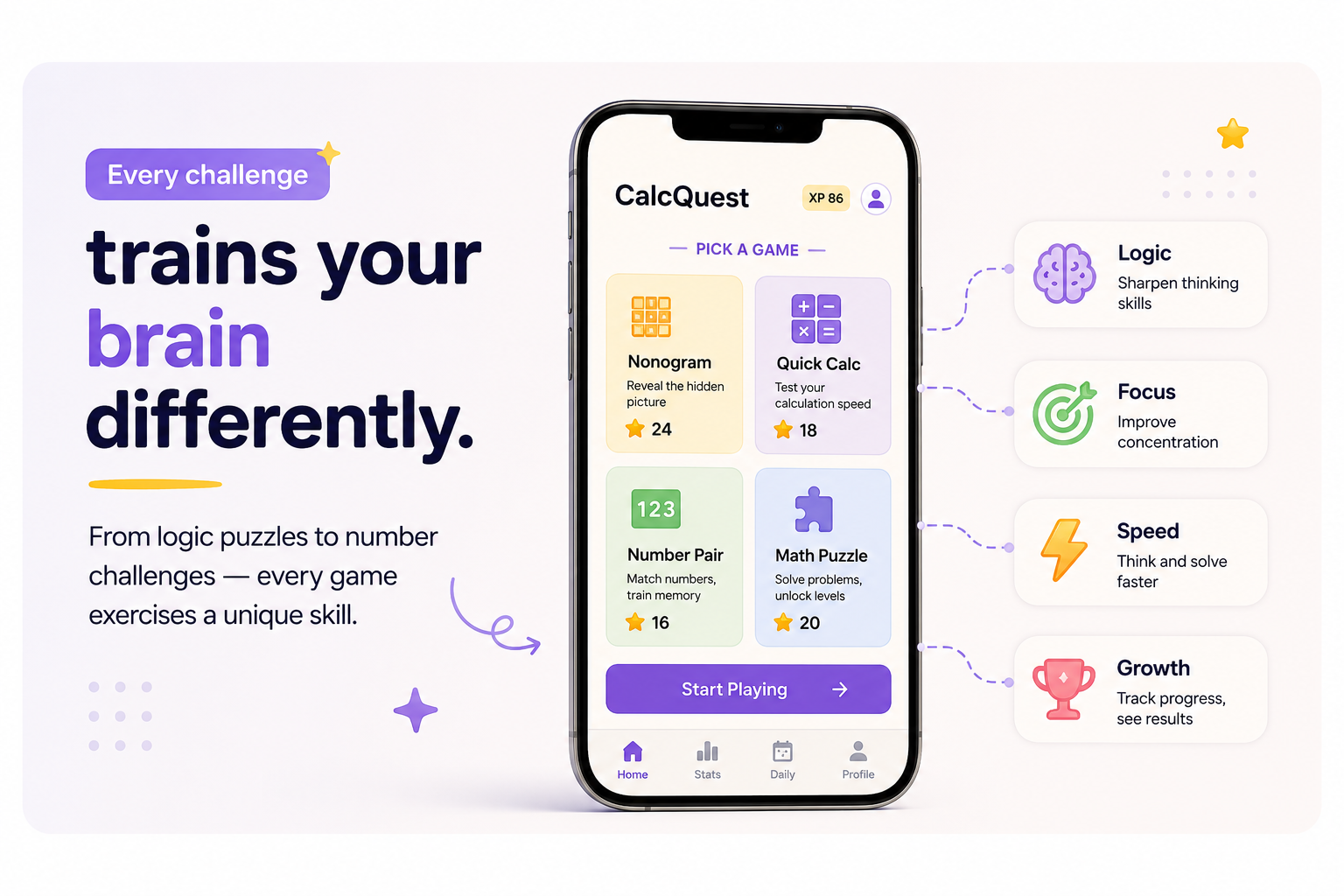
Calc Quest is built for exactly this kind of daily training short, focused challenges that cover calculation, pattern recognition, memory, and logic. Each session takes minutes. Each one makes the next one a little easier.